
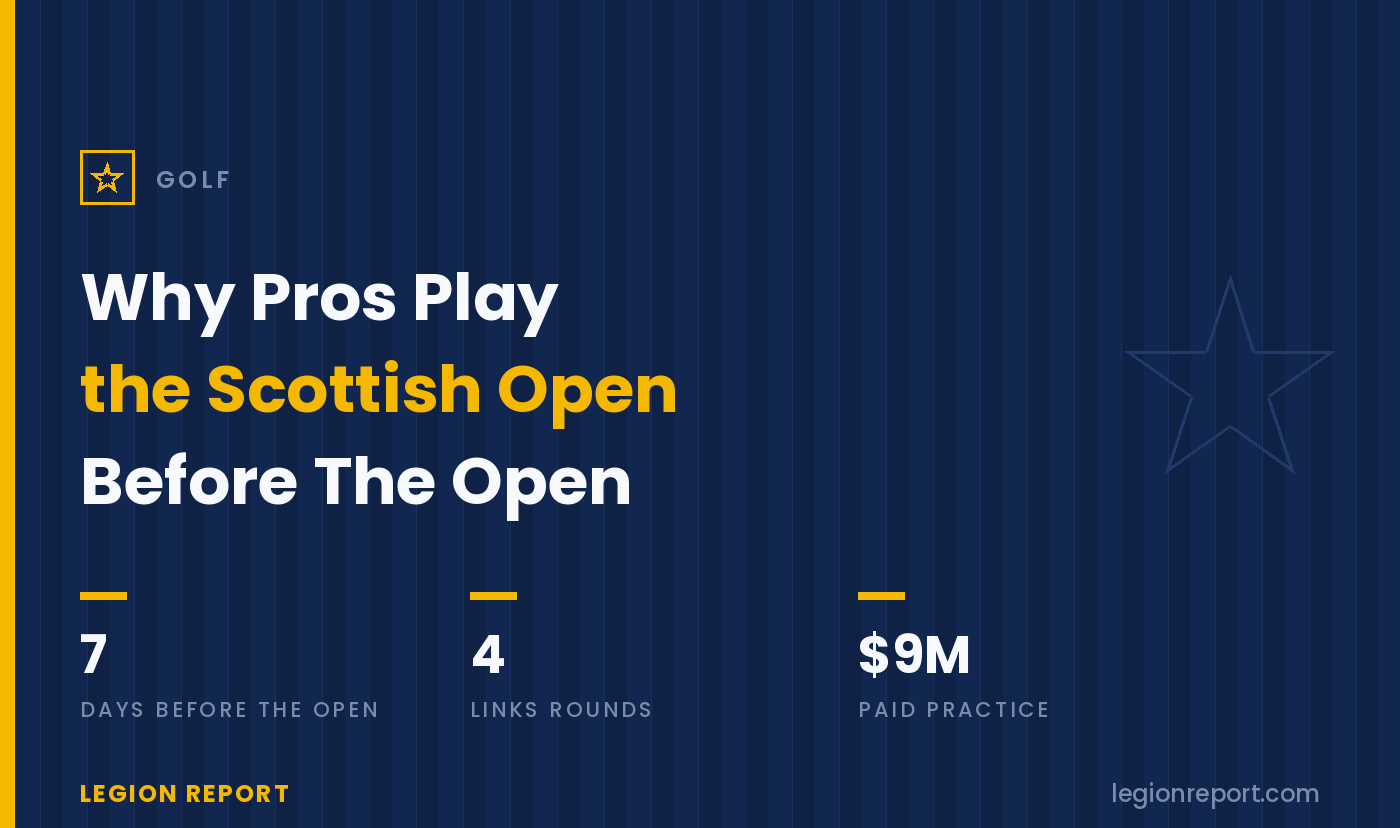

Every July, the best golfers on earth do something they almost never do the week before a major: play a full tournament. The Masters, PGA, and U.S. Open all see stars rest, scout, and arrive early; The Open Championship alone gets the opposite, a stampede into the Genesis Scottish Open, where this week the world’s top two, the LIV contingent, and 150 others are grinding through four competitive rounds seven days before Royal Birkdale. It looks like a scheduling mistake. It’s actually the most rational week in golf.
The reason is that links golf is a different sport wearing the same clothes, and there is exactly one way to re-learn it on a deadline: competitive reps on firm turf, in wind, with a scorecard that counts. The Scottish Open is that classroom, with a $9 million purse attached and Open Championship spots for the students who ace it.
The chart below covers what makes links preparation different, the tournament’s tune-up track record, the qualifying carrot, and the case against playing. Take a look, then we’ll break it all down.
A different sport in the same clothes
The case for playing starts with an honest admission about golf geography: the game the world’s best play 48 weeks a year, target golf through the air, onto soft greens, in managed conditions, is not the game The Open demands. Links golf runs on the ground: firm fescue turf where a landing ball rolls 30 or 40 more yards, seaside wind that turns club selection into live arithmetic, pot bunkers that punish rather than inconvenience, and short-game questions (putt from 40 yards? bump a 7-iron? flight a wedge under the gust?) that simply don’t exist in Ohio. Those skills atrophy, and the only way to rebuild them on a deadline is competitive reps, decisions made under a scorecard, not a practice-round shrug, which is precisely what four rounds at the Renaissance Club provide, along with the unglamorous logistics win of a full week on UK time before the major begins. Practice rounds teach the shots; tournaments teach the choosing.
The proof, from Phil to the field itself
The strategy has a patron saint: Phil Mickelson won the 2013 Scottish Open at Castle Stuart and, seven days later, won The Open at Muirfield, the double that converted a scheduling theory into orthodoxy. The pattern has held ever since, Scottish Open contenders populate Open leaderboards almost annually, most recently Chris Gotterup, whose 2025 win in North Berwick preceded a Sunday run at the Claret Jug itself, and the most persuasive evidence is simply behavioral: this week’s field contains the world’s top two, the co-sanctioned LIV stars, and essentially everyone with Birkdale ambitions, players who could rest anywhere on earth voluntarily choosing wind and fescue. For decades, conventional wisdom held that you never play the week before a major; the Scottish Open is the exception that swallowed the rule, because links golf’s re-learning curve outweighs the fatigue cost, and because the event stacked the incentives: a $9 million purse, dual-tour points, and, for the non-exempt, Open Championship places awarded to leading finishers, making the tune-up double as a final qualifier with a major tee time on the line.
The holdouts, and the honest trade-off
The counterargument survives in a minority practice: some stars still skip the Scottish in favor of early scouting at the Open venue itself, the Tiger Woods method, prioritizing course-specific knowledge and freshness over competitive sharpening, and the venue-mismatch critique has teeth (the Renaissance Club is links-adjacent rather than a carbon copy of any Open host, and no tune-up replicates Birkdale’s specific questions). The trade is real: four rounds of wind-game calibration and pressure reps, purchased with some fatigue and the risk of a confidence-denting missed cut a week before the year’s last major. But the market has voted, and keeps voting: the week before The Open is now the strongest non-major field in golf, the winner leaves with $1.62 million and an automatic storyline, and somewhere in the field, a player you haven’t heard of is four good rounds from both. That’s why they play.
Final Word
Why the pros play the Scottish Open before The Open: because links golf is a ground-and-wind sport their regular tour never rehearses, and four competitive rounds on firm Scottish turf, plus a week on UK time, is the only crash course that works, validated by Mickelson’s 2013 double, Gotterup’s 2025 near-repeat, and a field that now includes everyone; sweetened by a $9 million purse and Open spots for non-exempt finishers; and contested only by the scouting-over-sharpening holdouts. The week before a major is sacred rest everywhere else in golf, and a stampede to North Berwick every July, for one very good reason: The Open is different, so preparing for it has to be.
What makes the terrain so foreign is explained in what is a links course?, this year’s tune-up money is in Scottish Open prize money 2026, and the major it all points toward is previewed in Open Championship winners by year.