
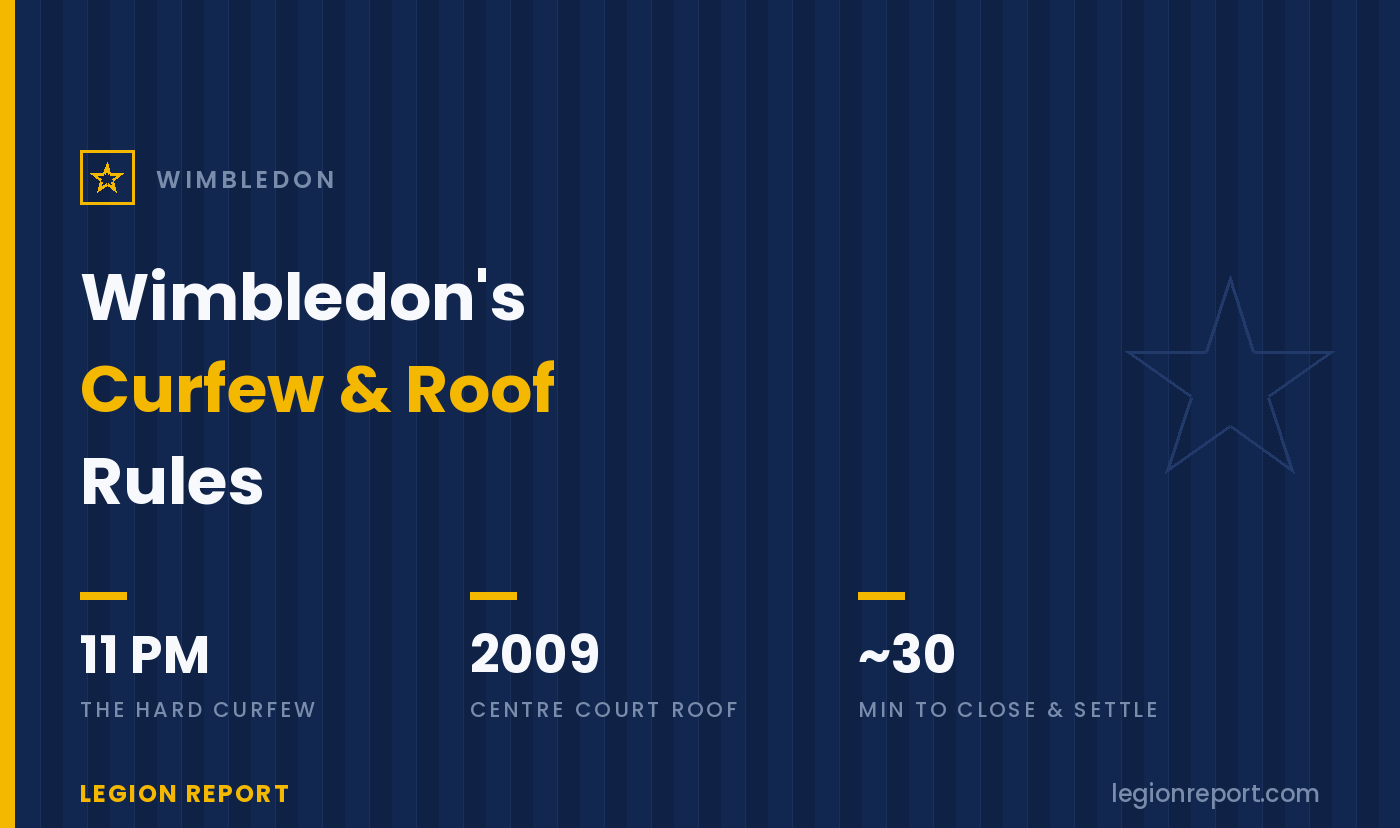

Every Wimbledon, it happens: a match builds toward its crescendo deep in the London evening, and then, at 11 p.m., it simply stops. Players walk off mid-drama, the crowd groans, and casual viewers around the world ask the same question, why does the most prestigious tournament in tennis have a bedtime? The answer isn’t tradition or television. It’s a local planning condition: Wimbledon sits in a residential neighborhood, and the 11 p.m. curfew was imposed by Merton Council as a condition of building the Centre Court roof, to protect the neighbors’ sleep and let the crowds catch the last trains home.
The roofs are the other half of the story. Centre Court got its retractable lid in 2009, No. 1 Court in 2019, and between them they ended a century of rain chaos, while creating a new rulebook of their own: closing takes minutes, but stabilizing the indoor air takes far longer, the referee alone decides, and once a match goes indoors it generally stays there. Together, the curfew and the roofs govern every late-night Wimbledon drama you’ve ever seen suspended.
The chart below covers the whole system: the curfew and its exact logic, the famous races against the clock, both roofs and their specs, the rules of when and how they close, and what the tournament looked like before the lids existed. Take a look, then we’ll break it all down.
The bedtime: why 11 p.m. is non-negotiable
The Wimbledon curfew is one of the few rules in sports written by a city council. When the All England Club sought permission to build the Centre Court roof, with the floodlights that would let tennis run into the night for the first time, the London Borough of Merton attached a condition: play ends at 11 p.m. The logic is entirely local. Wimbledon is a tournament embedded in a residential neighborhood, and 11 p.m. protects the neighbors while ensuring fifteen thousand spectators can still reach London’s last trains. The curfew applies regardless of the score: a match at 10-all in a fifth-set tiebreak stops like any other, with only a few minutes’ discretion available to officials to close out a game already effectively decided. Andy Murray’s 2012 win over Marcos Baghdatis, completed at 11:02 p.m., remains the outer edge of that discretion, while the 2018 Djokovic-Nadal semifinal is the canonical heartbreak: an all-time classic frozen at the stroke of the clock and finished the following afternoon. The contrast with New York is the point: the US Open, unburdened by neighbors, lets matches run past 2 a.m. Wimbledon chose the neighborhood.
The roofs: ten minutes to close, thirty to play
Centre Court’s translucent folding roof arrived in 2009, No. 1 Court’s in 2019, and together they ended the tournament’s oldest enemy. The mechanics are quick, roughly ten minutes for the roof itself, but the restart isn’t: the air-management system needs additional time to stabilize temperature and humidity so the indoor conditions don’t warp the ball’s behavior, which is why a “brief” rain closure typically consumes half an hour. The rulebook around the machinery is philosophical: Wimbledon officially remains an outdoor event, so roofs close for rain or failing light on the referee’s authority alone, not for player comfort, and once closed they generally stay closed for the remainder of that match to keep conditions consistent. Players care because the physics care, indoor Wimbledon plays heavier and rewards big serving, and the eighteen other courts still have no roofs at all, meaning an ordinary rainy Wednesday still produces the traditional scenes: covers sprinting out, matches stacking up, and the roofed show courts playing on serenely above the chaos.
What the lids replaced
To appreciate the current system, remember what it ended. Pre-2009 Wimbledon was hostage to the sky: whole days washed out, finals pushed back, and the occasional “People’s Monday,” when a rain-wrecked schedule spilled onto an unplanned fifteenth day with cheap, unreserved seating and the loudest crowds the grounds ever heard. The traditional Middle Sunday rest day, once broken only by rain emergencies, became a permanent playing day in 2022, another quiet casualty of roof-era reliability. And the sport’s longest match predates the safety net entirely: Isner-Mahut in 2010, the 70-68 fifth set, was suspended on consecutive evenings not by any curfew but by simple darkness, on an outer court with no lights, a reminder that before Merton Council’s 11 p.m. rule, Wimbledon’s original curfew was the sun.
Final Word
Wimbledon’s curfew and roof rules, explained: an 11 p.m. hard stop written into the roof’s planning permission by the local council, for the neighbors and the trains; two retractable roofs (2009 and 2019) that close in ten minutes but cost thirty in stabilization; a referee-only closure doctrine that keeps Wimbledon an outdoor event; and a pre-roof history of washouts, People’s Mondays, and darkness suspensions that explains why everyone tolerates the bedtime. When this weekend’s drama runs late, you’ll know exactly which document stops it, and why Murray’s 11:02 remains the record nobody’s allowed to break by much.
The finals the clock is guarding are chronicled in Wimbledon champions by year, the marathon that darkness kept pausing lives in the longest Wimbledon match ever, and the tournament’s other great tradition is served cold in strawberries and cream at Wimbledon.