Tennis’s most storied list has its newest entry, and it’s a repeat one — Jannik Sinner defended his title, joining the Wimbledon gentlemen’s singles champions, a roll call running from Rod Laver through Borg’s five straight, Sampras’s seven, Federer’s record eight, and the Alcaraz-Sinner handover of the last three years. Jannik Sinner defends against Alexander Zverev, and either result writes history: a first repeat champion since Djokovic, or a first-time Wimbledon winner completing the strangest redemption season in recent memory.
Here is every Open Era champion, the records inside the list, and what the 2026 final added.
The chart below covers all 57 Open Era champions, the all-time title leaders, and the list’s greatest quirks. Take a look, then we’ll break it all down.
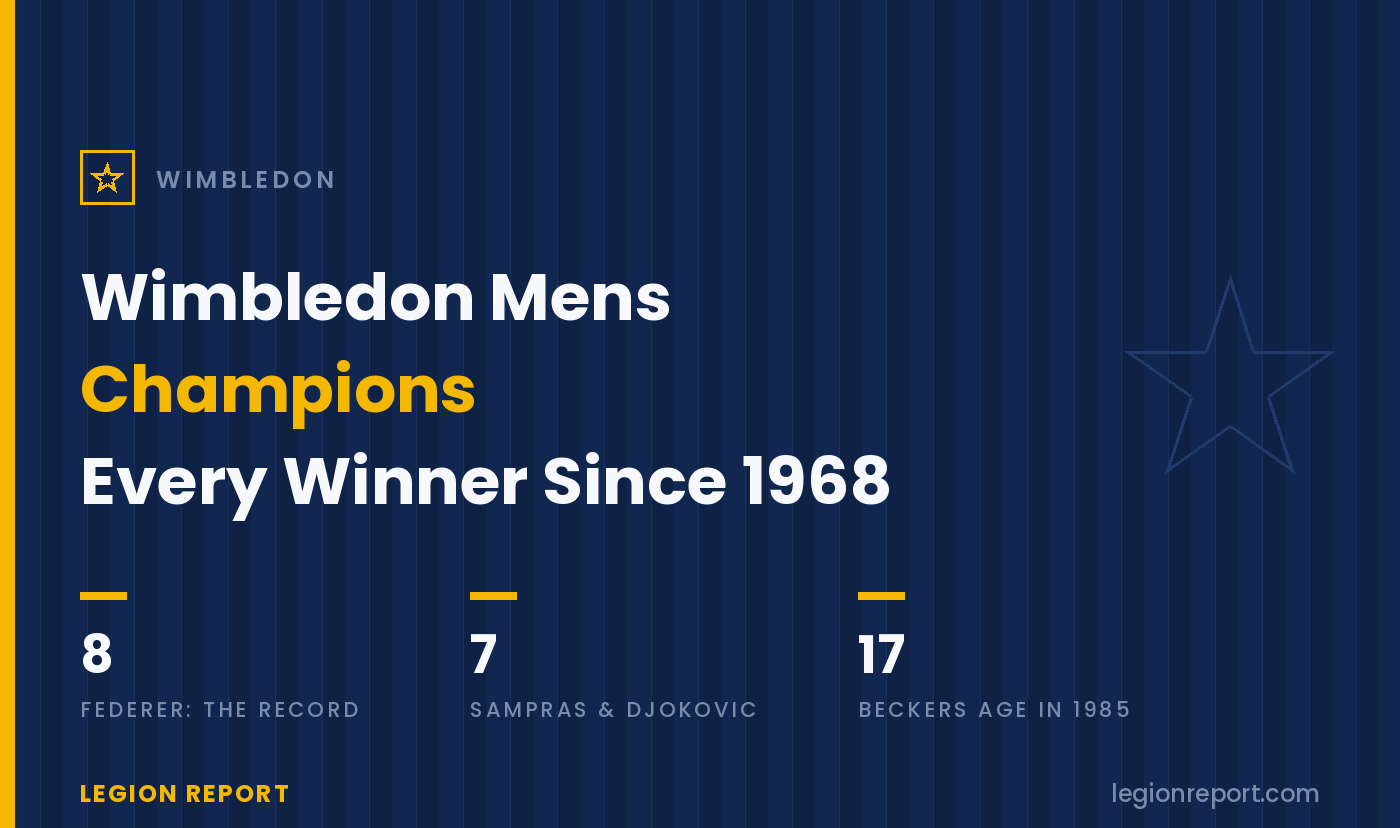
Wimbledon
Wimbledon men’s champions: every winner since 1968
7
each: Sampras & Djokovic
17
Becker’s age in 1985: still youngest
2x
Sinner: back-to-back champ
Every Open Era champion (1968-2025)
| Year |
Champion |
Note |
| 2026 |
Jannik Sinner |
d. Alexander Zverev 6-7(7), 7-6(2), 6-3, 6-4 — back-to-back titles; 5th major |
| 2025 |
Jannik Sinner |
Beat Alcaraz in 2025, then Zverev in 2026 — back-to-back |
| 2024 |
Carlos Alcaraz |
Back-to-back, both over Djokovic |
| 2023 |
Carlos Alcaraz |
Ended Djokovic’s 34-match Centre Court streak in a 5-set epic, at 20 |
| 2022 |
Novak Djokovic |
His 4th straight — and 7th overall |
| 2021 |
Novak Djokovic |
Tied the big three at 20 slams apiece |
| 2019 |
Novak Djokovic |
THE final: 2 championship points saved on Federer’s serve, 13-12 in the 5th |
| 2018 |
Novak Djokovic |
The comeback-from-injury title |
| 2017 |
Roger Federer |
THE RECORD: his 8th, without dropping a set, at 35 |
| 2016 |
Andy Murray |
His second |
| 2015 |
Novak Djokovic |
Beat Federer in the final, again |
| 2014 |
Novak Djokovic |
The first of three straight finals vs. Federer |
| 2013 |
Andy Murray |
77 years of waiting for a British champion, over |
| 2012 |
Roger Federer |
His 7th, tying Sampras — beating Murray’s first final run |
| 2011 |
Novak Djokovic |
His first Wimbledon, in his takeover season |
| 2010 |
Rafael Nadal |
His second |
| 2009 |
Roger Federer |
16-14 in the 5th vs. Roddick: the 77-game final |
| 2008 |
Rafael Nadal |
d. Federer 9-7 in the dark: widely called the greatest match ever played |
| 2007 |
Roger Federer |
5 straight — matching Borg |
| 2006 |
Roger Federer |
|
| 2005 |
Roger Federer |
|
| 2004 |
Roger Federer |
|
| 2003 |
Roger Federer |
The first of the 20 |
| 2002 |
Lleyton Hewitt |
|
| 2001 |
Goran Ivanišević |
A WILD CARD wins Wimbledon: the People’s Monday final, after 3 final losses |
| 2000 |
Pete Sampras |
His 7th — then the record |
| 1999 |
Pete Sampras |
|
| 1998 |
Pete Sampras |
|
| 1997 |
Pete Sampras |
|
| 1996 |
Richard Krajicek |
The only man to beat Sampras here in 8 years |
| 1995 |
Pete Sampras |
|
| 1994 |
Pete Sampras |
|
| 1993 |
Pete Sampras |
The first of the seven |
| 1992 |
Andre Agassi |
The rebel wins the cathedral |
| 1991 |
Michael Stich |
|
| 1990 |
Stefan Edberg |
The third straight Becker-Edberg final |
| 1989 |
Boris Becker |
|
| 1988 |
Stefan Edberg |
|
| 1987 |
Pat Cash |
The original crowd-climb celebration |
| 1986 |
Boris Becker |
|
| 1985 |
Boris Becker |
Champion at 17: still the youngest men’s winner ever |
| 1984 |
John McEnroe |
Lost 4 games in the final: near-perfection |
| 1983 |
John McEnroe |
|
| 1982 |
Jimmy Connors |
8 years after his first |
| 1981 |
John McEnroe |
Ended Borg’s 41-match streak — and his Wimbledon era |
| 1980 |
Björn Borg |
The 18-16 tiebreak final vs. McEnroe: tennis’s most famous set |
| 1979 |
Björn Borg |
|
| 1978 |
Björn Borg |
|
| 1977 |
Björn Borg |
|
| 1976 |
Björn Borg |
The first of 5 straight, without dropping a set |
| 1975 |
Arthur Ashe |
The great tactical upset of Connors |
| 1974 |
Jimmy Connors |
|
| 1973 |
Jan Kodeš |
The boycott year |
| 1972 |
Stan Smith |
|
| 1971 |
John Newcombe |
|
| 1970 |
John Newcombe |
|
| 1969 |
Rod Laver |
Mid-Grand Slam: the calendar sweep year |
| 1968 |
Rod Laver |
The first Open Era champion |
The 2020 championships were cancelled (the only interruption since WWII). Sinner’s 2026 defense holds the top row — just the 10th successful men’s title defense of the Open Era.
The all-time title leaders
| 8 — Roger Federer |
2003-2017, the last one without dropping a set at 35 |
| 7 — Pete Sampras |
Seven in eight years (1993-2000); one man interrupted him |
| 7 — Novak Djokovic |
2011-2022, incl. four straight — still one short, still trying |
| 5 — Björn Borg |
Five STRAIGHT (1976-80) — a streak only Federer has matched |
| 3 — John McEnroe / Boris Becker |
The 80s, divided between a genius and a teenager |
The last decade’s twist: after 20 years of dynasties (Federer-Djokovic won 15 of 20 editions), the title has changed hands between three men since 2023 — and Sinner’s repeat is the first back-to-back by anyone not named Djokovic, Federer, or Alcaraz this century — sealed 6-7(7), 7-6(2), 6-3, 6-4, his 10th straight win over Zverev.
The list’s greatest quirks
| The wild card champion |
Goran Ivanišević, 2001: ranked 125th, in on a wild card, after losing three finals — still the only one ever |
| The teenager |
Boris Becker, 1985: champion at 17, unseeded — both records still stand |
| The two greatest matches |
2008 (Nadal d. Federer, 9-7 in the dark) and 2019 (Djokovic saves 2 championship points, wins 13-12 in the 5th) — the list contains its own GOAT debate |
| The 77-year wait |
Andy Murray, 2013: the first British men’s champion since Fred Perry in 1936 |
Every era’s defining argument is somewhere in the Note column — this is less a list than the sport’s biography.
Champions via AELTC records. The 2026 row was added Sunday, July 12: Sinner d. Zverev in four sets — the title defended, major No. 5 secured.
Federer’s Eight, and the Dynasty Habit
The men’s list is a study in ownership. Where the women’s roll call has produced nine different champions in nine years, the men’s title spends decades at a time in the same hands: Borg’s five straight (1976-80, the first three without dropping a set), Sampras’s seven-in-eight (1993-2000, interrupted only by Krajicek’s 1996 lightning strike), and then the twenty-year Federer-Djokovic condominium that yielded Federer’s record eight, the last of them in 2017 at age 35 without losing a set, and Djokovic’s seven, including the 2019 final in which he saved two championship points on Federer’s own serve, the most consequential two points in the tournament’s history. The dynasty habit is what makes the current moment remarkable: since 2023 the title has passed from Alcaraz (who ended Djokovic’s 34-match Centre Court streak at age 20) to Alcaraz again to Sinner, and the 2026 final produced the answer: the first repeat champion of the new era, the most democratic stretch the men’s event has had since the 1990s. Djokovic, meanwhile, remains one title from Federer’s eight at 39, and this fortnight’s semifinal exit means the pursuit, like his 25th major, rolls forward rather than ending.
The Quirks That Keep the List Human
For all its dynasties, the list’s soul is in the outliers. Goran Ivanišević’s 2001 title remains sport’s best fairy tale: ranked 125th, admitted on a wild card after three final defeats across the 90s, winning a rain-delayed “People’s Monday” final in front of a ground-pass crowd that behaved like a soccer terrace, still the only wild card ever to win a major. Boris Becker’s 1985 championship, unseeded, 17 years old, serve-and-volleying like a man with no memory, set youngest-champion and unseeded-champion records that have survived four decades of prodigies. Andy Murray’s 2013 win ended a 77-year national wait so heavy it had its own name (“since Fred Perry”), Arthur Ashe’s 1975 tactical dismantling of Connors remains the thinking-fan’s favorite final, and Jan Kodeš’s 1973 title carries the asterisk of the great boycott. Even the list’s two most famous entries are arguments more than results: 2008’s Nadal-Federer, finished at 9-7 in near-darkness and routinely called the greatest match ever played, and 2019’s Djokovic-Federer, the championship-points final, sit sixteen rows apart, quietly hosting the sport’s eternal debate. Row 58 is written: the era’s dominant force went back-to-back, dropping a first-set tiebreak before winning 10 straight in the rivalry — against a Zverev who had never before passed the fourth round here.
Final Word
The Wimbledon men’s champions: 57 Open Era winners from Rod Laver in 1968 to Sinner in 2025, ruled by Federer’s eight, Sampras’s and Djokovic’s sevens, and Borg’s five straight, seasoned by Becker at 17, Ivanišević off a wild card, Murray after 77 years, and the two greatest matches ever played (2008 and 2019) sitting inside the table. Row 58 belongs to Sinner: 6-7(7), 7-6(2), 6-3, 6-4 over Zverev for back-to-back titles — the first repeat of the post-Djokovic era, a fifth major, and his 100th Grand Slam match win in one evening.
The women’s roll call is in Wimbledon women’s champions by year, the rivalry behind the final is broken down in Sinner vs. Zverev: the head-to-head, and the cross-era records live in most Wimbledon titles ever.