
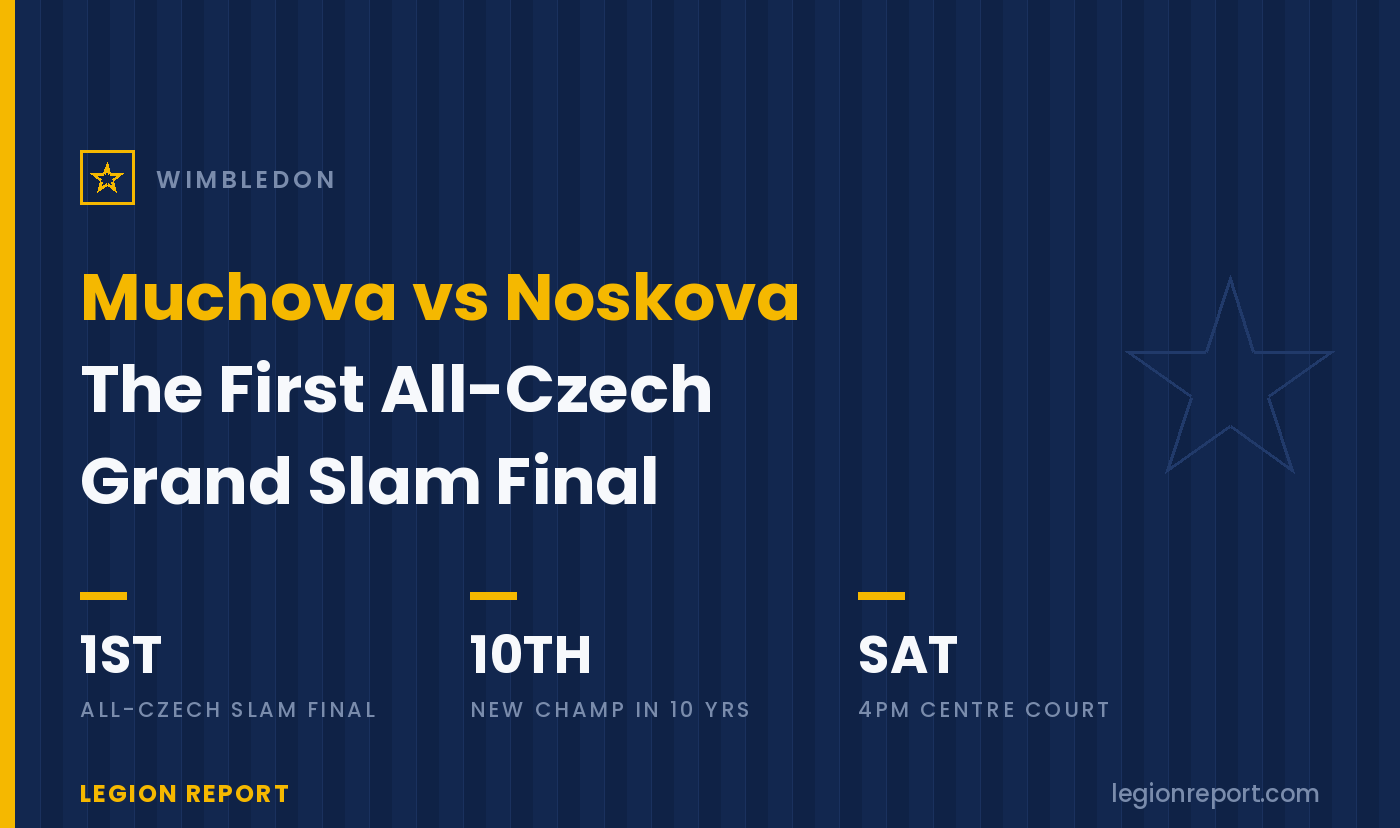

Saturday’s Wimbledon women’s final is a first in the sport’s history: Karolína Muchová vs. Linda Nosková, the first all-Czech Grand Slam final ever played, and the first Wimbledon final between two players from the same nation since Venus and Serena in 2009. It guarantees a first-time major champion, extends Wimbledon’s streak of new champions to ten straight years, and comes with a twist no rivalry can match: the two finalists are Olympic doubles partners.
Muchová, 29, arrives having beaten three major champions in a row, surviving Coco Gauff in a 12-10 deciding tiebreak. Nosková, 21, hasn’t needed a deciding set all tournament and can become the youngest Wimbledon champion since Petra Kvitová in 2011. Here’s everything about the match.
The chart below covers the matchup, both roads to the final, the history on the line, and the details for Saturday. Take a look, then we’ll break it all down.
The Strangest Great Final: Partners Across the Net
Every angle of this final is historic, but the strangest is the warmest: Muchová and Nosková aren’t just compatriots, they’re doubles partners, having teamed for Czechia at the Paris 2024 Olympics, and now they’ll contest the biggest match of either career from opposite ends of Centre Court. It’s the first all-Czech major final in tennis history, an overdue coronation for the sport’s most improbable production line: Czechia, a nation of ten million, has now sent a different woman to the Wimbledon final in each of the last several editions, with Vondroušová winning unseeded in 2023, Krejčíková channeling her late mentor Jana Novotná in 2024, and now two more guaranteed to extend the run, a lineage tracing through Novotná and Kvitová all the way back to the Czech-born Navratilova, whose nine titles crown the whole tournament. Saturday also guarantees a tenth different champion in ten editions, the most democratic stretch in Wimbledon’s history, and the first same-nation final at the All England Club since Serena beat Venus in 2009. The trivia is endless; the truth underneath it is simpler: two friends, one Venus Rosewater Dish, and a first Grand Slam for whoever wants it more.
Craft vs. Surge: How the Match Plays
The tennis matchup is a genuine style clash. Muchová at 29 is the players’ player, all-court invention, sliced backhands, drop-volley touch, and a tactical mind that just dismantled three major champions consecutively (Krejčíková, Osaka, and Gauff, making her only the fifth woman of the Open Era to beat three slam winners en route to a major final), capped by the semifinal of the tournament: 6-2, 1-6, 7-6 with a 12-10 deciding tiebreak in which she saved a match point, clutching her abdomen in the heat, and won it anyway with a diving volley in the highlight reel. Her injury-wrecked career has produced exactly one previous slam final, the 2023 French Open loss to Świątek, and everything about her game says grass is where the second chance should come. Nosková at 21 is the future arriving early: a Berlin title on grass, straight-set dismissals of Keys, Mertens, and Kostyuk, and a semifinal she won with fewer than ten winners because her defense manufactured every error she needed. Muchová won their only prior meeting (2025 US Open, three sets) and enters a slight favorite; Nosková can become the youngest champion since Kvitová in 2011. Craft against surge, 29 against 21, partner against partner, and either way, the honor board gets a name nobody predicted a month ago.
Final Word
The 2026 Wimbledon women’s final: Karolína Muchová vs. Linda Nosková, Saturday July 11 on Centre Court (not before 4 p.m. local / 11 a.m. ET), the first all-Czech Grand Slam final ever, the first same-nation Wimbledon final since the Williams sisters in 2009, a guaranteed first-time champion and a tenth different winner in ten years, with £3.6 million and the Venus Rosewater Dish between two Olympic doubles partners. Muchová brings the gauntlet run (three major champions beaten in a row, a match point saved against Gauff) and a 1-0 head-to-head; Nosková brings youth, a grass title, and the chance to be the youngest champion since 2011. The result gets added here, and to the champions list, Saturday evening.
Every winner who came before is listed in Wimbledon women’s champions by year, the payday is broken down in Wimbledon prize money, and the trophy itself is explained in the Wimbledon trophy: the Dish and the pineapple.