
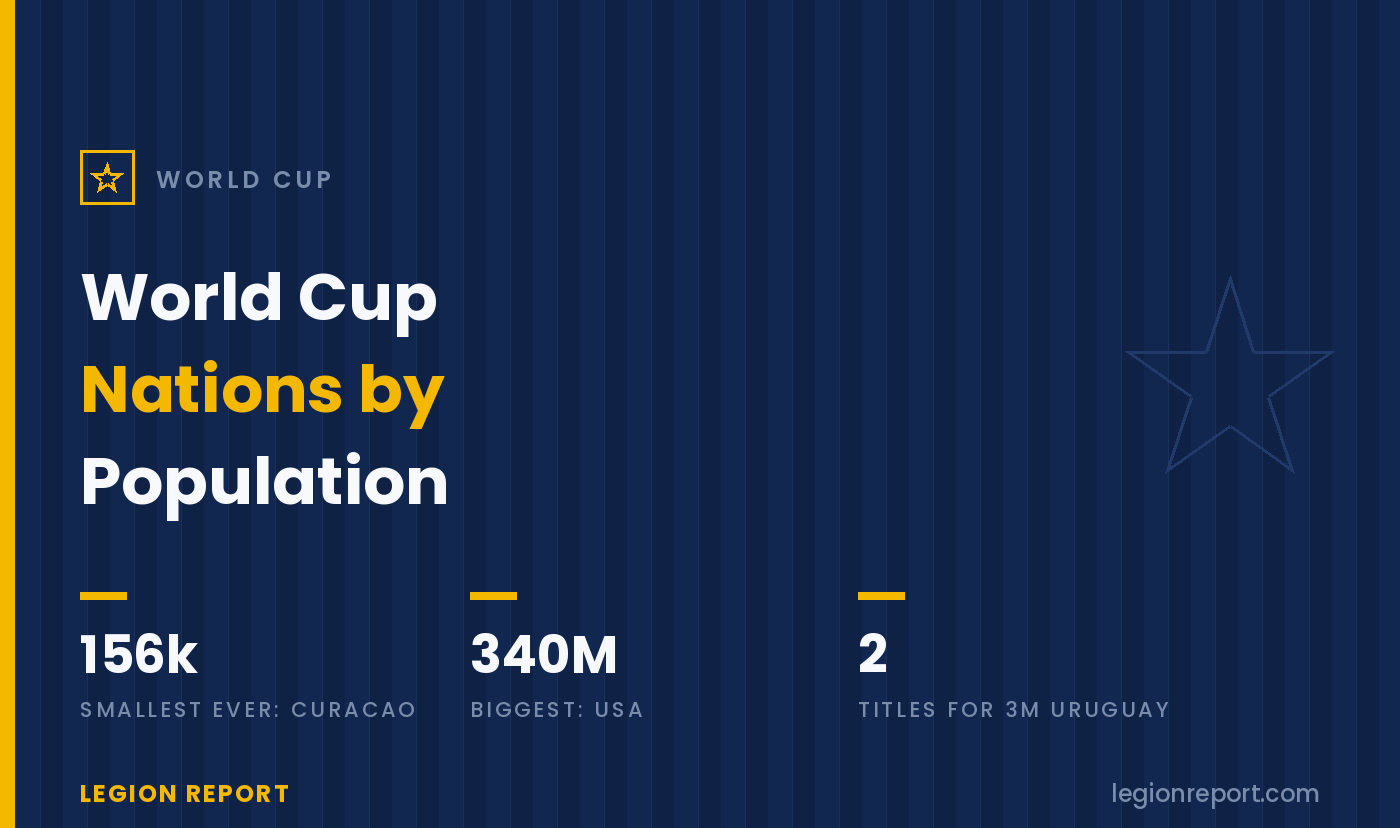

The 2026 World Cup contains the most lopsided population matchup in the tournament’s history: the United States, 340 million people, sharing a field with Curacao, population roughly 156,000, the smallest nation ever to qualify for a World Cup. That’s a gap of more than 2,000 to one. Entire American suburbs outnumber the island whose team just played on the sport’s biggest stage.
Population is the World Cup’s favorite hidden storyline. The tournament’s most decorated overachiever is a country of three million with two titles. The two most populous nations on Earth, home to nearly three billion people combined, have played a grand total of one World Cup between them. And this year’s expanded 48-team field stretched the extremes further than ever, adding half-million-strong Cabo Verde and record-shattering Curacao to a bracket containing three of the world’s fifteen biggest countries.
The chart below covers the whole subject: every one of the 48 nations at the 2026 World Cup ranked by population, the smallest nations ever to qualify, what population has to do with winning (very little), the absent giants, and the per-capita math that makes tiny qualifiers so miraculous. Take a look, then we’ll break it all down.
The 2,000-to-one World Cup
Ranked top to bottom, all 48 nations, the 2026 field is the widest spread the tournament has ever staged. At the top: the United States (~340 million), the most populous host in World Cup history, followed by ever-present Brazil (~212 million), co-host Mexico (~130 million), Japan, Egypt, and, quietly sixth, DR Congo’s 105 million, back at a World Cup for the first time since 1974. The full table hides good trivia in its middle: the United Kingdom’s 68 million splits into separate English and Scottish entries, and Qatar’s listed 2.7 million contains only about 300,000 actual citizens, arguably making it the field’s true minnow by passport. At the bottom, officially: Cabo Verde, an Atlantic island chain of roughly 525,000 that not only debuted but escaped its group, and below even them, Curacao, population around 156,000, the smallest nation ever to reach a World Cup, less than half the size of the previous record holder. The gap between the field’s extremes runs past 2,000 to one; a single mid-sized American metro outnumbers the entire country whose flag flew at this tournament. The 48-team expansion was pitched as growing the game’s map, and whatever else it did, it rewrote the small-nation record book in a single summer.
Small doesn’t mean hopeless: the Uruguay problem
If population decided soccer, the sport’s history would be unrecognizable, and Uruguay is the standing proof. A country of about two million when it won the first World Cup at home in 1930, and barely three million when it silenced 200,000 Brazilians in the 1950 Maracanazo, Uruguay owns two titles, more than England, Spain, or the Netherlands, and remains, per capita, the most successful soccer nation ever: roughly one World Cup per 1.7 million citizens. Croatia (~3.9 million) has reached a final and won two bronzes since 1998. Meanwhile every champion in history falls in a band between Uruguay’s three million and Germany’s mid-eighty millions, with Brazil the lone giant, meaning the tournament has literally never been won by a country as big as the one hosting this year’s final. Population buys a deeper talent pool; it doesn’t buy the culture, coaching, and league infrastructure that convert people into players. Headcount is potential energy. Soccer nations are built, not counted.
The three billion who stay home
The inverse table is more startling. India (~1.44 billion) has qualified exactly once, in 1950, when withdrawals cleared its path, and then declined to travel to Brazil; the popular legend blames FIFA’s ban on barefoot play, the duller records point to cost and indifference, and either way India has never played a World Cup match. China (~1.41 billion) has one appearance, 2002: three defeats, zero goals scored. Indonesia’s entire World Cup history is one match in 1938, contested under its colonial name, the Dutch East Indies. Pakistan and Bangladesh, some 420 million people combined, have never come close. Add it up and roughly three billion people, well over a third of humanity, are represented at World Cups either never or nearly never, a concentration that makes the tournament’s “world” title as much aspiration as description, and explains why FIFA keeps expanding the field toward the game’s unconquered markets.
The per-capita miracle, and how it’s actually done
The math of tiny qualifiers borders on absurd. Curacao’s 2026 squad represents roughly one professional spot per 6,000 residents; scaled to the United States, that’s a national team of 56,000 players. Iceland’s 2018 side, the previous miracle, ran about one per 15,000. The open secret behind these numbers is the diaspora: Curacao’s record-breaking team was largely assembled from players of island descent developed in the Dutch football system, eligible through FIFA’s parent-and-grandparent rules, just as Cabo Verde draws on Portugal’s academies. Small-nation qualification is really a story about migration, ancestry rules, and federations smart enough to organize both, which is why the record Curacao just set may not last: the eligibility rulebook has turned every diaspora into a scouting network, and there are smaller flags with bigger diasporas still out there.
Final Word
World Cup countries by population, explained: a 2026 field stretching from 340-million-strong host USA down to record-smashing Curacao at ~156,000, a smallest-ever table rewritten twice in one tournament, a two-title champion with three million people, and three billion humans, India and China foremost, whose World Cup history fits in a single paragraph. The lesson runs both directions: population has never won this tournament, and the lack of it has never disqualified anyone with a good enough diaspora and a functioning academy. The World Cup’s real census isn’t people. It’s players.
The rules that make the miracles possible live in World Cup eligibility rules, the marks the giants and minnows chase in World Cup records, and the tiny champion’s greatest day in Brazil’s World Cup history (they remember 1950 differently).