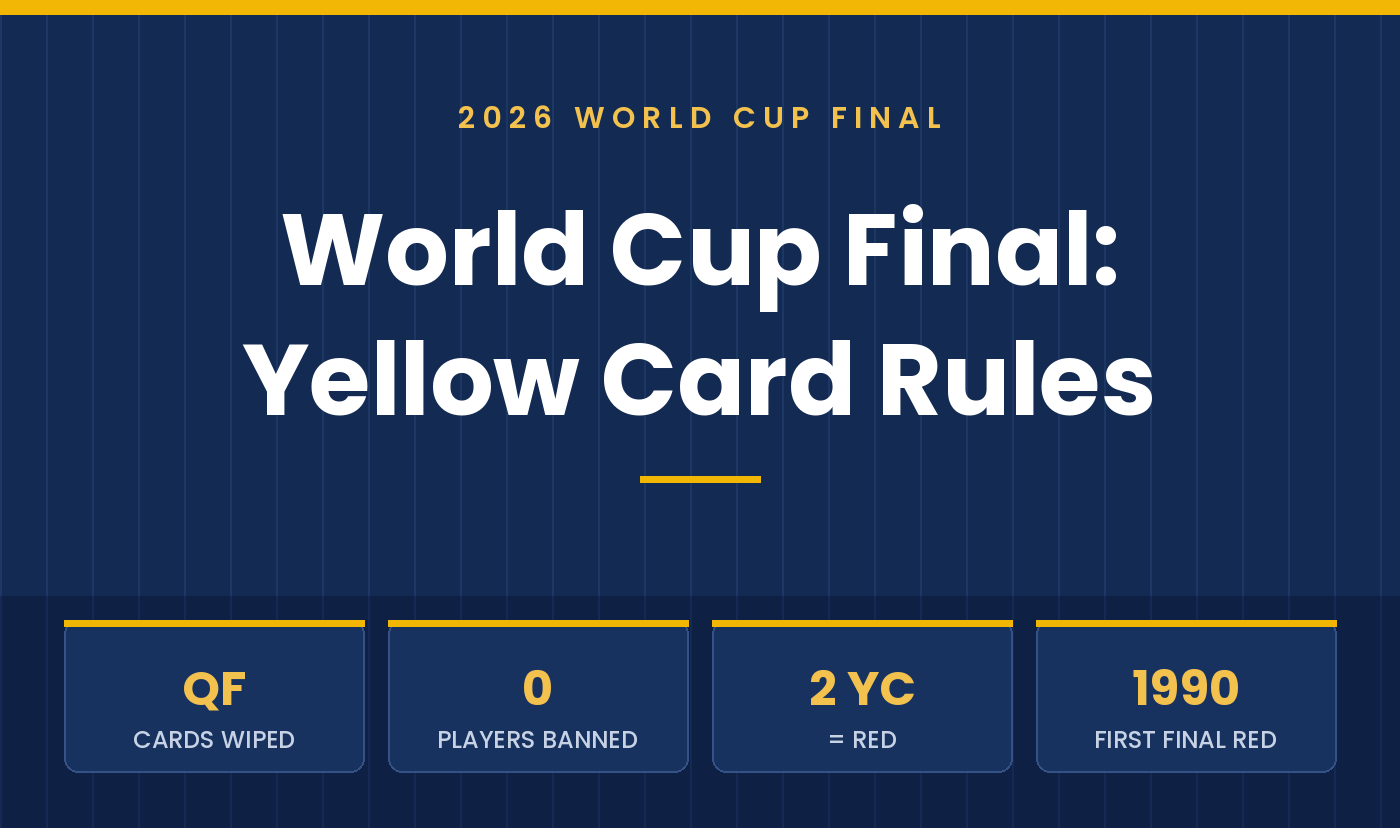
The World Cup’s yellow card rules are built around one goal: making sure no star misses the final over an accumulation technicality. FIFA wipes all accumulated yellow cards after the quarterfinals, meaning every booking from the group stage through the quarters was erased before the semis. A single yellow in the semifinal carries no suspension — which is why Kylian Mbappé, booked against Spain, was free for the bronze final, and why every player on Spain and Argentina’s rosters is available Sunday.
After the wipe, the only way to miss the final through cards was a red in the semifinal — either a straight red or two yellows in that match — and none were shown. Inside the final itself, cards work normally: two yellows mean a red and a team playing short-handed, bookings in extra time count, and this tournament adds a new one — players can be shown red for leaving the pitch in protest of a refereeing decision.
2026 World Cup Final
Yellow Card Rules for the Final
Why nobody is suspended Sunday — and what cards mean once it kicks off
QFCards Wiped After
0Players Banned
2 YC= Red in Final
1990First Final Red
The Rules, Question by Question
FIFA disciplinary regulations at the 2026 World Cup.
| Question |
Answer |
Detail |
| Cards wiped after quarterfinals |
Yes |
All accumulated yellows were cleared, so no one enters the final at risk from earlier rounds |
| Semifinal yellow card |
No ban |
A single caution carries no suspension — every booked player is available Sunday |
| Missing the final via yellows |
Effectively impossible |
Post-wipe, only two yellows in one match (a red) could rule a player out |
| Red card in the semifinal |
Final ban |
A straight red or two yellows in the semis would have meant missing the final — none were shown |
| Cards in the final itself |
Count normally |
Two yellows in the final = red; extra-time bookings count; a red means playing short-handed |
Why FIFA Wipes the Slate
The rule exists because of finals past: before the reset was introduced, players missed championship matches over two scattered bookings weeks apart. Clearing cards after the quarters guarantees the final gets both teams at full strength.
Reds in Finals Past
Final red cards are rare but unforgettable: Argentina’s Pedro Monzón drew the first ever in 1990 (teammate Gustavo Dezotti followed in the same match), and Zinedine Zidane’s 2006 headbutt remains the most famous sending-off in football history.
The Referee’s Tightrope
Final referees historically manage games to keep 22 players on the pitch — but the 2010 final drew a record 14 cards, proof that a final between contrasting styles can force an official’s hand. Spain was involved in that one, too.
The Bottom Line
Cards wiped after the quarters, no one suspended, and a clean disciplinary slate for both squads Sunday — from kickoff, though, every booking is live. What happens if the drama runs past 90 minutes is covered in what happens if the final ends in a tie, and the teams those rules protect in the predicted lineups.