

It’s the strangest fixture in soccer: a match between two teams that just had their hearts broken, playing for a trophy neither wanted. The World Cup third place match, the “bronze final,” pits the two losing semifinalists against each other the day before the final. Players have called it pointless, coaches have campaigned to abolish it, and one legendary manager declared it should never be played at all. It has also produced some of the most entertaining games in World Cup history, precisely because nobody defends like it matters.
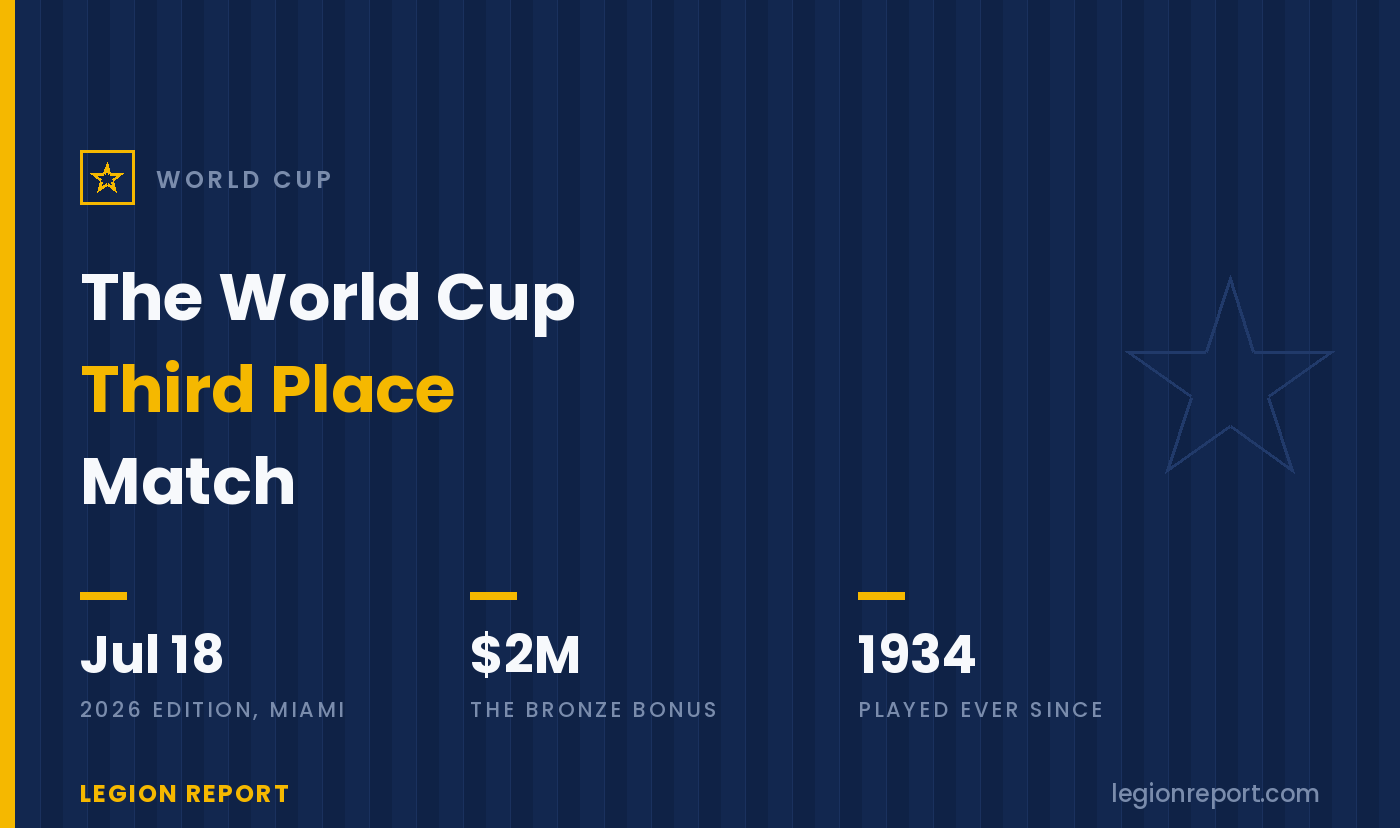
This year’s edition arrives July 18 at Hard Rock Stadium in Miami, twenty-four hours before the final in New Jersey, with a bronze medal, $2 million in extra prize money, and a strange kind of closure on the line. And whatever the players say about it, the fixture keeps delivering: goals, farewells, records, and once, the fastest goal in World Cup history.
The chart below covers everything about the third place match: the 2026 edition’s details, the money at stake, the case against it and FIFA’s case for it, the famous bronze finals, and the records the game has produced. Take a look, then we’ll break it all down.
What the third place match is
The World Cup third place match is exactly what it sounds like: the two teams beaten in the semifinals meet one last time to decide who finishes third and who finishes fourth. It’s been part of every World Cup since 1934, the lone exception being the inaugural 1930 tournament, which skipped it entirely (FIFA later credited the United States with third place retroactively, still the best American men’s finish ever). The game follows full knockout rules, extra time and penalties if needed, and the winner collects bronze medals, FIFA ranking points, and in 2026, a $29 million payout, $2 million more than the loser’s. This year’s edition is set for Saturday, July 18 at Hard Rock Stadium in Miami, with the semifinal losers from Dallas and Atlanta getting a few days to regroup first.
The most resented fixture in the sport
No World Cup match is complained about more. The players contesting it are days removed from the most painful defeat of their careers, asked to summon intensity for a prize nobody dreamed about, with a club season’s worth of injury risk attached. Louis van Gaal delivered the definitive protest before the 2014 edition, arguing the game should not exist because it forces a devastated team to play for nothing; European soccer agreed with him decades earlier, abolishing the Euro’s third-place match after 1980. FIFA’s answer is a bundle of quiet incentives: a full weekend of broadcast inventory before the final, medals and money that federations genuinely value, ranking points, and one last stage for stars the tournament is about to lose. The fixture survives because the sport’s accountants outvote its semifinalists.
Why it’s secretly great
Here’s the twist the complaints miss: the third place match is reliably one of the most entertaining games of any World Cup, for exactly the reason players resent it. With nothing existential at stake, teams attack, coaches empty the bench to give squad players a World Cup appearance, and legends get farewells. History’s bronze finals read like a highlight reel. Just Fontaine scored four times in France’s 6-3 win in 1958 to finish with 13 goals, a single-tournament record no one has approached since. Hakan Sukur opened the 2002 edition with a goal after roughly 11 seconds, still the fastest in World Cup history. The Netherlands beat Brazil 3-0 in 2014 to deepen the host’s 7-1 trauma; Belgium’s golden generation sealed its best-ever finish over England in 2018; and in 2022, Luka Modric’s Croatia edged Morocco 2-1 in a genuinely emotional bronze, one team’s send-off meeting another’s history. And when the host lands in it, the game transcends itself: Germany’s 2006 win over Portugal set off street parties that outshone the final.
Final Word
The World Cup third place match, explained: the losing semifinalists play the day before the final, this year July 18 in Miami, for bronze medals, a $2 million prize bump to $29 million, and closure. Players call it the game nobody wants; the record book calls it the game that gave us Fontaine’s 13, the fastest goal ever, and some of the freest soccer the tournament produces. It’s the World Cup’s consolation prize, and like most consolation prizes, it means nothing right up until the moment it’s yours.
It’s the second-to-last chapter of the tournament we’ve been covering all month. See who’s lifted the real trophy in World Cup finals history, and how teams got seeded into this bracket in World Cup tiebreakers explained.