

The World Cup is the most pressure-packed stage in football, the place careers are made and legends are born. So there is something almost unbelievable about the players who have walked onto it as teenagers, some of them barely 17, going up against grown men at the peak of their powers. A few crumbled. A few became the greatest of all time.
One name sits at the very top, and it is not the one most people expect. The youngest player in World Cup history is not Pele, though he is on the list, but a 17-year-old from Northern Ireland who had played just two competitive club games before he took the field at a World Cup. There is also no minimum age to play, which is exactly why this list exists.
The chart below ranks the youngest players in World Cup history, shows the teenager who has already cracked the list at the 2026 tournament, and lays out the related age records. Take a look, then we’ll get into the stories.
The record holder who came from nowhere
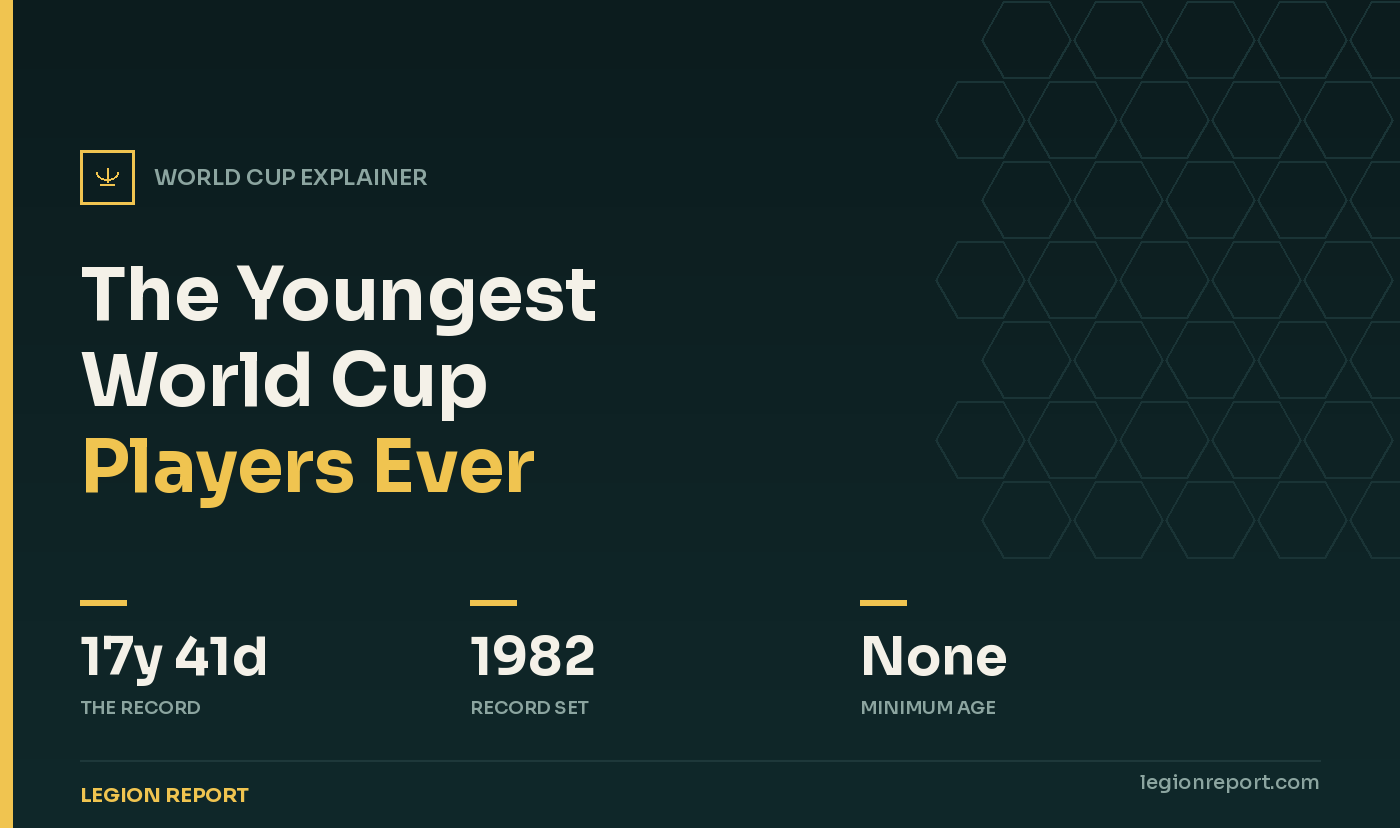
The youngest player in World Cup history is Norman Whiteside, who was 17 years and 41 days old when he started for Northern Ireland against Yugoslavia at the 1982 World Cup in Spain. What makes his story extraordinary is how raw he was: when his manager named him to the squad, Whiteside had played just two competitive games at club level for Manchester United. He broke a record that had stood for 24 years, and he did it as a near-unknown.
Whiteside more than held his own. He played the full match in a hard-fought goalless draw, and Northern Ireland went on to win their group, beating the hosts Spain in one of the country’s greatest ever nights. He even picked up a small extra footnote that day, becoming the youngest player ever to be booked at a World Cup after an overenthusiastic challenge. The record he set has now stood for more than four decades.
The legend he beat
The player Whiteside surpassed was none other than Pele, who appeared at the 1958 World Cup in Sweden at 17 years and 235 days. Pele sits fifth on the all-time list, but he owns nearly every other youth record in the men’s game, because unlike most teenagers on the list, he did not just show up, he dominated. He scored on his run through the knockout stages, became the youngest goalscorer in World Cup history, then the youngest to score a hat-trick, in the semifinal against France.
In the final against the hosts, Pele scored twice in a 5-2 win, making him the youngest player ever to feature and score in a World Cup final, and the youngest World Cup winner at just 17. The torch-passing between the two even had a personal touch: after Whiteside broke his appearance record, Pele sent him a message of congratulations, joking that he hoped Whiteside would go on to win three World Cups as he had.
A list full of future superstars
What stands out about the youngest-players list is how many of these teenagers became genuine greats. Cameroon’s Samuel Eto’o sits second, having debuted at 17 years and 99 days in 1998, and he went on to become one of the finest African forwards in history across four World Cups. Cameroon in fact appears repeatedly, with Salomon Olembe and Rigobert Song also among the youngest ever, a sign of how often the country has blooded teenagers on the biggest stage.
Not every name became a household one, which is part of the intrigue. Nigeria’s Femi Opabunmi, third on the list after facing England at the 2002 World Cup aged 17 years and 101 days, saw his career derailed by an eye condition and never reached the heights his early promise suggested. The list is a mix of the immortals and the what-could-have-beens, which is what makes it such a fascinating snapshot of football’s gambles on youth.
The teenagers of 2026
This record book is being written in real time. At the 2026 World Cup, co-hosted by the United States, Canada, and Mexico, Mexico’s Gilberto Mora has already broken into the all-time top 10, appearing against South Africa at 17 years and 240 days to become the youngest player at this tournament. He arrived with a remarkable resume for his age, having already become the youngest player to start and score in Liga MX history and the youngest to debut for Mexico’s senior side.
He is not alone. Spain’s Lamine Yamal, already one of the brightest young stars in world football at 18, is lighting up the tournament, and the 48-team format means more nations than ever are handing debuts to teenagers. None of them are likely to catch Whiteside’s record this time, but the 2026 edition is a reminder that the World Cup has always been a launchpad for the game’s next generation.
The other youth records
A few related records round out the picture. While Whiteside is the youngest to play, Pele is the youngest to score, to play in a final, and to win the whole thing, a clean sweep of the most meaningful youth milestones. And if you stretch the definition beyond the finals to qualifying matches, the youngest of all is staggering: Souleymane Mamam of Togo played a World Cup qualifier against Zambia in 2001 at just 13 years and 310 days old, an age at which most players are still in youth academies.
That extreme is possible because FIFA has no minimum age requirement to play at the World Cup. Any player named to a nation’s final squad is eligible, regardless of age, which is exactly why this list can include 17-year-olds and why a 13-year-old could appear in qualifying. It is the mirror image of the other end of the spectrum, where players have lasted into their mid-40s. For the opposite extreme, see our list of the oldest World Cup players ever.
Final Word
The youngest players in World Cup history are a rare breed: teenagers thrown into the deepest end the sport has to offer, with Norman Whiteside’s record of 17 years and 41 days standing tall for more than 40 years. The list runs from raw unknowns to Pele himself, and it captures one of football’s enduring truths, that the World Cup is where the next great generation so often announces itself.
With no minimum age and a 48-team field in 2026, the door to this list is wider than ever, and players like Gilberto Mora are already walking through it. The next time a 17-year-old steps onto a World Cup pitch, remember that you might be watching the early chapter of an all-time great, or one of the sport’s great what-ifs. Either way, history is being made.