
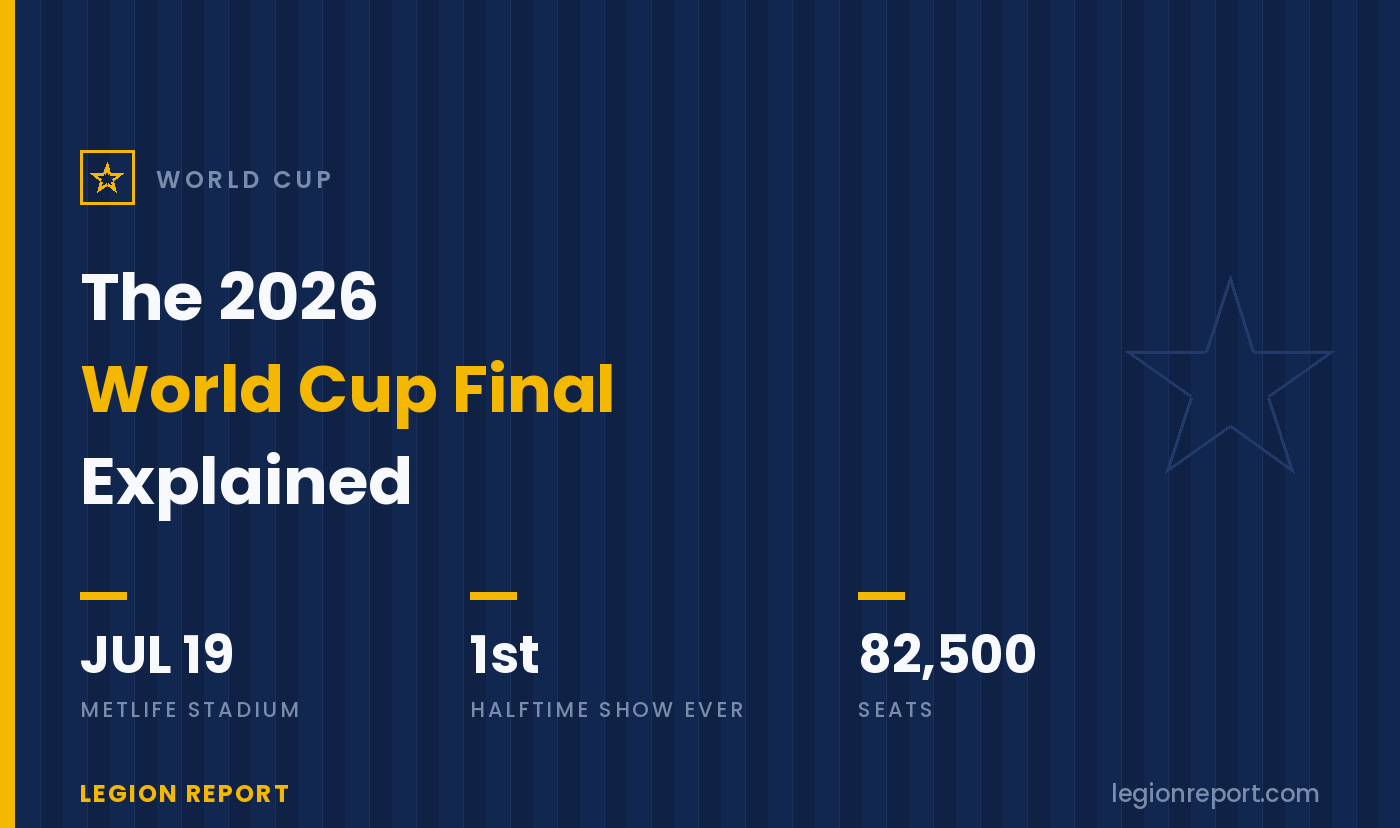

The 2026 World Cup final kicks off Sunday, July 19 at 3 p.m. ET at MetLife Stadium in East Rutherford, New Jersey, 82,500 seats, five miles from Manhattan, the climax of the biggest World Cup ever played. And this final will do something no World Cup final has done in 96 years of trying: stop for a halftime show. Madonna, Shakira, and BTS will co-headline an 11-minute, Super Bowl-style performance curated by Coldplay’s Chris Martin, the first in tournament history, and one that has already ignited a very loud argument about what soccer is becoming in America.
The teams aren’t known yet, the semifinals play out July 14 in Dallas and July 15 in Atlanta, but the stakes already are: a record $50 million to the champion, Argentina chasing the first title defense since 1962, Messi at 39 leading the Golden Boot race of a tournament that has shattered every attendance and scoring record it touched.
The chart below covers everything you need for the 19th: the essentials, the historic halftime show, the road to the final, the money and records on the line, and the scene around it, from a 50,000-person Central Park watch party to the stadium FIFA won’t call by its name. Take a look, then we’ll break it all down.
The what, where, and when
The basics: Sunday, July 19, 3 p.m. Eastern, MetLife Stadium in East Rutherford, New Jersey, a venue FIFA will insist on calling “New York New Jersey Stadium” because its sponsorship rules scrub corporate names for the tournament. The stadium holds 82,500 for the final, having removed 1,740 corner seats to widen its NFL field to World Cup dimensions. The 3 p.m. kickoff, confirmed back in December, is a global compromise: Sunday afternoon in America, 9 p.m. prime time across Western Europe. Fox and Telemundo carry it in the US. The finalists emerge from the semifinals on July 14 in Dallas and July 15 in Atlanta, with the losers consoling themselves in Miami’s third-place match on the 18th, and if the final itself is level after 90 minutes, extra time and then penalties decide it, exactly as they decided Argentina’s epic in 2022.
The halftime show: a 96-year first
The headline novelty is the halftime show, the first in World Cup history. Madonna, Shakira, and BTS co-headline, a lineup announced on May 14 in a video featuring Chris Martin, Elmo, Cookie Monster, and the Muppets (who will also appear in the show itself). Martin and Coldplay manager Phil Harvey curated the bill; Global Citizen produces; and the whole spectacle, reported at roughly 11 minutes starting around 3:50 p.m. ET, doubles as a fundraiser for the FIFA Global Citizen Education Fund’s $100 million campaign. The casting is a map of the sport’s audience: Madonna brings American pop royalty (and 2012 Super Bowl experience), Shakira is practically the World Cup’s house artist, from “Waka Waka” to this tournament’s official song “Dai Dai,” and BTS delivers the largest fanbase in Asia. The controversy is real too: soccer’s laws cap halftime at 15 minutes, last year’s Club World Cup show at this same stadium stretched the break toward 25, and a vocal chunk of the sport’s traditionalists regards the whole thing as the Super Bowl swallowing football. FIFA’s bet is simpler: the people complaining will watch anyway, and a billion new viewers might stay for the second half.
What’s actually at stake
Beneath the spectacle, the sporting stakes are the heaviest in the event’s history. The winner collects $50 million from a record $871 million prize pool, the largest single prize in soccer. If Argentina reaches the 19th, they’ll be attempting the first successful World Cup title defense since Brazil in 1962, with a 39-year-old Messi, at his record sixth World Cup and leading the Golden Boot race, chasing the last honor imaginable. The tournament arrives at its final having already destroyed the record book: all-time attendance and total-goals marks fell weeks ago, and this will be the 104th match of the largest World Cup ever staged. Around the stadium, the region is treating the day as a holiday: 50,000 people on Central Park’s Great Lawn for the world’s biggest watch party, a Coldplay concert in Times Square, and a projected global audience that should rank among the most-watched broadcasts ever. Whoever the semifinals deliver, July 19 is engineered to be the biggest single day in the history of American soccer, with a decent claim on the biggest in American sports.
Final Word
The 2026 World Cup final: July 19, 3 p.m. ET, MetLife Stadium, 82,500 seats, Fox and Telemundo, finalists decided in Dallas and Atlanta the week before, $50 million and possibly a 64-year first on the line, and, for the first time in World Cup history, a halftime show, Madonna, Shakira, and BTS for 11 minutes, curated by Chris Martin, cheered by the Muppets, and protested by purists. This page updates as the bracket resolves: check back after each semifinal for the confirmed matchup, and after the 19th for how the biggest World Cup ever ended.
The gold on the podium is dissected in the World Cup trophy explained, the repeat Argentina is chasing in back-to-back World Cup champions, and every previous final in World Cup finals history.