
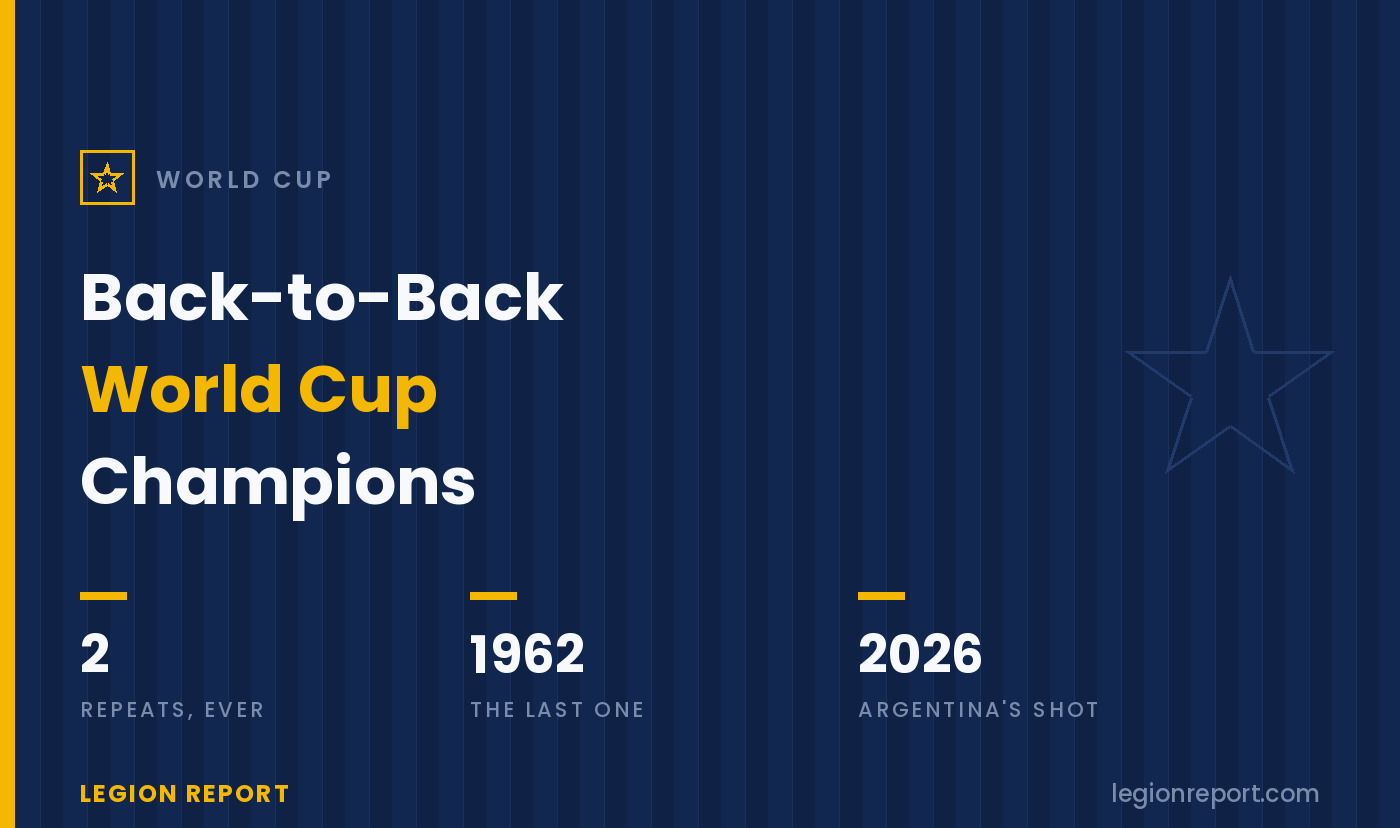

Has anyone ever won back-to-back World Cups? Yes, twice, and then never again. Italy repeated in 1934 and 1938, Brazil repeated in 1958 and 1962, and in the 64 years and fifteen tournaments since, no defending champion has managed it. Not Pele’s later Brazils, not Maradona’s Argentina, not the Spain and Germany dynasties. The World Cup repeat is arguably the rarest feat in team sports.
It’s also, right now, live. Argentina, the 2022 champions, are still alive in the 2026 knockout rounds, chasing the first successful title defense since Brazil in 1962, with a 39-year-old Messi leading the Golden Boot race. History says they’ll fail: since 1962, defending champions have reached three finals and lost all three, the last one, France in 2022, on penalties after one of the greatest finals ever played. The trophy, it turns out, is easier to win than to keep.
The chart below covers the whole question: the two repeats and how they happened, every defending champion’s fate since 1962, the “champions’ curse” era, and why going back-to-back is so brutally hard. Take a look, then we’ll break it all down.
The only two: Pozzo’s Italy and Garrincha’s Brazil
The first repeat belonged to Vittorio Pozzo, still the only coach to win two World Cups. His Italy took the 1934 tournament at home, controversially and physically, with Argentine-born “oriundi” like Luis Monti anchoring the side, then proved it abroad by retaining the title in France in 1938, the last World Cup before the war swallowed the next twelve years. The second repeat is soccer’s great misremembered story. Brazil’s 1958 title in Sweden introduced the 17-year-old Pele to the world; the 1962 defense in Chile is filed under his name too, but Pele tore a muscle two games in and missed the rest of the tournament. The repeat was carried by Garrincha, the anarchic winger whose 1962, goals, chaos, and a semifinal red card famously forgiven before the final, remains one of the most dominant individual tournaments ever played. Both repeats share one more quirk: each second title was won on foreign soil. In 96 years, no nation has ever defended the trophy at home.
Sixty-four years of failure, sorted by cruelty
The post-1962 record of title defenses is a museum of distinct disasters. The quick deaths: Brazil’s 1966 defense ended in the group stage with Pele literally kicked out of the tournament by rotating hatchet men, and the 1974, 1978, and 1982 holders all died in second group rounds. The near-misses are crueler: Argentina’s 1990 defense reached the final and lost it to a late, forever-disputed German penalty; Brazil’s 1998 defense reached the final and dissolved amid Ronaldo’s still-mysterious pre-match seizure. Then came the curse era, four consecutive cycles (2002, 2010, 2014, 2018) in which the defending champion, France, Italy, Spain, and Germany in turn, failed to survive the group stage, a pattern so reliable it became a genuine superstition among federations. France broke the curse in 2022 in the most agonizing way available: a 3-3 final for the ages, an Mbappe hat trick, and a penalty-shootout defeat that preserved the drought by the width of a shootout.
Why the repeat is the rarest feat in team sports
The structural explanation is that international soccer bans the one thing dynasties require: recruitment. A club that wins the Champions League buys reinforcements; a country that wins the World Cup can only wait four years and hope its academies produced replacements for a core aging from roughly 27 to 31 across the gap. Add the loyalty trap, champions’ coaches almost always keep their title-winners one cycle too long, the permanent target on the holders’ back, and a single-elimination format in which a repeat requires two essentially flawless tournaments played four years apart, and the math turns merciless. It’s why club soccer produces repeat champions routinely and the World Cup has produced two in nearly a century, and why Argentina’s current attempt, built around a 39-year-old genius carrying the side much as Garrincha once did, is chasing something rarer than almost any record in the sport. Win on July 19, and they join a club whose last member was admitted when color television was a novelty.
Final Word
Back-to-back World Cup champions: Italy (1934, 1938) and Brazil (1958, 1962), and no one since, fifteen straight failed defenses spanning group-stage humiliations, two lost finals, a genuine group-stage curse, and France’s 2022 penalty heartbreak. The repeat is hard because nations can’t buy players, cores age on a four-year clock, and everyone plays the champions like it’s their final. Argentina’s 2026 run is the first defense in decades to carry real weight this deep, and if Messi’s side goes all the way, the answer to this page’s question changes for the first time in 64 years. Bookmark accordingly.
The trophy they’re all chasing is dissected in the World Cup trophy explained, every final’s result lives in World Cup finals history, and the day it could all happen is previewed in the 2026 World Cup final guide.