
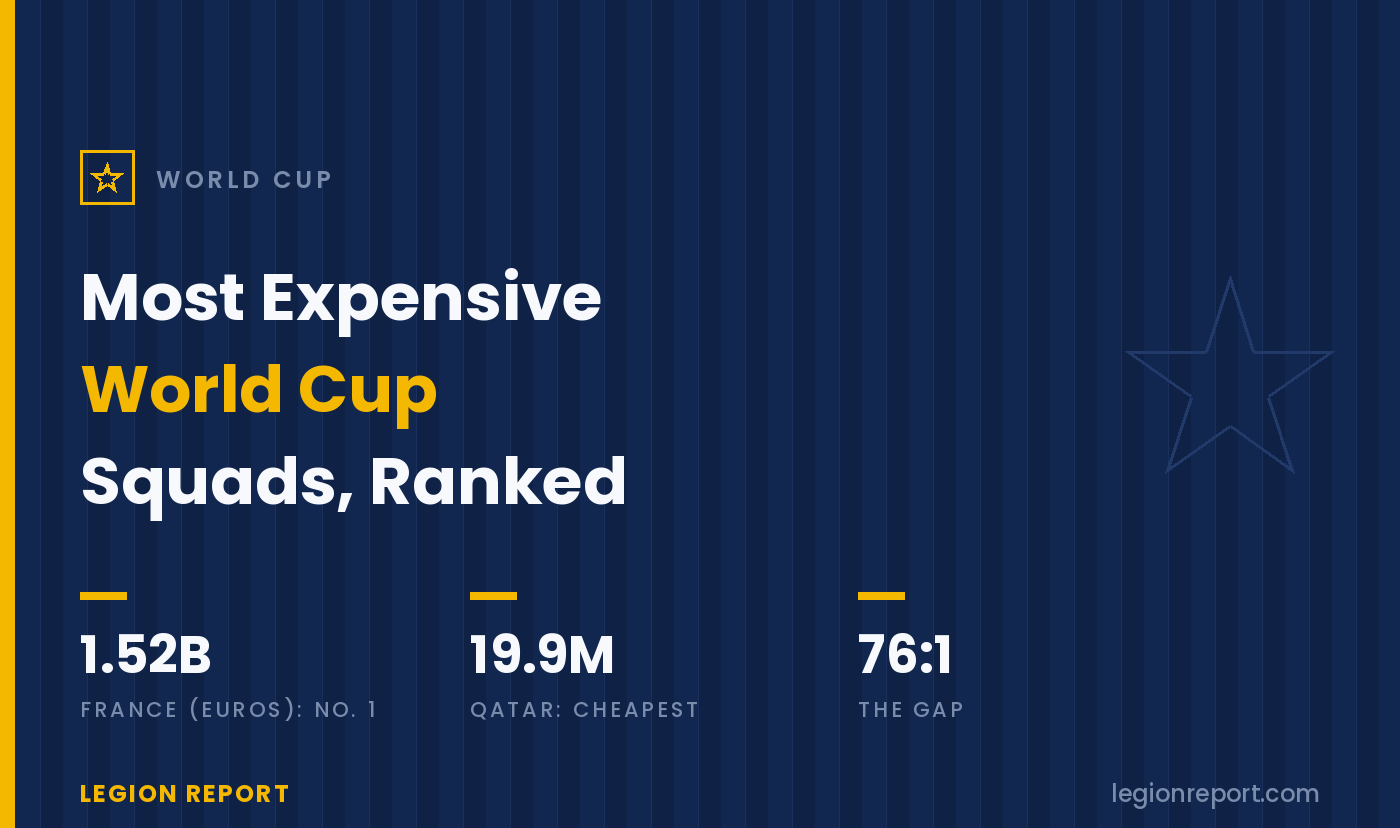

Which World Cup team has the most expensive roster? By the measure the soccer industry actually uses, it’s France, whose 2026 squad carries a combined market value of about 1.52 billion euros, more than the bottom two dozen squads at this tournament put together. At the other end sits Qatar, whose entire roster is valued at 19.9 million euros, less than a tenth of what a single French, Norwegian, or Spanish superstar is worth on his own. The gap between the richest and poorest rosters at this World Cup runs roughly 76 to one.
A note on what “expensive” means here, because it matters: players’ actual salaries are paid by their clubs, scattered across dozens of leagues that mostly don’t disclose wages, so no reliable ranking of squad salary totals exists anywhere. What the sport ranks instead is combined transfer market value, Transfermarkt’s estimate of what each player would cost to buy, which tracks star power and salary closely enough that it’s become the standard measure of roster wealth. That’s the ranking below, with a section on where the actual paychecks come from, and how absurd the biggest ones are.
The chart covers the full picture: the top 10 most valuable squads, the rest of the field with every landmark, the priciest individual players (and the shockingly cheap legends), how salaries actually work for World Cup players, and whether any of this money predicts winning. Take a look, then we’ll break it all down.
What “most expensive” actually measures
First, the honest accounting. There is no ranking of World Cup squads by actual salaries, because there can’t be: the 1,248 players at this tournament draw their wages from clubs across dozens of leagues, most of which never disclose contracts. What the industry ranks instead is combined transfer market value, Transfermarkt’s running estimate of what each player would cost to buy, and it works as a wealth proxy because transfer values and salaries travel together: the players clubs would pay the most to acquire are overwhelmingly the players clubs pay the most to keep. So when this article says France has the most expensive roster at the 2026 World Cup, it means the market prices those 26 players, collectively, at about 1.52 billion euros, a number built from Kylian Mbappe’s 180-million-plus valuation, fourteen additional teammates worth over 50 million each, and a “cheapest” player (N’Golo Kante, 4 million) who would rank among the most valuable men on a dozen other squads here.
The ranking’s shape: billionaires, the middle, and the 76-to-1 gap
The table has three distinct floors. At the top, four squads clear a billion euros, France (1.52B), England (1.36B, on Bellingham, Rice, and Saka), European champions Spain (1.22B, on the Yamal-Pedri axis), and Portugal (1.01B, carried not by Ronaldo but by PSG’s Vitinha and Joao Neves), with Germany, Brazil, Argentina, and the Netherlands filling out a top eight that towers over everyone. The fascinating middle belongs to the new money: Norway ninth at 590 million with roughly a third of it in Erling Haaland alone, and Ivory Coast eleventh at 522 million, the most valuable squad ever assembled from outside Europe and South America, ahead of Senegal, Turkiye, and Morocco. The United States sits seventeenth at 386 million, tops among the host confederation, led by Christian Pulisic and Folarin Balogun. Then the floor drops: fourteen squads are valued under 100 million total, down to Qatar’s 19.9 million, a 76-to-1 spread from top to bottom, and the tournament’s single starkest fact, eighteen individual players are each worth more than fourteen entire national teams.
The legend paradox, and where the real money is
The player valuations produce this World Cup’s best irony. The three most valuable footballers on Earth are all here, Haaland, Mbappe, and Lamine Yamal, each priced around the 200-million mark. Meanwhile Lionel Messi, arguably the tournament’s best player and its Golden Boot leader, is valued at roughly 15 million, 363rd among the 1,248 players present, and Cristiano Ronaldo at about 14 million, with only five of his own teammates priced lower. The explanation is that market value prices the future: a 39-year-old’s remaining sellable years approach zero regardless of his present genius. Salaries tell the opposite story, by reported club income, Ronaldo (a Saudi package reported north of 200 million a year) and Messi (a Miami deal reported around 60 million) are almost certainly the two best-paid men at the tournament, out-earning the youngsters “worth” fifteen times their transfer value. And the national teams themselves pay almost none of it: countries offer match fees and tournament bonuses funded by FIFA’s prize pool ($50 million to the champion federation), which is why a World Cup is, financially speaking, 1,248 employees on loan from their real jobs.
Does the expensive roster win?
The 2026 group stage ran the experiment in public. Germany’s 947-million-euro squad was eliminated by Paraguay. Qatar, the tournament’s cheapest team, took a point off Switzerland, a roster worth seventeen times more. Australia beat 474-million Turkiye; Brazil’s 928 million went out in the last sixteen. And yet: look at who keeps reaching the final weekends of World Cups, and the billion-euro shelf dominates, because value ultimately measures depth, the ability to lose a starter and replace him with another 60-million player, across seven matches in a month. The honest verdict is that money predicts the destination, not the route: squad value tells you who’ll probably be standing in the semifinals, while the group stage exists to prove, several times per tournament, that it guarantees nothing on any given afternoon. France’s 1.52 billion is the favorite’s price tag. Paraguay already showed what it costs to assume that settles anything.
Final Word
The most expensive rosters at the 2026 World Cup: France’s 1.52 billion euros leads England, Spain, and Portugal’s billion-plus squads, with Ivory Coast setting a non-European record at eleventh, the USA topping CONCACAF at seventeenth, and Qatar’s 19.9 million anchoring a 76-to-1 gap, all measured by market value, since true salary totals are unpublishable, and all carrying the tournament’s great footnote: the two highest-paid players here are the two legends the market calls cheap. The money picks the favorites. The matches, as Germany just learned, still get a vote.
It pairs with our other full-field ranking in World Cup countries by population, the rules governing who plays for whom in World Cup eligibility rules, and the marks these squads chase in World Cup records.