
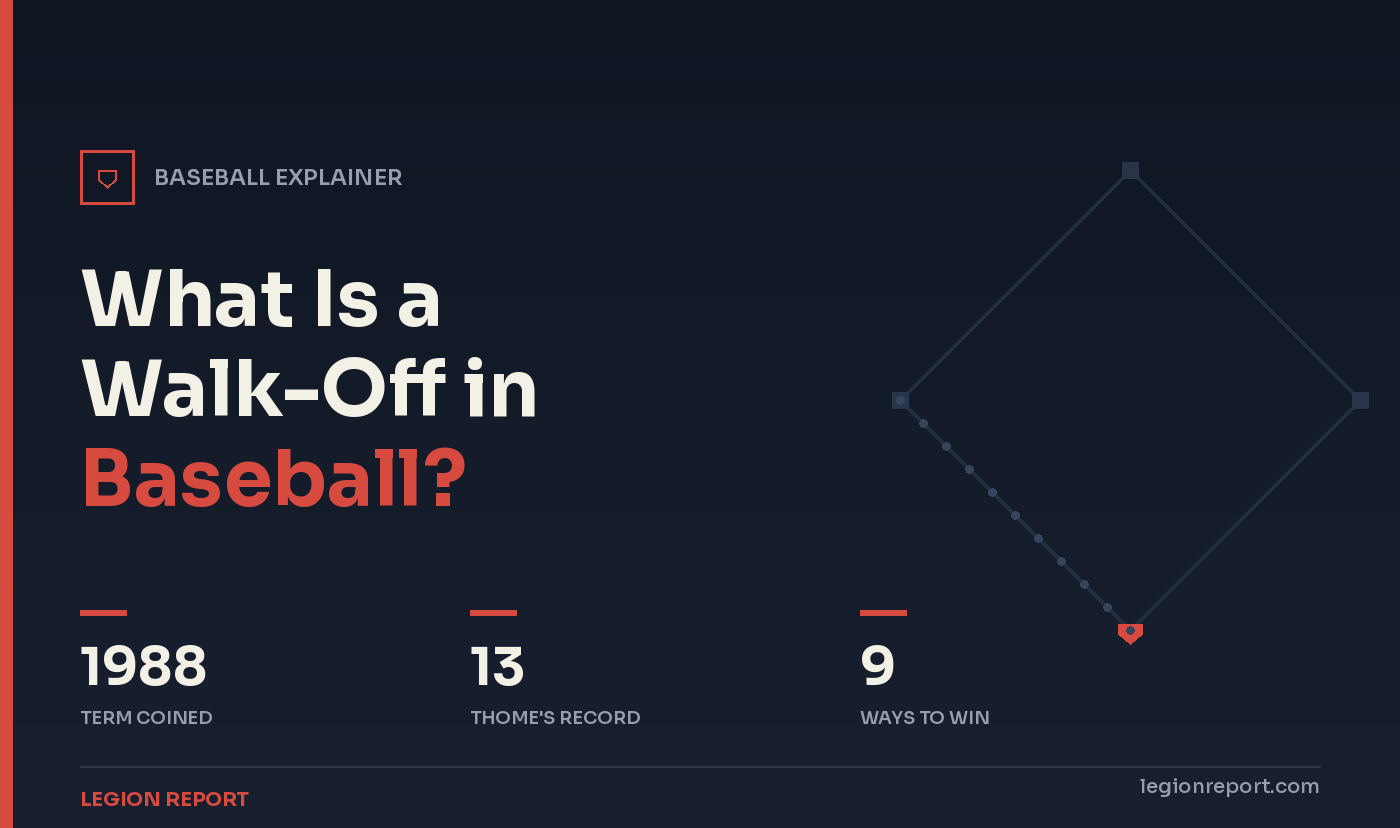

One of the best things about baseball is the sheer number of ways a game can end. A called third strike, a routine grounder, a diving catch in the gap, or, on the best nights, one swing that ends everything at once and sends the home crowd into the parking lot grinning. That last kind has a name you have surely heard a broadcaster shout: the walk-off.
The short version is simple. A walk-off is any play that scores the winning run for the home team in the bottom of the final inning, ending the game on the spot. The longer version is more fun, because a walk-off can happen in far more ways than most fans realize, and the term itself was born from an insult.
The chart below lays out every way a walk-off can happen, the famous ones that defined World Series history, and the records worth knowing. Take a look, then we’ll get into the stories behind it.
How a walk-off actually works
The mechanics are straightforward once you remember one rule: the home team always bats last. In every game, the visiting team hits in the top of each inning and the home team in the bottom. If the home team is tied or trailing when it comes to bat in the ninth, and it scores the run that puts it ahead, the game is over immediately. There is no need to finish the inning, because the visitors will not get another turn at the plate. That instant ending is what makes a walk-off so dramatic.
This is also why a road team can never record a walk-off. If the visitors take the lead in the top of the ninth, the home team still bats in the bottom half, so the game keeps going. A walk-off is, by definition, the home crowd’s reward for batting last, and it is the single most exciting way that batting order can pay off.
Far more than just a home run
When people picture a walk-off, they usually imagine a towering home run and a mob at home plate, but the home run is only one of many ways to do it. The most common walk-off is actually a humble single, where a runner already in scoring position trots home on a base hit to the outfield. From there the list runs through doubles, sacrifice flies, and bases-loaded walks, all the way down to the strange ones: a hit by pitch with the bases loaded, a wild pitch or passed ball that lets a runner dash home from third, or a fielding error that hands the winning run to the offense.
The walk-off walk is a personal favorite of trivia lovers precisely because it is so anticlimactic. With the bases loaded, ball four forces the runner on third across the plate, and a tense, hours-long game ends not with a swing but with a pitcher missing the strike zone by an inch. It is rare, a handful of times across an entire season leaguewide, which only makes it more memorable when it happens. The rarest finish of all is the walk-off grand slam, a bases-loaded home run that ends the game with one swing, and the single most spectacular version of that, an inside-the-park walk-off grand slam, has happened exactly once in MLB history.
Where the name came from
Here is the twist most fans do not know: the word “walk-off” started as an insult aimed at the pitcher, not a celebration of the hitter. It comes from Dennis Eckersley, the Hall of Fame Oakland closer known for inventing his own colorful baseball slang. He used the phrase “walkoff piece” to describe a game-ending home run, the kind a pitcher gives up before trudging off the mound with his head down. The term first appeared in print in 1988.
The irony is almost too perfect. That very same season, in Game 1 of the 1988 World Series, Eckersley himself surrendered one of the most famous walk-off home runs ever, a pinch-hit blast by an injured Kirk Gibson who could barely run the bases. Over the following years the phrase flipped its meaning entirely, shedding the pitcher’s shame and becoming a celebratory term for the hero who ends the game. By the early 2000s it was everywhere.
The walk-offs that made history
A short list of walk-offs sit among the most replayed moments in the sport. Bill Mazeroski’s home run in Game 7 of the 1960 World Series remains the only Game 7 ever ended by a walk-off homer, winning the title for the Pirates over a Yankees team that had outscored them badly across the series. Carlton Fisk’s 1975 shot off the Fenway foul pole, which he famously tried to wave fair, forced a Game 7 and became one of baseball’s defining images. Gibson’s 1988 limp around the bases gave the Dodgers a Game 1 they had no business winning.
Then there is Joe Carter, who in 1993 hit a three-run homer to win the World Series outright for the Blue Jays, one of only two times a championship has ended on a walk-off home run. And in 2001, Luis Gonzalez ended an unforgettable Game 7 with a soft single off the great Mariano Rivera, giving the Diamondbacks their first title. None of these were the same kind of play, which is exactly the point: the walk-off comes in many forms, and each great one has its own character.
The records worth knowing
If you want the numbers, a few stand out. Jim Thome holds the career record with 13 walk-off home runs, a fitting crown for a gentle giant who made a habit of ending games, and he sits just ahead of an elite group, Babe Ruth, Jimmie Foxx, Mickey Mantle, Stan Musial, and Frank Robinson, all tied at 12. For a single season, the 1959 Pirates piled up 18 walk-off wins, the most ever, which is remarkable for a team that barely finished above .500.
And for the rarest feat of all, Roberto Clemente owns a record that may never be matched: the only inside-the-park walk-off grand slam in major league history, hit in 1956 when he blew through a stop sign at third base and never slowed down. It is the kind of once-in-a-century play that captures why walk-offs are baseball’s great equalizer, any game, any player, any kind of contact can suddenly end it all.
Final Word
A walk-off is the purest version of baseball’s promise that any game can turn on a single moment. It can arrive as a 450-foot home run or as a checked-swing single, as a bases-loaded walk or as a ball squirting past the catcher, and in every case the result is the same: the home team wins, the game ends instantly, and a stadium erupts. That variety is the whole charm. You never quite know which form it will take until it happens.
So the next time you are watching a tight game head into the bottom of the ninth, pay attention to who is batting and who is on base. If it is the home team and they have a runner in scoring position, you are one swing, one wild pitch, or one walk away from seeing baseball’s best ending in person. If you want to keep learning the language of the game, our guide to the position numbers in baseball is a good next stop.