

Newcomers to soccer often hit the same confusing moment: a World Cup game ends 0-0 or 1-1, nobody wins, and the broadcast moves on as if that is perfectly normal. Coming from sports where every game has a winner, it can be baffling. So what actually happens when a World Cup match ends in a draw, and does it work differently in the group stage versus the knockout rounds?
The answer depends entirely on which stage of the tournament you are in, and once you understand the split, the whole format clicks into place. Here is exactly how draws work at the World Cup.
The chart below breaks down what a draw means in each stage of the World Cup. Take a look, then we’ll explain each part.
The Key Distinction: Group Stage vs Knockouts
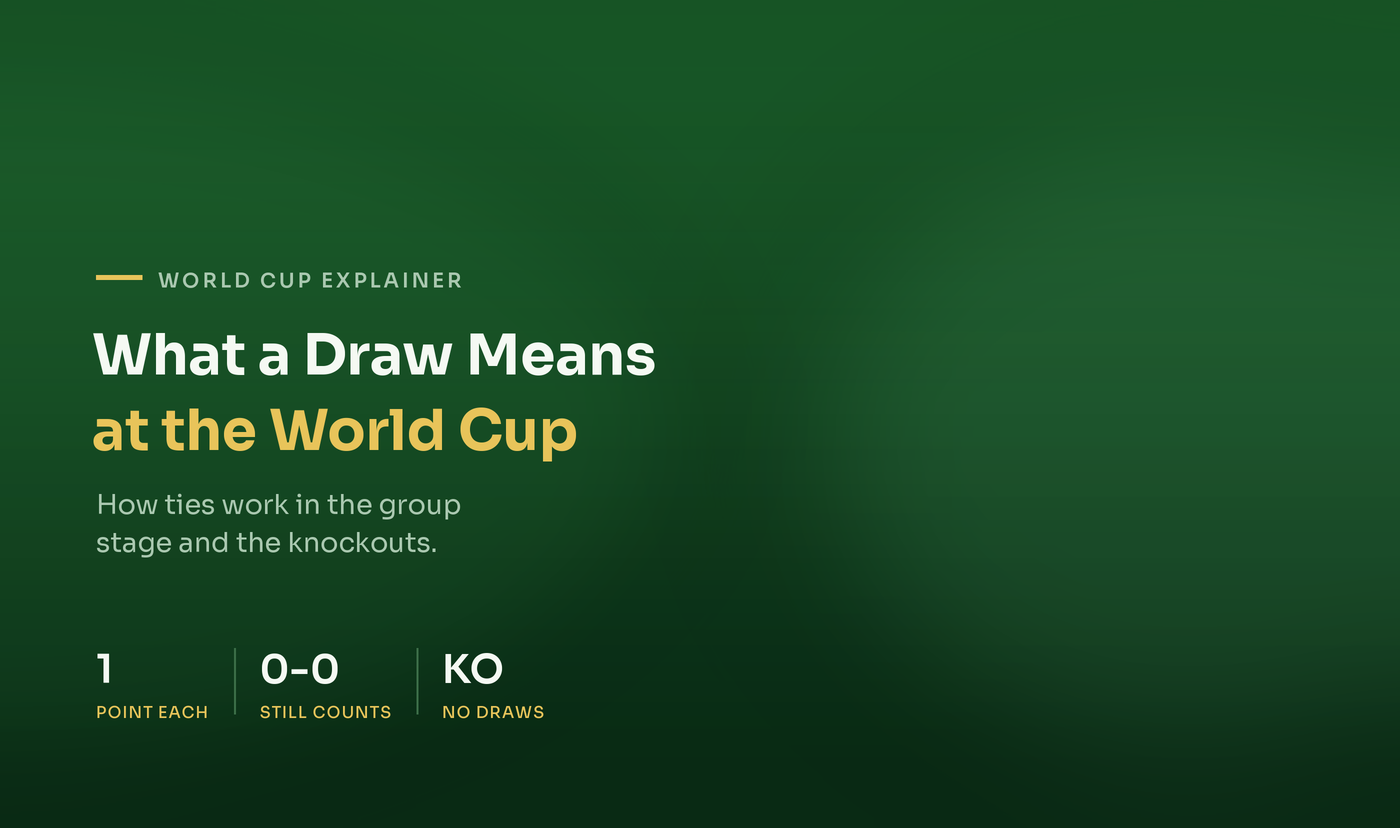
The single most important thing to understand is that draws work completely differently depending on the stage. In the group stage, a draw is a perfectly valid result: the match simply ends level, and each team takes one point. In the knockout stage, a draw cannot stand, because the tournament needs one team to advance and one to go home. So a tied knockout game keeps going, into extra time and, if necessary, a penalty shootout, until a winner emerges. Once you grasp this split, the whole World Cup format suddenly makes sense.
What a Draw Means in the Group Stage
During the group stage, each team plays three games and earns points: three for a win, one for a draw, and none for a loss. When a group game ends in a tie, both teams walk away with a single point added to their tally, and that is the end of it, no extra time, no shootout. Those points are then used to rank the four teams in each group. A draw might seem unsatisfying, but it can be hugely valuable. For an underdog facing a powerhouse, holding on for a 1-1 or 0-0 draw earns a precious point and is often celebrated like a victory. Two draws can even be enough to send a team through.
What Happens to a Draw in the Knockouts
Once the tournament reaches the knockout rounds, draws are no longer allowed, because the bracket requires a winner to advance. If a knockout match is level after 90 minutes, it goes to extra time: two 15-minute halves, played in full. Whichever team is ahead after those 30 extra minutes wins. If the score is still level after extra time, the match is decided by a penalty shootout, with each team taking five penalty kicks, and sudden death after that if needed. This is how dramatic finishes like Argentina’s 2022 final win over France on penalties come about. The knockout stage guarantees a winner every time.
Why Draws Can Be So Valuable
Because group standings come down to points, a draw is often a smart and meaningful result rather than a disappointment. A point from a draw keeps a team’s hopes alive and can be decisive in a tight group. The 2026 World Cup offered a perfect example: Curaçao, the smallest nation ever to reach the finals, earned its first-ever World Cup point with a hard-fought 0-0 draw against Ecuador, a result the whole island celebrated. Draws also interact with goal difference, the main tiebreaker, so teams sometimes weigh whether to push for a winner or protect a valuable point. If you want the full picture of how points decide who advances, see our guide to World Cup standings and tiebreakers.
Common Questions About World Cup Draws
A few questions come up again and again. Can the World Cup final end in a draw? No, the final is a knockout game, so if it is level after 90 minutes it goes to extra time and then penalties. Is a 0-0 draw worth anything? Yes, in the group stage it earns each team one point. Why does soccer allow draws when other sports do not? Because the group stage is essentially a mini-league, and leagues around the world use points over multiple games to rank teams, with draws as a normal outcome. The knockout rounds, by contrast, are a straight bracket, which is why they cannot end level. Understanding that two-part structure, league then bracket, is the key to the whole thing.
The Bottom Line
What happens when a World Cup game ends in a draw depends entirely on the stage. In the group stage, a draw is allowed and earns each team one point, which can be enough to advance and is often a triumph for an underdog. In the knockout rounds, draws are impossible: a tied game goes to extra time and then a penalty shootout until someone wins. That blend of a points-based group league and a winner-takes-all knockout bracket is exactly what gives the World Cup its drama, where a single point or a single penalty can change everything.