
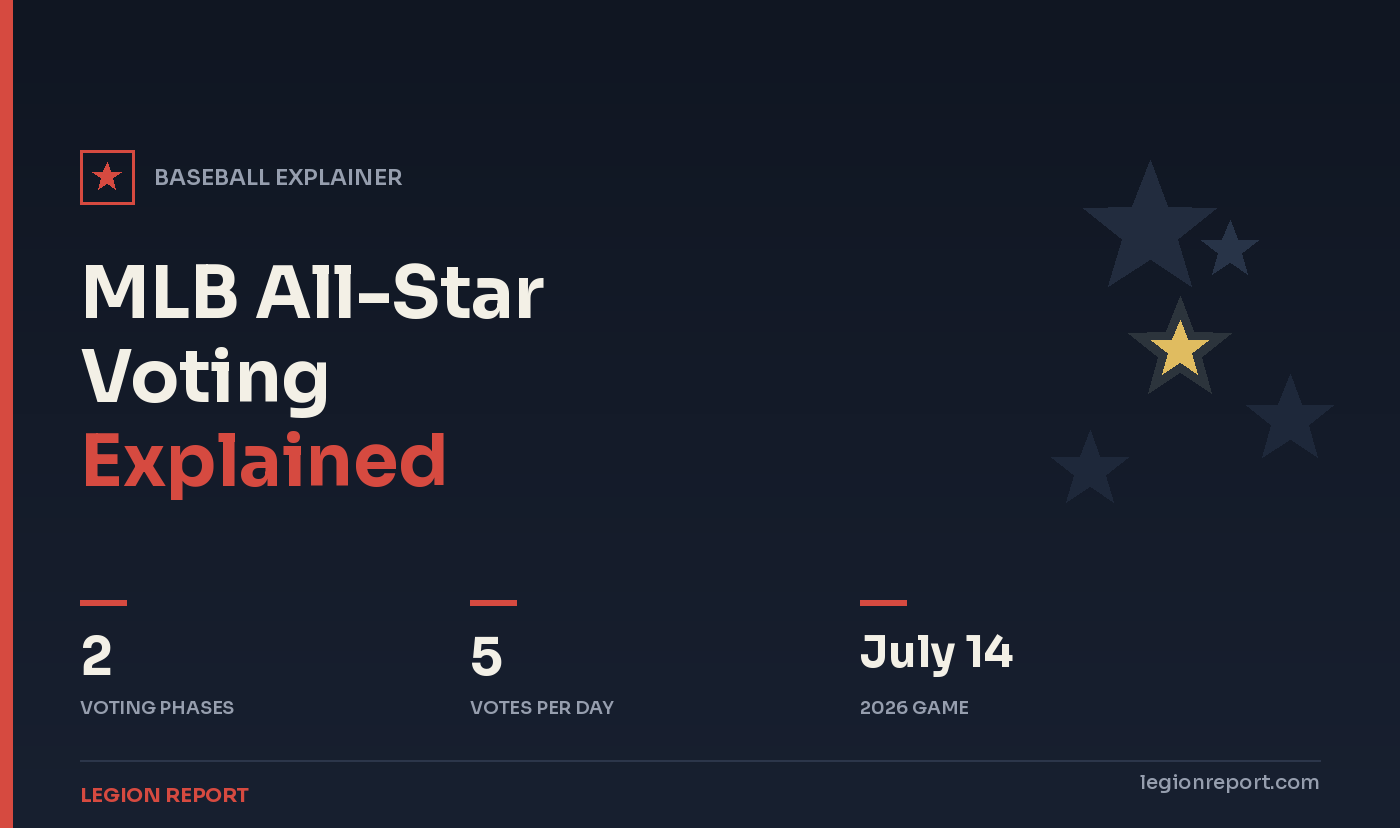

Understanding how it works matters, because the All-Star vote regularly produces drama: ballot-box stuffing by passionate fan bases, surprise snubs of deserving players, and down-to-the-wire finishes for the final starting spots. The 2026 race is already heating up, with Shohei Ohtani and Ernie Clement leading their leagues heading into the decisive phase.
The chart below breaks down how the two-phase system works, who gets to vote, and how the rest of the roster is filled. Take a look, then we’ll get into the details.
The two-phase system, explained
Before 2022, All-Star voting was a single marathon: fans voted over several weeks and the top vote-getter at each position simply started. The problem was that early leaders, often from big markets with passionate fan bases, could build insurmountable leads that smaller-market stars could never overcome. So MLB split the vote into two phases to keep the race competitive down the stretch.
In Phase 1, fans vote across all the candidates at every position to narrow the field. Then Phase 1 resets the race: the top two vote-getters at each position (and the top six outfielders) advance to Phase 2 as “finalists,” and the slate is wiped clean. In Phase 2, fans choose only among those finalists, and the winners become the starters. This reset gives every finalist a fresh shot, preventing a runaway early lead from deciding everything.
The automatic starter twist
There is one important shortcut built into the system. Since 2022, the single leading overall vote-getter in each league, the player with the most total votes across all positions, automatically earns a starting spot and skips Phase 2 entirely. It is a reward for being the most popular player in the league that year. In 2026, that distinction went to Shohei Ohtani in the National League and Ernie Clement in the American League, both of whom locked up their starting spots in Phase 1.
This rule recognizes that the most-voted player has clearly earned their place and removes any suspense about whether they will start. For everyone else, though, the road runs through Phase 2, where the finalists compete head-to-head for the fans’ final say. When an outfielder is the league’s top overall vote-getter, only the next four outfielders advance to fill the remaining two starting spots.
Who fans actually pick, and who they don’t
It is a common misconception that fans vote for the entire All-Star roster. In reality, the fan vote only decides the starting position players, the eight or nine names in each league’s starting lineup. Everyone else, the pitchers and the reserves who fill out the rest of the squad, is selected through a combination of a player vote and the Commissioner’s Office. This split exists because pitching and bench value are harder for casual fans to judge than star power.
There is also a key constraint that shapes the whole roster: every one of the 30 MLB teams must have at least one All-Star representative. This “every team” rule sometimes forces a deserving star off a stacked roster to make room for the best player on a weaker team, which is a frequent source of debate when the rosters are announced. It is meant to keep every fan base invested in the game.
How to vote, and the ballot-stuffing history
Voting happens online at MLB.com and through the MLB app, with fans allowed to cast up to five votes per day during Phase 1. That daily allowance, multiplied across a passionate fan base, is how teams can rocket their players up the leaderboard, and it has a controversial history. The most infamous case came in 1957, when Cincinnati fans stuffed the ballot so aggressively that they voted in seven of the eight National League starters, prompting the league to temporarily take the vote away from fans entirely.
Today’s digital system has guardrails, but organized fan campaigns still drive big swings, as seen in recent years with the passionate voting blocs behind teams like the Toronto Blue Jays. The two-phase format helps balance this, since the Phase 2 reset means a coordinated early push cannot single-handedly lock up a spot. Fan passion is the point, but the system is designed to keep it from completely overwhelming merit.
Final Word
MLB’s All-Star voting is a two-phase system built to balance fan enthusiasm with fairness: Phase 1 narrows the field and crowns each league’s automatic starter, while Phase 2 lets fans choose the rest of the starting lineup from the finalists. The pitchers and reserves come from player and league votes, and the every-team rule guarantees all 30 clubs are represented.
So as the 2026 vote builds toward the July 14 game in Philadelphia, you will know exactly what is happening: who locked up an auto-start, who has to survive Phase 2, and why your favorite snubbed star might still make it as a reserve. The fan vote is one of the best traditions in baseball, a rare chance to shape the game itself. For more on the event it feeds, see our list of MLB All-Star Game winners by year.