
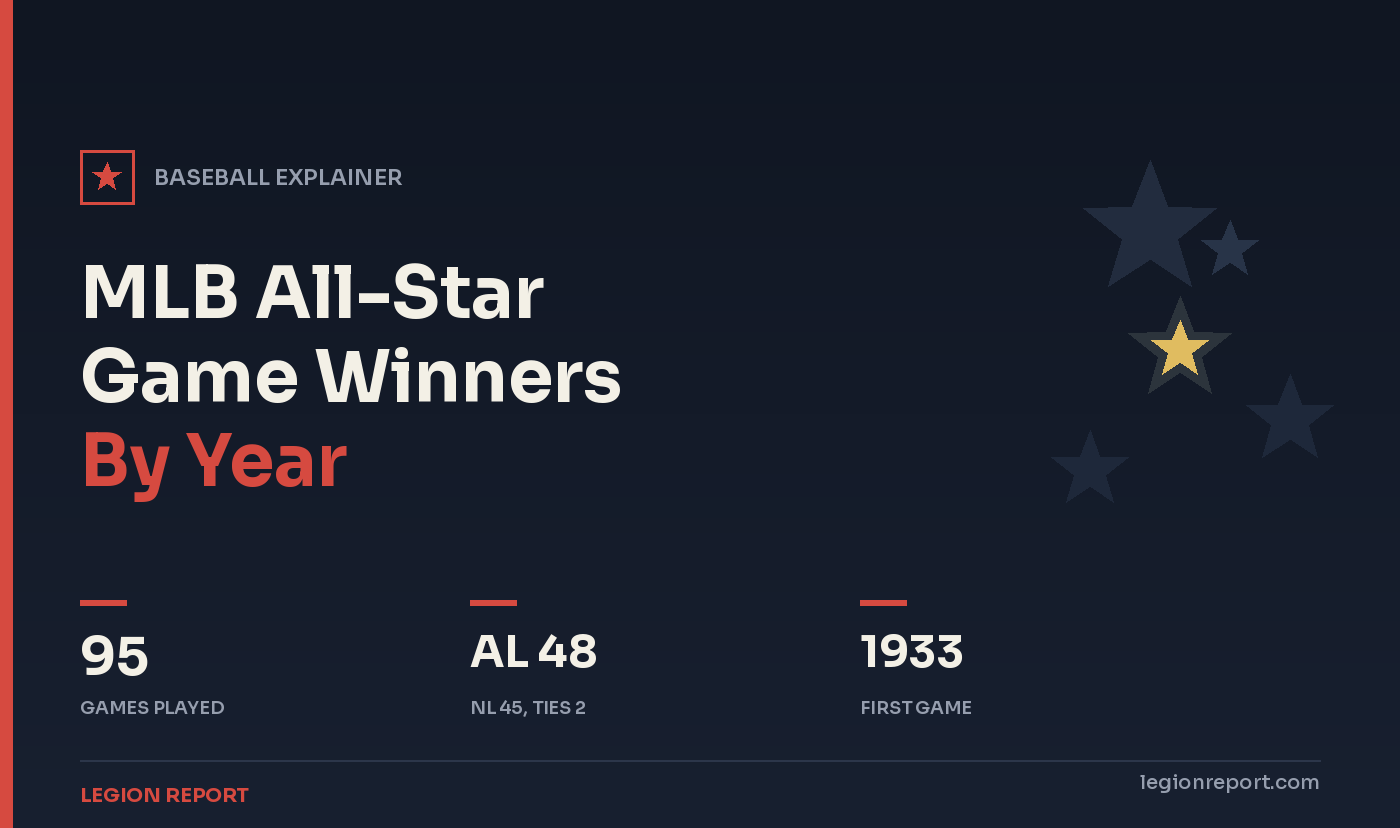

Every July, the best players in baseball gather for one night to settle an old argument: which league is better, the American or the National? The All-Star Game has been asking that question since 1933, and across more than nine decades the answer has swung back and forth in long, dramatic streaks. The series is remarkably close, but the two leagues have taken turns dominating for entire eras.
The American League holds the all-time edge, but it has not always been that way. The National League once won 19 of 20 games across the 1960s and 70s, only for the AL to roar back and dominate the modern era. Mixed in are some of baseball’s most memorable moments, from a 15-inning marathon to a tie that ended in controversy to the first-ever “swing-off” finish in 2025.
The chart below lists the All-Star Game winner for every recent year, the all-time series record, and the milestones worth knowing. Take a look, then we’ll get into the history.
A series defined by long streaks
What makes the All-Star Game rivalry fascinating is how lopsided it has been in stretches, even though the overall record is nearly even. The American League jumped out early, winning 12 of the first 16 games from 1933 to 1949. Then the pendulum swung hard the other way: from 1950 to 1987, the National League went 33-8-1, including an astonishing run from 1963 to 1982 when the NL won 19 of 20 games. For an entire generation of fans, the National League simply owned the Midsummer Classic.
Then it flipped again. Since 1988, the American League has dominated, going 28-8-1, which included a 13-game unbeaten streak from 1997 to 2009. That modern AL surge is what pushed the all-time series back into the American League’s favor, and in 2018 the AL took its first overall lead in the series since 1963. The result is a rivalry that is statistically close, 48 wins to 45, but that has rarely felt close in any given era.
The moments that became legend
The All-Star Game has produced some unforgettable theater. The 2008 game at Yankee Stadium stretched to 15 innings and 4 hours and 50 minutes, the longest by time in history, tying the 1967 game for the most innings. Both leagues nearly ran out of pitchers, and the American League finally won in walk-off fashion. It remains the gold standard for All-Star drama.
The most recent twist came in 2025, when the game ended 6-6 and was decided by a first-ever “swing-off,” a home run derby-style tiebreaker. The National League won it, and Philadelphia’s Kyle Schwarber, who launched the decisive homers, took MVP honors. It was a fitting bit of foreshadowing, since Philadelphia hosts the 2026 game at Citizens Bank Park.
The tie that changed everything
Not every All-Star Game has a winner. The game has ended in a tie twice, in 1961 and most famously in 2002, when both teams ran out of available pitchers after 11 innings and the game was called 7-7. The 2002 tie, played in Milwaukee in front of commissioner Bud Selig’s home crowd, was so unpopular that it led to a controversial rule change: for more than a decade afterward, the league that won the All-Star Game earned home-field advantage in the World Series, an attempt to make the exhibition “count.”
That rule was finally dropped in 2017, returning the All-Star Game to a pure exhibition. The 2025 swing-off format is the latest attempt to guarantee a clean finish without exhausting pitching staffs, a modern solution to the same problem that produced the infamous 2002 tie.
The MVP tradition
The All-Star Game MVP award has been handed out since 1962, when Maury Wills of the Dodgers won the first one. Since then it has gone to a who’s who of baseball greats, with Mike Trout becoming the first player to win it in back-to-back years, in 2014 and 2015. The award is a snapshot of a single brilliant night, and it has rewarded everyone from legends like Mariano Rivera and Cal Ripken Jr. to surprise names who seized their one moment on the big stage.
For pitchers, the All-Star MVP is rare and special, since position players usually dominate the voting. Rivera’s 2013 award was a sentimental favorite, given to the greatest closer of all time in his final All-Star appearance. These individual honors are part of what keeps the game meaningful even as an exhibition.
Final Word
The MLB All-Star Game is one of the oldest and most evenly matched rivalries in sports, with the American League holding a narrow 48-45-2 edge over the National League through 95 games. But the overall record hides the real story: this is a series of long, dramatic eras, the AL’s early dominance, the NL’s two-decade reign, and the AL’s modern resurgence, each lasting a generation.
As the leagues prepare to meet again in Philadelphia in 2026, the National League will be looking to build on its 2025 swing-off win, while the American League defends its all-time lead. Whoever wins, the game will add another chapter to a rivalry that has been going strong since 1933. For more on baseball’s biggest stage, see our list of College World Series winners by year.