

Sports agents occupy one of the most misunderstood jobs in the industry. Pop culture, from “Jerry Maguire” to “Ballers,” paints them as fast-talking dealmakers raking in fortunes, and at the very top, that is true. But for most agents, the reality is far more modest and far more variable, because a sports agent’s income is almost entirely commission-based. They do not earn a salary so much as a percentage of the deals they negotiate.
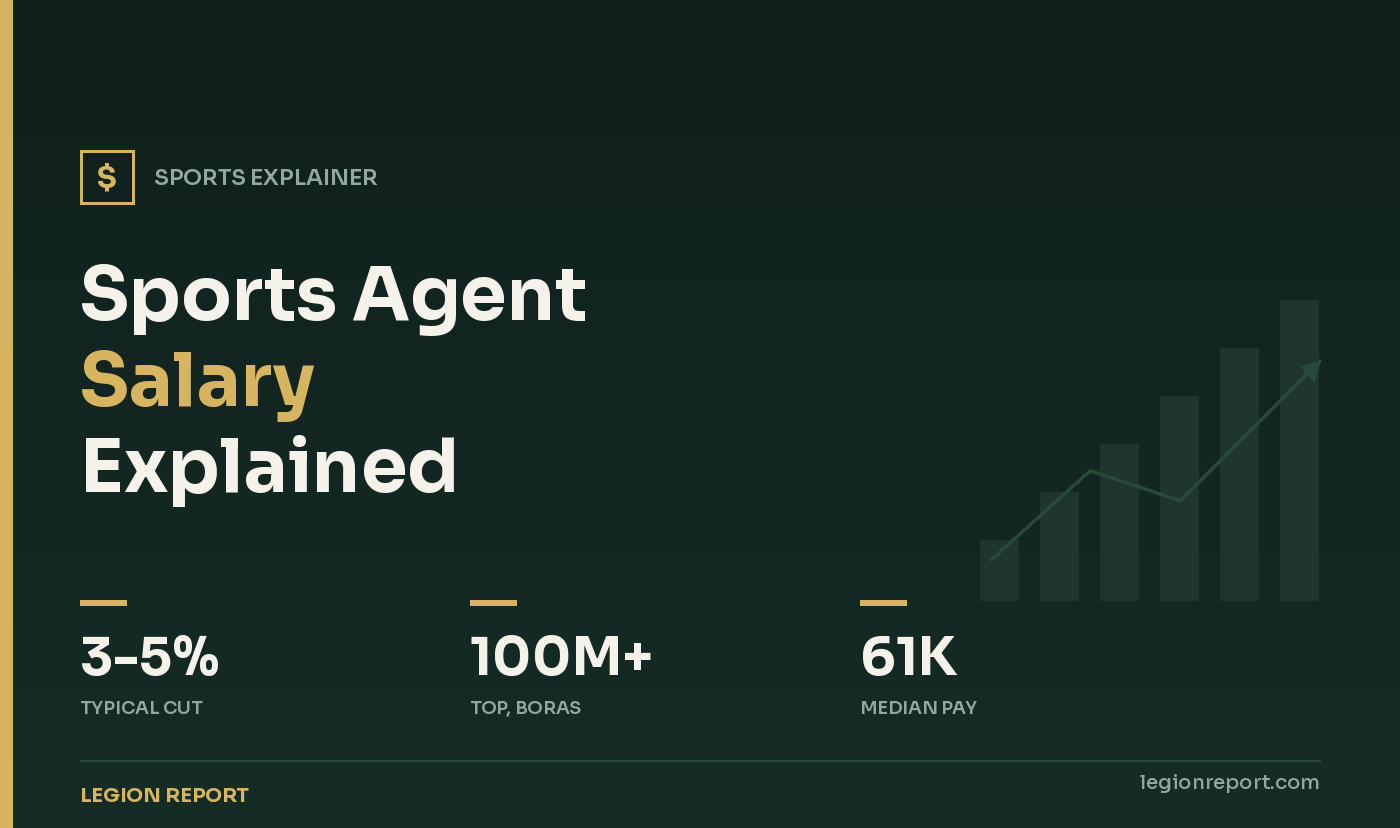
That structure makes the range enormous. A struggling new agent might earn close to nothing in their first years, while a super-agent like Scott Boras reportedly pulls in over $100 million annually. The key to understanding agent pay is the commission system, the percentage cut they take, which is tightly regulated and differs by league. That single number, applied to contracts worth millions, is where all the money comes from.
The chart below breaks down the commission caps by league, what agents typically earn, and how a single big contract translates into a payday. Take a look, then we’ll get into the details.
How sports agents actually get paid
The single most important thing to understand about sports agent pay is that it is commission-based. Agents do not collect a fixed salary tied to their own performance; instead, they earn a percentage of the contracts and deals they negotiate for their clients. When a player signs, the agent takes their cut; when the player earns an endorsement, the agent takes a piece of that too. This means an agent’s income rises and falls entirely with the success and earnings of the athletes they represent.
That structure explains why there is no meaningful “average salary” in the traditional sense. Estimates put the median somewhere around $61,000, and the Bureau of Labor Statistics lists all sports and entertainment agents around $116,000, but those figures blur together struggling newcomers and multimillionaire super-agents. The real story is in the commission rates and the caliber of clients, which is where the enormous spread comes from.
The commission caps that shape everything
Each major league’s players’ association sets a maximum commission an agent can charge on playing contracts, and these caps directly shape how much agents can earn. The NFL has the lowest cap at 3 percent, the NBA caps fees at 4 percent (though 3 percent is common for established players, and rookie deals can go higher), and the NHL sits around 4 to 5 percent. Major League Baseball is the outlier with no union-mandated cap, though the industry standard lands at 4 to 5 percent.
These caps matter enormously because they apply to contracts worth tens or hundreds of millions of dollars. A low percentage of a massive number is still a fortune. And critically, the caps apply only to playing contracts, endorsement and marketing deals are negotiated separately and command much higher rates, often around 10 percent and sometimes up to 20 percent, with no cap. For marketable stars, that endorsement income can be where an agent makes the most.
What a single contract is worth to an agent
The math reveals why landing one elite client can be life-changing. Consider a $300 million MLB free-agent deal: even at a 4 percent commission, that is $12 million for the agent, typically paid out over the life of the contract rather than all at once. A $220 million NBA max contract at 4 percent yields roughly $8.8 million. In the NFL, a $20 million deal at the 3 percent cap pays the agent $600,000.
Contrast that with the bottom of the market. An NFL rookie on the league minimum of around $1 million, on a non-guaranteed contract, generates only about $30,000 in commission for the agent at 3 percent. This is the central truth of the profession: a handful of marquee clients can be worth far more than a large roster of minimum-salary players, which is why agents compete so fiercely to recruit and retain top talent.
From struggling newcomers to super-agents
The career arc of a sports agent is steep and unforgiving. Entry-level agents, those in their first few years without established clients, often earn between $0 and $35,000 from commissions alone, and many supplement their income with a day job or by working as a salaried associate at an agency for $35,000 to $60,000. Building a client roster takes years of networking, recruiting, and trust-building before the commissions become meaningful.
Those who break through can earn very well: an established agent with a solid mid-tier roster might make $80,000 to $250,000, and the top 5 to 10 percent of the profession, those representing genuine stars, clear $1 million or more annually. At the very summit sit the super-agents. Drew Rosenhaus has negotiated billions in NFL contracts and reportedly earns around $30 million a year, while baseball’s Scott Boras, famous for record-shattering deals, is reported to earn over $100 million annually from his large client portfolio.
Final Word
Sports agent pay is a story of extremes. Because income is almost entirely commission-based, typically 3 to 5 percent of a client’s contract, the difference between a new agent earning nothing and a super-agent earning nine figures is wider than in almost any other profession. The commission caps (NFL 3%, NBA 4%, MLB uncapped) set the ceiling, but it is the quality of an agent’s clients that determines whether they scrape by or strike it rich.
For the lucky and talented few who land marquee athletes, the rewards are staggering, but for most, it is a grind of long hours and modest pay built on the hope of one breakthrough client. It is a high-risk, high-reward profession where you only eat what you kill. For more on sports-world pay, see our breakdown of MLB general manager salaries.