

If you have watched a soccer match or listened to any commentary, you have almost certainly heard the phrase “clean sheet.” Pundits praise goalkeepers for keeping one, managers build entire game plans around earning one, and fans celebrate them. But what exactly is a clean sheet, where did the strange name come from, and why does it matter so much? The concept is simple, but the story behind it is more interesting than you might expect.
In short, a clean sheet is when a team gets through an entire match without conceding a single goal. It is one of the clearest signs of defensive strength, and while the goalkeeper usually gets the credit, it is truly a team-wide achievement. With the 2026 World Cup putting soccer in front of a huge new audience, plenty of people are hearing the term for the first time and wondering what all the fuss is about.
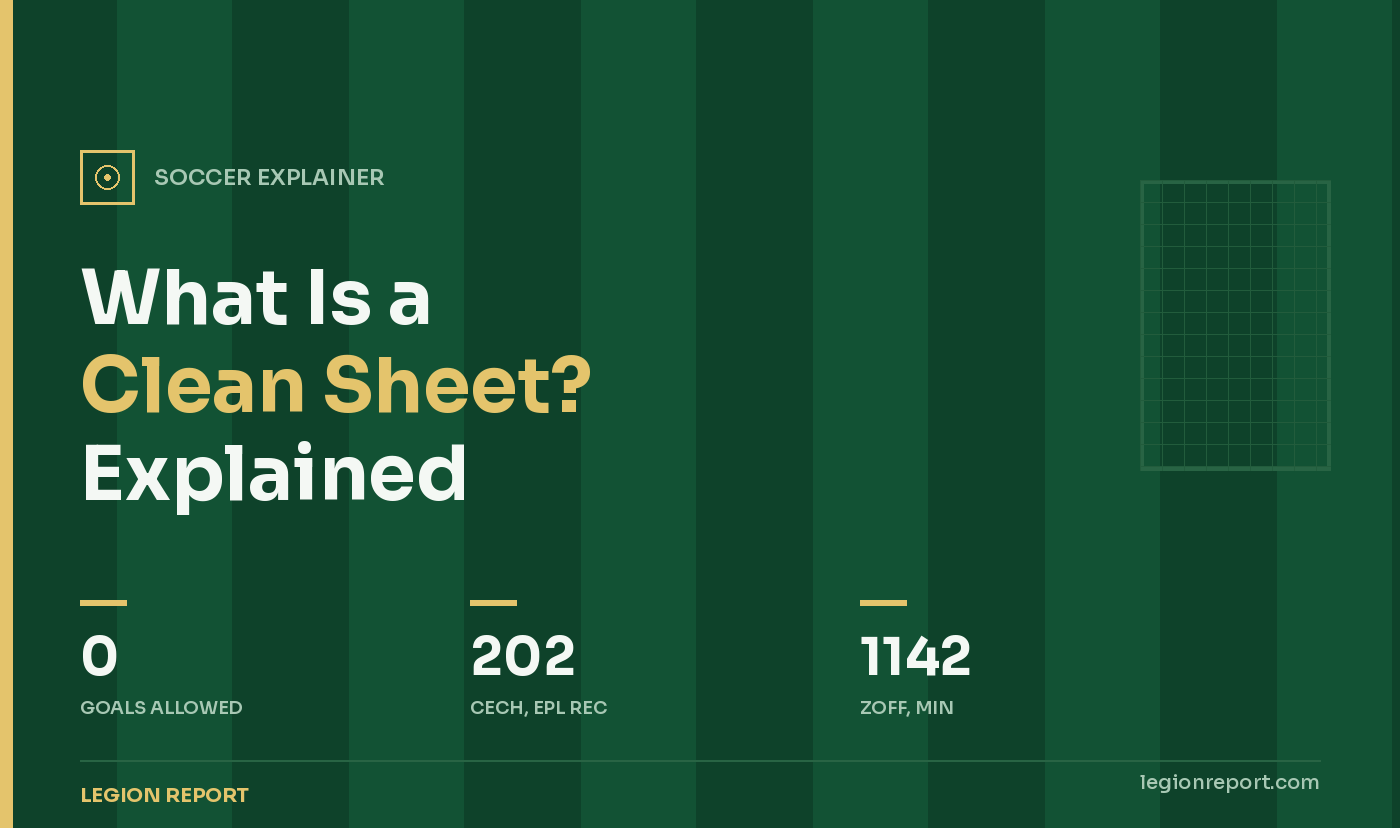
The chart below breaks down exactly what a clean sheet is, where the name comes from, how it differs from a “shutout,” and the all-time record holders. Take a look, then we’ll get into the details.
What a clean sheet actually is
A clean sheet in soccer is simply a match in which a team does not concede a single goal. If your team wins 2-0 or even draws 0-0, you have kept a clean sheet. The moment the opposition scores, even a deflected goal in stoppage time, the clean sheet is gone for that match. It is one of the most fundamental measures of defensive performance in the sport, valued because in a low-scoring game like soccer, keeping the other team off the scoreboard is half the battle.
One detail that surprises newcomers is that both teams can keep a clean sheet in the same match. If a game finishes 0-0, neither side conceded, so both are credited with a clean sheet. To American sports fans used to high-scoring games, a 0-0 result can seem dull, but in soccer it often reflects two well-organized defenses canceling each other out, and it is a perfectly common and respectable outcome.
Where the strange name comes from
The term “clean sheet” sounds odd until you know its origin, which dates back to the early days of the sport. Before computers and electronic scoreboards, match reporters and scorekeepers recorded all the details of a game by hand on sheets of paper: the goals, the scorers, the cards, and more. If a team conceded no goals, its side of the scoresheet was left completely blank, or “clean.” From that simple practice, the phrase “clean sheet” was born, and it stuck.
The term originated in England, the birthplace of modern soccer, and has since spread to become universal football language used across leagues and countries worldwide. Even today, at amateur levels where a referee may still track the score in a paper notebook, the phrase retains some of its literal meaning. It is a charming reminder of the game’s pre-digital roots that has outlived the technology that created it.
Clean sheet versus shutout
If you follow North American sports, you may know this concept by a different name: a “shutout.” The two terms mean exactly the same thing, keeping the opponent from scoring, but the vocabulary differs by region. “Clean sheet” is standard across Europe, South America, Africa, and Asia, while “shutout” is more common in the United States and Canada, where it is also used in hockey and baseball. So when an American broadcaster says a goalkeeper recorded a shutout, they mean precisely what the rest of the world calls a clean sheet.
This is one of many small vocabulary differences between American soccer coverage and the global game, alongside “field” versus “pitch” or “game” versus “match.” As soccer’s popularity grows in the United States, especially with the 2026 World Cup being co-hosted there, the term “clean sheet” is becoming more widely used by American fans and commentators too.
A team effort credited to one player
Statistically, the clean sheet is almost always credited to the goalkeeper, and goalkeepers are judged heavily on how many they keep. But in reality, a clean sheet is a collective achievement that depends on the entire team’s defending. The back line of defenders, the defensive midfielders shielding them, and even forwards who track back all contribute to keeping the ball out of the net. A goalkeeper can make ten brilliant saves, but if the defense is disorganized, the clean sheet rarely survives.
That is why the most prolific clean sheet keepers tend to play for the best-drilled, most disciplined teams. The recognition still flows mainly to the goalkeeper, though: at the end of many competitions, the keeper with the most clean sheets receives the Golden Glove award. It mirrors how attackers are judged by goals and assists, defenders and keepers are judged, in large part, by clean sheets.
The record holders
Some goalkeepers have built legendary careers on their ability to keep clean sheets. In the English Premier League, Petr Cech holds the all-time record with 202 clean sheets across his career with Chelsea and Arsenal, a mark well ahead of any rival. Across his entire career in all competitions, Italy’s Gianluigi Buffon is reported to have kept over 500 clean sheets, the most of any goalkeeper, including 77 for the Italian national team.
Perhaps the most remarkable record belongs to another Italian, Dino Zoff, who went 1,142 consecutive minutes without conceding a goal in international play during the early 1970s, a world record that helped power Italy to its 1982 World Cup triumph. In Major League Soccer, Nick Rimando set the standard with 167 clean sheets over a twenty-year career. These marks are benchmarks of goalkeeping greatness, the defensive equivalent of a striker’s all-time goal records.
Why clean sheets matter so much
Beyond the statistics, clean sheets carry real competitive weight. The simplest reason is mathematical: if you do not concede, you cannot lose, the worst possible result is a 0-0 draw. That defensive guarantee is the foundation of many successful teams, and entire eras have been built on it, like the famous Italian “Catenaccio” style of the 1960s and 70s that prioritized airtight defending above all else.
Clean sheets are especially decisive in knockout competitions like the World Cup or Champions League, where a single goal can end a team’s tournament. A clean sheet in a knockout tie guarantees you will not be eliminated in regulation, which is why defensively solid teams so often go deep in these events. They also provide a psychological edge, boosting a team’s confidence while frustrating and demoralizing opponents. For all these reasons, the humble clean sheet remains one of the most prized achievements in the sport.
Final Word
A clean sheet is soccer’s term for a match in which a team concedes no goals, a simple idea with a charming origin in the blank paper scoresheets of the sport’s early days. Known as a “shutout” in North America, it is credited to the goalkeeper but earned by the whole team, and it remains one of the clearest measures of defensive quality in the game. Legends like Petr Cech, Gianluigi Buffon, and Dino Zoff built their reputations on keeping them.
The next time you hear a commentator praise a team for “keeping a clean sheet,” you will know exactly what it means and why it is such a valued feat. For more on the game’s rules and terminology, see our explainer on the offside rule.