

No name carries more weight in the baseball card hobby than Mickey Mantle. Alongside the T206 Honus Wagner, Mantle’s cards are the cornerstone of the entire collecting world, and for good reason: he was the most popular player of the post-war “Golden Age” of card collecting, a switch-hitting Yankees icon with 536 home runs, three MVP awards, a Triple Crown, and seven World Series titles. His cardboard sets the tone for the whole vintage market.
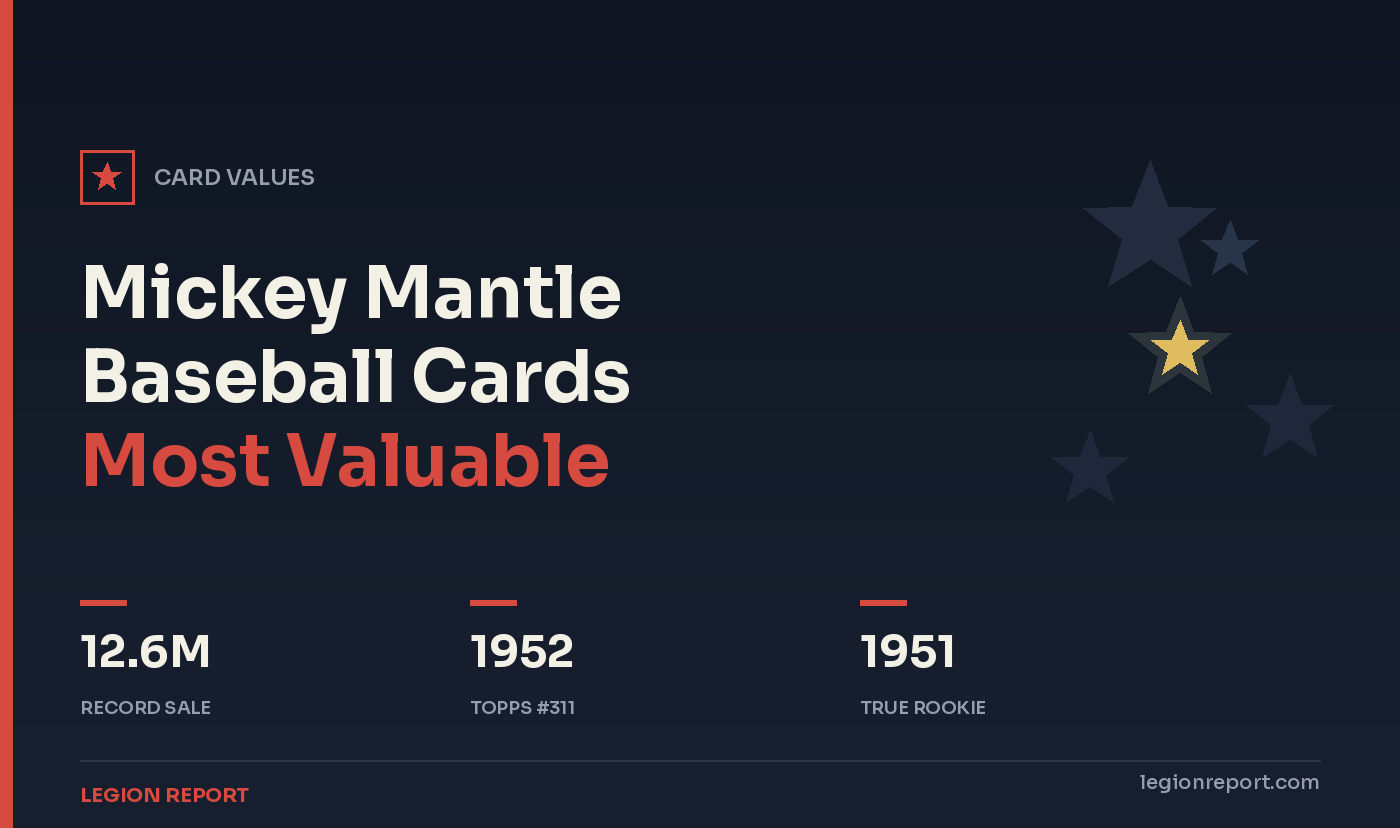
The headline is staggering: in 2022, a 1952 Topps Mantle sold for $12.6 million, the most ever paid for any sports collectible at the time. But there is a crucial twist that trips up even seasoned fans. The famous, record-setting 1952 Topps card is his most valuable and iconic card, but it is not actually his rookie card. That distinction belongs to his 1951 Bowman, issued a year earlier. Understanding that difference is the key to the whole Mantle market.
The chart below ranks the most valuable Mickey Mantle cards, with the record sale, the true-rookie distinction, the key cards by year, and what drives the prices. Take a look, then we’ll dig into the details.
The most famous card in the hobby: 1952 Topps
The 1952 Topps Mickey Mantle, card number 311, is widely considered the most important and valuable baseball card of the post-war era, a true “holy grail” of the hobby. In August 2022, a pristine example graded SGC 9.5 sold for a staggering $12.6 million, making it the most expensive sports collectible ever sold at the time, eclipsing even the legendary T206 Honus Wagner. Remarkably, this card is valuable in any condition: even heavily worn, low-grade copies sell for $25,000 or more, while mid-grade examples bring six figures.
Part of what makes this card so special is its origin story. Card #311 fell in the 1952 Topps set’s “high-number” sixth series, which was released late in the season when collector interest had shifted to football. According to hobby legend, much of that unsold high-number inventory, including countless Mantles, was literally dumped into the Atlantic Ocean. That makes surviving high-grade copies extraordinarily rare. The record-setting card itself traces to the famous 1986 “Mr. Mint” find, when collector Alan Rosen bought 5,500 pristine 1952 Topps cards from a Massachusetts attic; the card sold for $40,000 in 1991 and $12.6 million three decades later.
The plot twist: the 1952 Topps is not his rookie
Here is the detail that surprises almost everyone: despite being routinely called “the Mantle rookie card,” the 1952 Topps is not actually his rookie. That honor belongs to the 1951 Bowman, card number 253, issued a full year earlier and serving as Mantle’s true first card. For most players, the rookie card is the most valuable, but Mantle is the most famous exception to that rule in the entire hobby.
Why does the second-year Topps card command roughly three times the price of the actual rookie in the same grade? It comes down to mystique. The 1952 Topps was Mantle’s first card with Topps, the hobby’s most storied brand, it features gorgeous, vibrant artwork, and it carries the romance of that high-number series and its watery grave. The 1951 Bowman, while beautiful and scarce, simply never captured the collective imagination the same way. Still, it is enormously valuable: a PSA 9 sold for about $3.1 million in January 2022, and even low-grade copies fetch thousands.
The other landmark cards: 1953 and 1956
Beyond the two headliners, several Mantle cards are landmark issues in their own right. The 1953 Topps (#82) is celebrated for its stunning painted artwork, a young Mantle looking over his shoulder with a stadium behind him, and is considered one of his most beautiful cards; a PSA 9 has topped $300,000. That same year, the 1953 Bowman Color (#59) offered a clean, photo-driven design with no name on the front, and high-grade copies have sold around $500,000. The 1952 Bowman (#101), a hand-painted beauty, sits in similar territory.
The 1956 Topps (#135) is another fan favorite, capturing Mantle the same year he won the Triple Crown, and it is often recommended as the best entry point for collectors because nice mid-grade copies are more attainable. It is worth noting there are no Topps Mantle cards from 1954 or 1955, because Bowman held an exclusive contract with him those years, which is why his 1954 Bowman and 1955 Bowman “TV set” design cards exist instead.
The rarities: test issues and oddballs
For advanced collectors with deep pockets, Mantle’s rarest cards are the “white whales” of the hobby. The 1961 Topps Dice Game is the stuff of legend: an unreleased test issue from a set believed to contain just 18 players, with only a handful of each known to exist. Its stark black-and-white photo is unlike any other Mantle card, and its near-mythical scarcity makes it a prize few will ever own. The 1968 Topps 3-D test issue is similarly rare, a card that “exists but shouldn’t,” having escaped from the early stages of production.
Then there are the food and regional oddballs. Mantle appeared on hot-dog issues like the 1953 Stahl-Meyer and the 1954 Dan-Dee Potato Chip cards, the latter notoriously prone to staining from the oils of the chips they were packed with. The 1952 Berk Ross issue is another early regional rarity. These cards prove that even when Topps could not feature Mantle, his popularity meant he found his way onto cardboard one way or another.
What your Mantle is probably worth
If you have a Mantle card, the value depends enormously on which card and what condition. The 1952 Topps and 1951 Bowman are seven-figure cards in top grade and still command serious money even when worn. The 1953 issues are landmark cards worth a great deal in high grade. But Mantle’s later cards, from the late 1950s and 1960s, are far more plentiful, and while still desirable, they sell for four figures or less in high grade, dropping in value as you move toward the end of his career.
Two warnings are essential. First, condition is everything, the same card can be worth thousands or millions depending on its grade, which is why professional grading by PSA, SGC, or BGS is so important. Second, because Mantle cards are so valuable, they are among the most heavily counterfeited in the hobby. Never buy an ungraded high-value Mantle; always insist on a reputable third-party grade, and check recent sold listings for the exact card and grade, since values shift constantly with the market.
Final Word
Mickey Mantle’s cards sit at the very top of the collecting world, led by the iconic 1952 Topps, which set the all-time record at $12.6 million, and his true rookie, the 1951 Bowman. The crucial thing to remember is that the most famous Mantle card is his second-year Topps, not his rookie, a quirk unique to the Mick. From the painted beauty of the 1953 issues to the mythical 1961 Dice Game, his cards tell the story of the entire post-war hobby.
Whether you are a serious collector or just found an old card with the Mick’s face on it, the same rules apply: identify exactly which card you have, get it authenticated, and remember that condition drives everything. For more on the collecting world’s headline values, see our guide to 1981 Topps baseball card values.