

The referees at the World Cup have one of the most pressure-packed jobs in sport, making split-second decisions watched and scrutinized by billions of people. So how much do they actually earn for officiating football’s biggest tournament? The answer is a substantial payday, though perhaps smaller than many fans assume given the stakes, and it comes with an important catch: it is not a full-time salary.
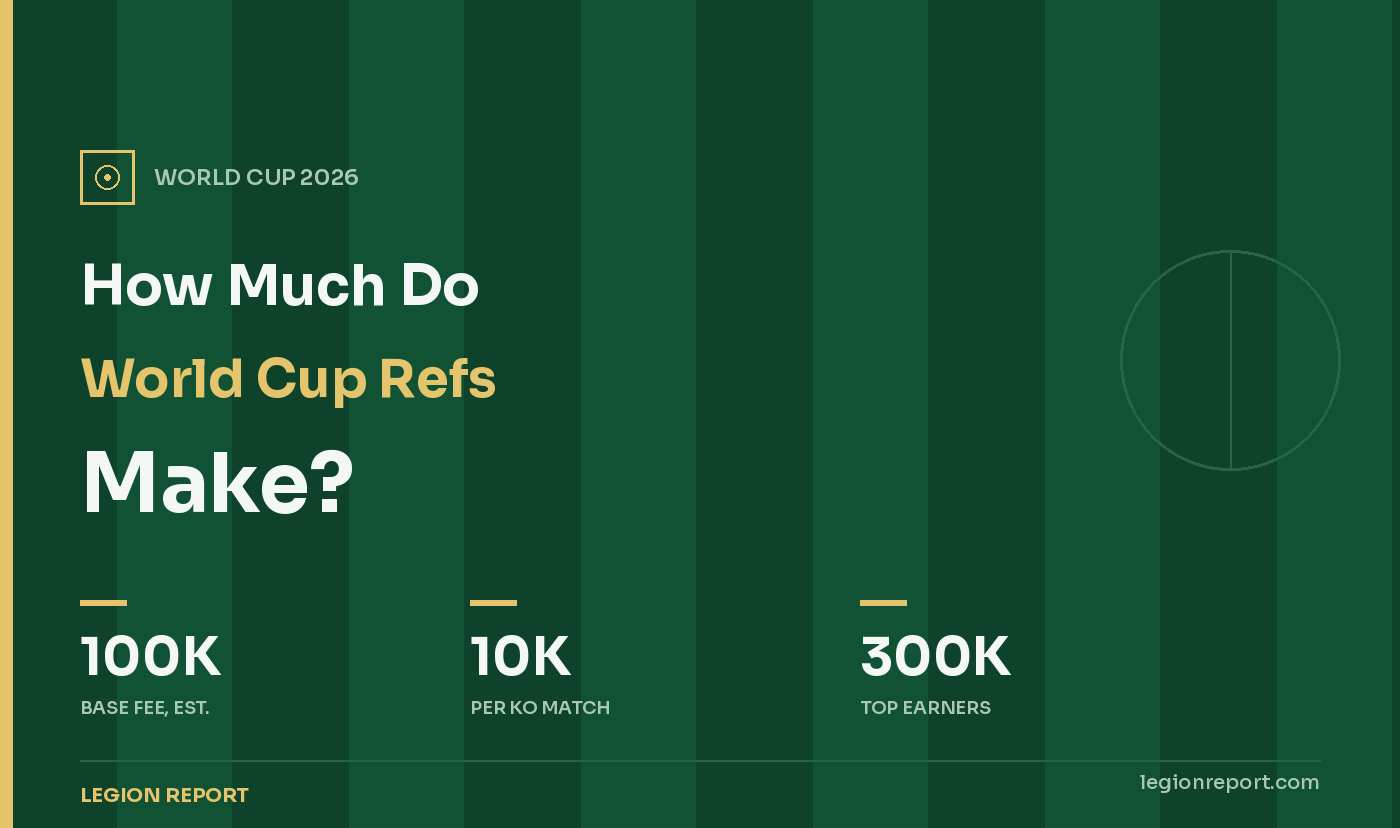
For the expanded 2026 World Cup, reporting from outlets including The Times suggests main referees receive a base participation fee of around $100,000 just for being selected, with per-match fees and knockout bonuses paid on top. The very top earners who officiate deep into the knockout rounds and the final could reportedly approach $300,000 in total. Importantly, FIFA does not publish an official pay table, so all figures are credible estimates rather than confirmed numbers.
The chart below breaks down what World Cup referees reportedly earn: the base fees, per-match pay, assistant and VAR officials, benefits, and how it compares. Take a look, then we’ll go through the details.
What World Cup referees reportedly earn
For the 2026 World Cup, reporting indicates that main (center) referees receive a base participation fee of around $100,000 simply for being selected to officiate the tournament. This is a flat, guaranteed amount, paid whether an official ends up working a single match or several. On top of that base, referees earn additional per-match fees, and those who advance deep into the tournament earn significant bonuses, which is where the biggest paydays come from.
Per-match fees rise as the tournament progresses. Group-stage matches are reported to pay in the region of $3,000 to $5,000 each, while high-stakes knockout matches can pay as much as $10,000. Because total earnings depend on how many matches an official works and how far they go, a referee who reaches the latter stages earns far more than one who exits after the group phase. According to reporting, the very top earners, those trusted with semifinals and the final, could see total tournament earnings approach $300,000.
The important caveat: these are estimates
One crucial point runs through any discussion of World Cup referee pay: FIFA does not publish an official referee fee schedule. Every figure quoted, including the ones here, comes from credible media reporting on this and past tournaments rather than from an official FIFA table. That is why you will see slightly different numbers from different outlets, and why the sensible approach is to treat any single headline figure as a well-sourced estimate rather than a confirmed fact.
There is also some variation in the reporting itself. The widely cited $100,000 base fee for 2026 comes from reporting in The Times, while the most recently confirmed benchmark from the 2022 tournament had a base fee closer to $70,000. The direction of travel is clear, pay has increased for the expanded 2026 event, but the precise figures remain estimates until, or unless, FIFA confirms them.
Assistant referees and VAR officials
Not every official earns the same. The main referee, who has ultimate authority on the field, receives the largest package. Assistant referees, the officials on the sidelines who help with offside and other calls, earn considerably less, with a reported base fee of around $25,000 plus a smaller per-match payment of roughly $2,000 to $2,500. Their pay reflects a supporting rather than lead role.
Video Assistant Referee (VAR) officials, a category that has grown in importance, are appointed separately and operate on a structure broadly similar to assistant referees, with a fixed tournament fee plus per-match payments. The 2026 tournament features a large contingent of these video match officials alongside the on-field crews, reflecting how central VAR has become to modern officiating. In all cases, these support officials earn a fraction of what the lead referee takes home.
The perks beyond the paycheck
The financial package goes well beyond the headline fees. FIFA covers all travel and accommodation for officials for the duration of the tournament, along with daily allowances for meals and incidentals, so the fees sit on top of a fully funded stay. Officials also receive a complete kit allocation from Adidas, FIFA’s official supplier, including boots, training wear, and match jerseys.
There have historically been standout gifts too: at the 2022 World Cup in Qatar, referees famously received a Hublot watch reported to be worth around $5,000 as part of FIFA’s timekeeper partnership. And for the officials chosen to work the final, there is a reward that money cannot buy: a commemorative medal, one of the most coveted honors in the profession and, for many, the crowning achievement of a decades-long career.
Why it is not really a “salary”
Perhaps the biggest misconception is that these figures represent a referee’s salary. They do not. The reported amounts are World Cup tournament fees, a one-off payment for a few weeks of work, not annual pay. Most World Cup referees are not full-time FIFA employees; they are elite officials who earn the bulk of their income from their domestic leagues, and FIFA selects them for international duty based on performance.
The reality varies by country. Top Premier League referees, for example, are full-time professionals earning a reported average of around £170,000 to £180,000 a year through their domestic body, so a World Cup appointment is a lucrative bonus on top of an existing salary. But a referee from many other confederations may be a semi-professional or amateur who earns their living elsewhere, making the World Cup fee a genuinely significant, if occasional, windfall. Either way, the tournament pay is separate from, and on top of, whatever an official earns at home.
Final Word
World Cup referees are reportedly well paid for their few weeks in the global spotlight: an estimated base fee of around $100,000 for 2026, plus per-match fees rising to about $10,000 for knockout games, with the top earners potentially approaching $300,000 including deep-run and final bonuses. Assistant and VAR officials earn considerably less, and everyone gets travel, lodging, kit, and, for the final, a commemorative medal.
The key context is that these are reported estimates, not official FIFA figures, and they represent tournament fees rather than a yearly salary, most officials earn their main living from domestic leagues. For more on the organization behind the numbers, see our explainer on what FIFA is and who runs the World Cup.