

Every four years, the World Cup brings the planet to a standstill, but who actually organizes it? The answer is FIFA, the global governing body of soccer, an organization with immense power, a complex structure, and a name many fans recognize without fully understanding what it does. From picking host nations to writing the rules and redistributing billions in revenue, FIFA sits at the very center of the world’s most popular sport.
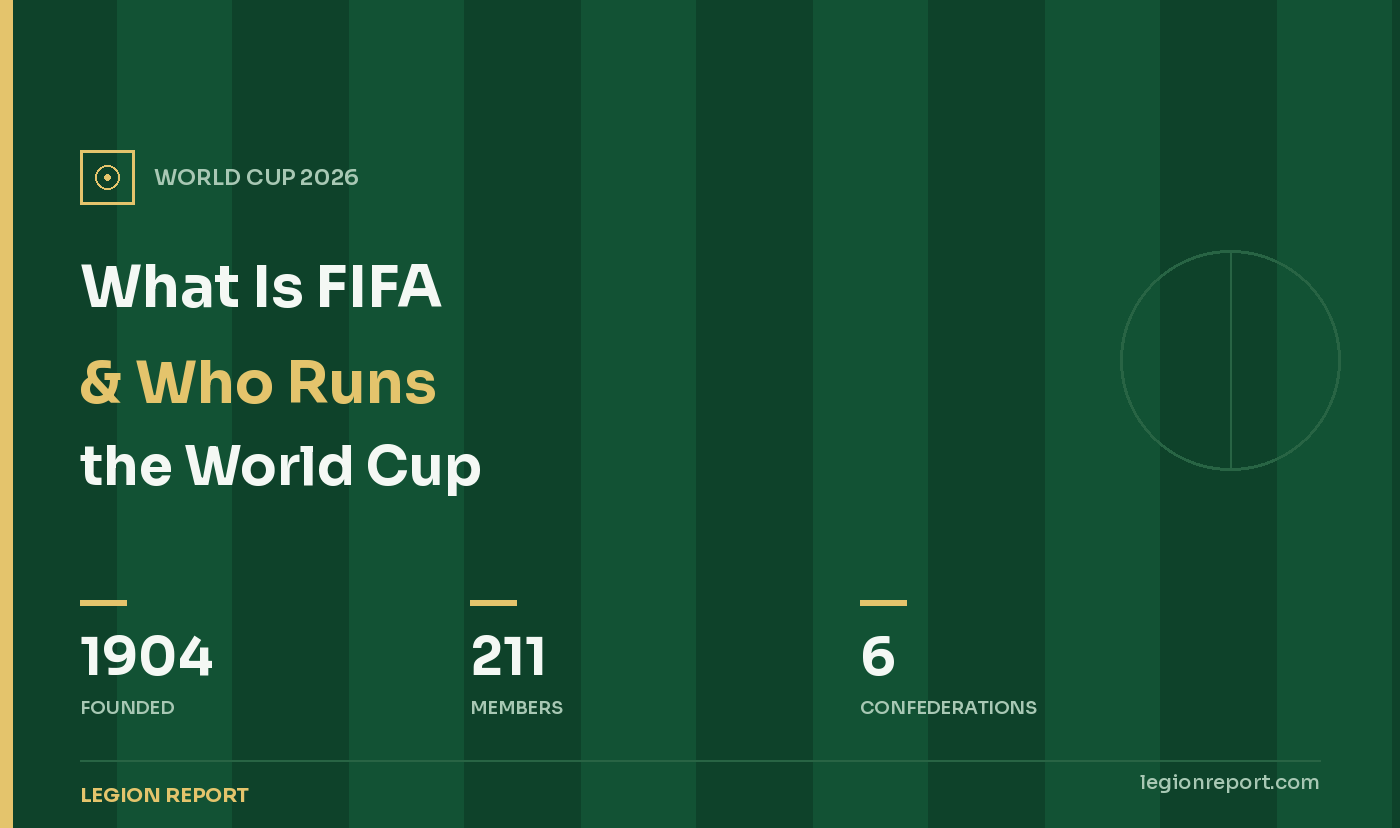
FIFA stands for the Federation Internationale de Football Association, founded in 1904 and headquartered in Zurich, Switzerland. It now comprises 211 member national associations, more than the United Nations has members, organized under six regional confederations. Understanding how FIFA is structured and who runs it explains how decisions about the World Cup, and global soccer as a whole, actually get made.
The chart below breaks down what FIFA is, how it is structured, and who runs it. Take a look, then we’ll go through the details.
What FIFA is
FIFA, the Federation Internationale de Football Association, is the international governing body of soccer (as well as futsal and beach soccer). It was founded on 21 May 1904 in Paris by seven European nations, Belgium, Denmark, France, the Netherlands, Spain, Sweden, and Switzerland, who wanted an organization to oversee international matches. From those modest beginnings, FIFA has grown into one of the most powerful sports organizations on earth, with its headquarters in Zurich, Switzerland.
Today, FIFA comprises 211 member national associations, such as US Soccer, England’s Football Association, and the Brazilian Football Confederation, which is actually more members than the United Nations. Legally, FIFA is a non-profit association registered under Swiss law. It is not a company with shareholders; instead, it is a membership organization, effectively “owned” in a conceptual sense by its 211 member associations, with revenues reinvested into the global game rather than paid out as profit.
How FIFA is structured
FIFA’s 211 members are organized into six regional confederations, each governing the sport in its part of the world: UEFA (Europe), CONMEBOL (South America), CONCACAF (North and Central America and the Caribbean), CAF (Africa), AFC (Asia), and OFC (Oceania). Each confederation runs its own World Cup qualifying competition to determine which of its teams reach the finals, which is why qualification works differently in each region.
This structure is the backbone of international soccer. When you see Brazil and Argentina battling through South American qualifying, or European giants competing in UEFA qualifiers, those competitions are run by the confederations under FIFA’s overall umbrella. The confederations also have significant influence within FIFA itself, holding seats on its governing council and shaping major decisions about the global game.
Who runs FIFA
FIFA is governed by several bodies. The supreme body is the Congress, made up of all 211 member associations, where each nation has one equal vote, meaning a small nation like Fiji has the same voting power as a giant like Brazil. The Congress elects the president and votes on major issues. Between congresses, strategic power lies with the FIFA Council, a body of 37 people including the president, eight vice-presidents, and 28 members drawn from the confederations, with at least one woman required per confederation.
At the top sits the FIFA president, currently Gianni Infantino, a Swiss-Italian lawyer who was elected in 2016 (and re-elected in 2019 and 2023) following a major corruption scandal that brought down his predecessor, Sepp Blatter. The president leads the organization, chairs the Congress and Council, and is the public face of world soccer. The day-to-day administration is handled by the General Secretariat, FIFA’s professional staff.
What FIFA does, and who makes the rules
FIFA’s most visible job is organizing the World Cup, both the men’s and women’s tournaments, as well as youth, futsal, and beach soccer World Cups. It sets the process for choosing host nations and selects them, which is how the United States, Canada, and Mexico were awarded the 2026 tournament. Crucially, FIFA also redistributes the enormous revenue it generates, mostly from World Cup broadcast rights and sponsorships, back to its member associations to fund the development of soccer around the world.
One common misconception is that FIFA writes the rules of the game. In fact, the actual Laws of the Game are set and amended by a separate body called the International Football Association Board (IFAB), which consists of FIFA plus the four British football associations (England, Scotland, Wales, and Northern Ireland). FIFA has half the votes on IFAB, but it does not control the laws alone, a quirk of history reflecting soccer’s British origins.
Final Word
FIFA is the global governing body that runs world soccer and, most visibly, the World Cup. Founded in 1904 and based in Zurich, it now unites 211 member nations under six regional confederations, is led by president Gianni Infantino, and operates as a non-profit that redistributes its vast World Cup revenues back into the game. From selecting hosts to funding grassroots development, FIFA sits at the heart of the sport.
While it does not write the rules of play itself, that job belongs to IFAB, FIFA’s reach over the global game is immense. For more on the tournament it organizes, see our explainer on how the World Cup round of 32 works.