
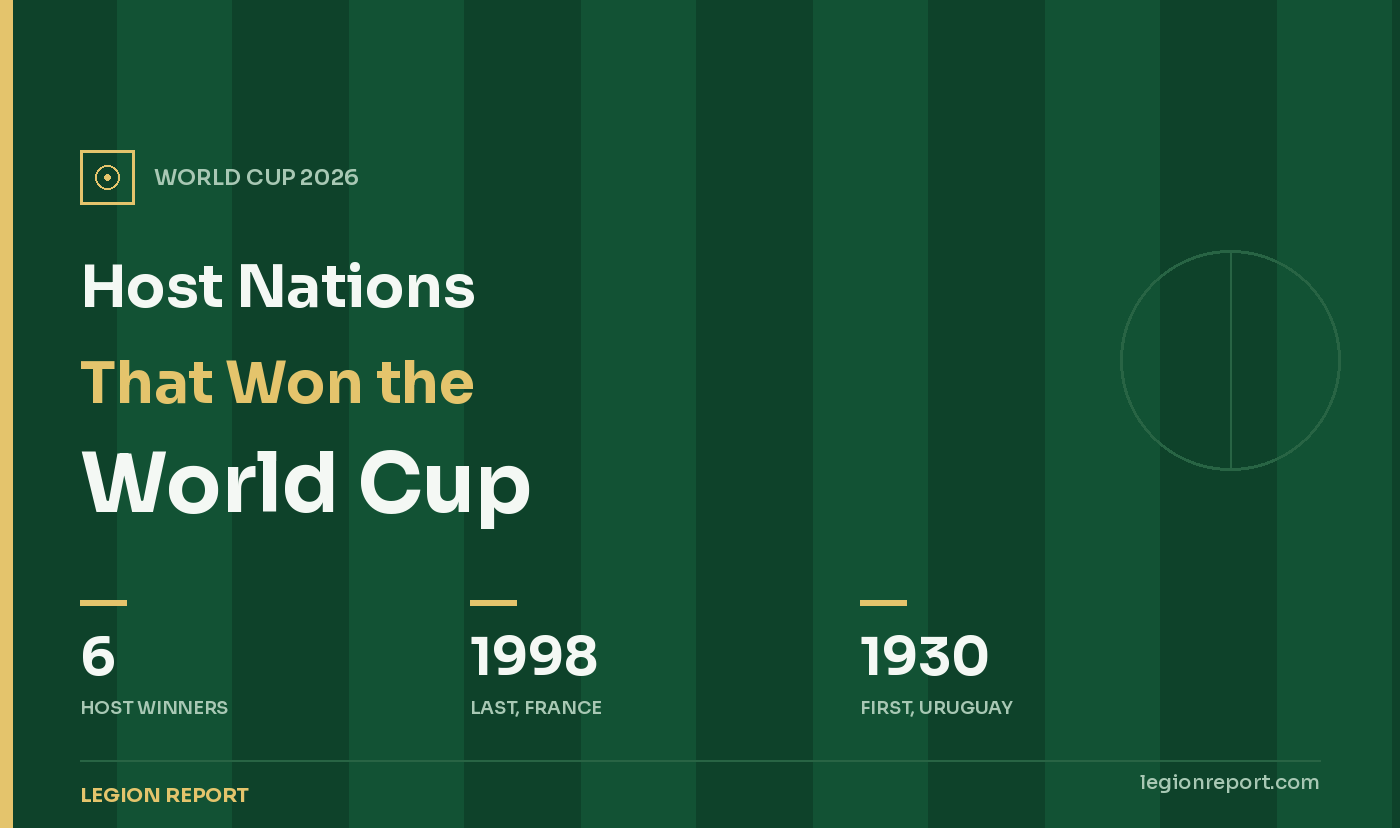

There is no bigger advantage in football than playing a World Cup on home soil. The roar of a home crowd, familiar conditions, and no long-distance travel have all helped host nations to some of the tournament’s most famous triumphs. Six times in World Cup history, the country hosting the tournament has gone all the way and lifted the trophy in front of their own fans.
From Uruguay winning the very first World Cup in 1930 to France’s golden generation in 1998, the list of host winners features some of the sport’s most iconic teams and moments. But the home advantage is not a guarantee: many hosts have fallen short, and no host nation has won the World Cup since France did it more than 25 years ago, a drought that adds intrigue to every modern tournament.
The chart below lists every host nation that won the World Cup, with the year, the final result, and how other notable hosts fared. Take a look, then we’ll get into the details.
The six host winners
Six nations have won the World Cup while hosting it, and the roll begins with the very first tournament. Uruguay won the inaugural 1930 World Cup on home soil, defeating Argentina 4-2 in the final in Montevideo to become the first world champions, and they remain the smallest country ever to win the trophy. Four years later, Italy continued the trend, beating Czechoslovakia 2-1 to win the 1934 tournament as hosts, the first of their back-to-back titles.
The most famous host triumph for English fans came in 1966, when England won their only World Cup at Wembley, beating West Germany 4-2 after extra time, with Geoff Hurst scoring a hat-trick in the final. West Germany themselves won as hosts in 1974, defeating the Netherlands 2-1, while Argentina claimed their first title on home soil in 1978, beating the Dutch 3-1 after extra time. The most recent host winner is France, whose golden generation thrashed Brazil 3-0 in the 1998 final in Paris.
The home advantage and its famous moments
Why do hosts so often succeed? Home advantage in a World Cup is powerful: passionate home crowds lift the players, teams avoid the fatigue of long-haul travel and acclimatize fully to local conditions, and the host nation automatically qualifies, often allowing for extra preparation. These factors have repeatedly helped home teams produce their best ever performances on the biggest stage.
The host triumphs have given us some of the sport’s iconic images: Geoff Hurst’s hat-trick and the “they think it’s all over” commentary in 1966, the youthful brilliance of France’s 1998 side led by Zinedine Zidane, who scored twice in the final, and the joyous scenes in Montevideo, Rome, Munich, and Buenos Aires. Notably, four of the six host winners, Uruguay, Italy, Argentina, and France, captured their very first World Cup title as hosts before going on to win again later.
When the home advantage was not enough
Hosting is no guarantee of glory, and several host nations have suffered heartbreak. The most famous example came in 1950, when Brazil, overwhelming favorites on home soil, lost the deciding match 2-1 to Uruguay in front of a vast Maracana crowd, a national trauma still known as the “Maracanazo.” Sweden reached the final as hosts in 1958 but ran into a teenage Pele and a brilliant Brazil side, finishing runners-up.
Even so, the pattern holds that hosting tends to produce a nation’s best ever result. South Korea reached an unprecedented fourth place when co-hosting in 2002, Chile finished third at home in 1962, and Mexico reached the quarter-finals both times they hosted, in 1970 and 1986, their best ever showings. The home crowd, it seems, almost always lifts a team beyond its usual level, even if the trophy stays out of reach.
The host drought and 2026
For all the historical success of host nations, a notable drought has developed in the modern era. No host has won the World Cup since France in 1998, a span that includes hosts like South Korea/Japan (2002), Germany (2006, third place), South Africa (2010, a group-stage exit), Brazil (2014, the infamous 7-1 semi-final loss to Germany), Russia (2018, quarter-finals), and Qatar (2022, a group-stage exit). As the game has globalized and the field has expanded, the home advantage has clearly diminished.
That makes the 2026 World Cup especially intriguing. For the first time, the tournament has three hosts, the United States, Canada, and Mexico, none of whom has ever won the World Cup. With the field expanded to 48 teams, the question of whether a host nation can end the 28-year drought, or whether the home-soil magic of the past is gone for good, will be one of the storylines of the tournament.
Final Word
Six host nations have won the World Cup, Uruguay (1930), Italy (1934), England (1966), West Germany (1974), Argentina (1978), and France (1998), a list that captures both the power of home advantage and some of the tournament’s greatest moments. Four of them lifted their first ever title as hosts, while England remain unique as the only nation to win the World Cup solely as a host.
With no host having won since 1998 and three first-time-hosting nations staging the 2026 tournament, the home-soil story remains one of the World Cup’s most compelling threads. For more on the sport’s most successful nations, see our guide to most World Cup wins by country.