
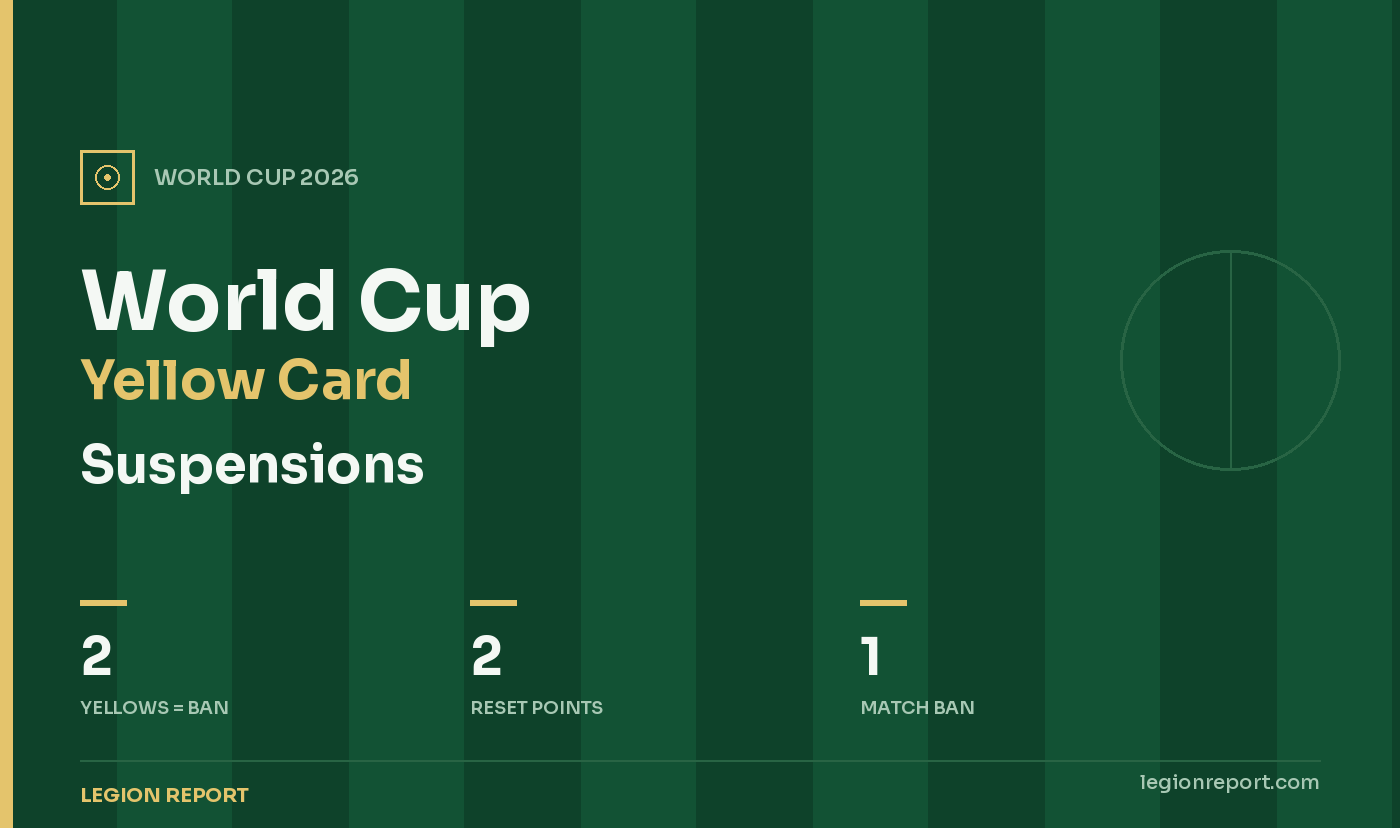

At the World Cup, a single yellow card can carry huge consequences. Pick up bookings in the wrong matches and a key player can be suspended for a crucial knockout tie, potentially even a semifinal. The rules around yellow-card accumulation and suspensions are among the most important, and most confusing, at the tournament, and for the expanded 2026 World Cup, FIFA changed them.
In short: two yellow cards in the same match become a red and a one-game ban, and two yellow cards across separate matches also trigger a one-game suspension. What is new for 2026 is that yellow cards are now wiped clean twice during the tournament, after the group stage and again after the quarterfinals, a second “amnesty” added because the 48-team format has an extra knockout round. Understanding when cards reset is the key to following who is available.
The chart below breaks down the World Cup yellow-card and suspension rules: the triggers, the reset points, red cards, and what it all means. Take a look, then we’ll go through the details.
The basic rule: two yellows mean a ban
The foundation of the system is simple: two yellow cards lead to a suspension. This happens in two ways. First, if a player receives two yellow cards in the same match, they are automatically shown a red card and sent off, forcing their team to finish with ten men, and they are also suspended for their team’s next match. Second, a player who is booked in two separate matches during the tournament accumulates two yellows and is suspended for the following game.
Either way, the punishment is a one-match ban. Crucially, this suspension applies regardless of what the next match is, a booking in your second and third group games means missing the Round of 32, just as a booking in the Round of 32 and Round of 16 means missing the quarterfinal. The rules also extend to coaching staff on the bench, who can be cautioned and suspended in the same way.
What changed for 2026: two reset points
The biggest change for the 2026 World Cup concerns when yellow cards are wiped clean. At past tournaments, single yellow cards carried over from the group stage deep into the knockouts, with only one “amnesty” (reset) point, after the quarterfinals. This was designed so no player would miss a final because of bookings picked up much earlier in the tournament.
For 2026, FIFA added a second reset. Now, single yellow cards are cancelled twice: once after the group stage, and again after the quarterfinals. The reason is the expanded 48-team format, which added an extra knockout round (the Round of 32). Without the second amnesty, players would have to survive far more matches without accumulating two bookings, making yellow-card suspensions much harsher than in the past. The extra reset keeps the risk roughly in line with previous tournaments.
How accumulation works stage by stage
Because of the two reset points, yellow-card accumulation effectively happens within three separate windows. In the group stage, a player who is booked in two of their three group matches will be suspended for their next game (the Round of 32). Then all single yellows are wiped. In the early knockout rounds, a player who is booked in two matches across the Round of 32, Round of 16, and quarterfinal will be suspended, and after the quarterfinals, all single yellows are wiped again.
There is one important subtlety around the second reset. A player whose second yellow card comes in the quarterfinal still serves that one-match ban in the semifinal, because the reset clears pending single cautions but does not erase a suspension that has already been triggered. However, because all single yellows are wiped after the quarterfinal, it is impossible for a player to accumulate enough bookings to miss the final. The only way to be suspended for the final is a red card in the semifinal.
Red cards and other offences
Red cards work slightly differently. A player sent off, whether for two yellows or a straight (direct) red for a serious offence like violent conduct or denying an obvious goalscoring opportunity, serves an automatic one-match suspension. For more serious offences, FIFA’s disciplinary committee can extend that ban beyond a single game if they judge one match to be insufficient. If a suspension cannot be completed during the World Cup, it carries over to the team’s next official international fixture.
The 2026 tournament also introduced two new sending-off offences: a player can be red-carded for covering their mouth to hide what they are saying during a confrontation with an opponent, and for deliberately leaving the field of play to protest a referee’s decision. In addition, VAR’s powers were expanded so that video officials can now review and overturn certain incorrect send-offs, including mistaken second-yellow dismissals and erroneous red cards.
Do qualifying cards carry over?
A common question is whether cards from World Cup qualifying carry into the finals. For the most part, they do not: single yellow cards and most minor one- or two-match bans accumulated during qualifying are cleared before the tournament, so players start the World Cup with a clean disciplinary slate. This prevents players from missing World Cup matches for bookings picked up months earlier in qualifiers.
The exception is for more serious offences. A significant red-card suspension handed down in qualifying, particularly one longer than a single match, can carry over into the World Cup itself, meaning a player could miss the start of the tournament. But routine yellow-card accumulation from qualifying is wiped, so the disciplinary count effectively resets when the finals begin.
Final Word
The World Cup yellow-card suspension rules come down to a simple principle, two yellows mean a one-match ban, with an important 2026 twist: single yellow cards are now wiped clean twice, after the group stage and after the quarterfinals, thanks to the expanded 48-team format. That second reset means no player can miss the final through accumulated bookings; only a red card in the semifinal can do that.
Knowing when the cards reset is the key to understanding who is available at each stage of the tournament. For more on the disciplinary system, see our explainer on soccer card rules.