
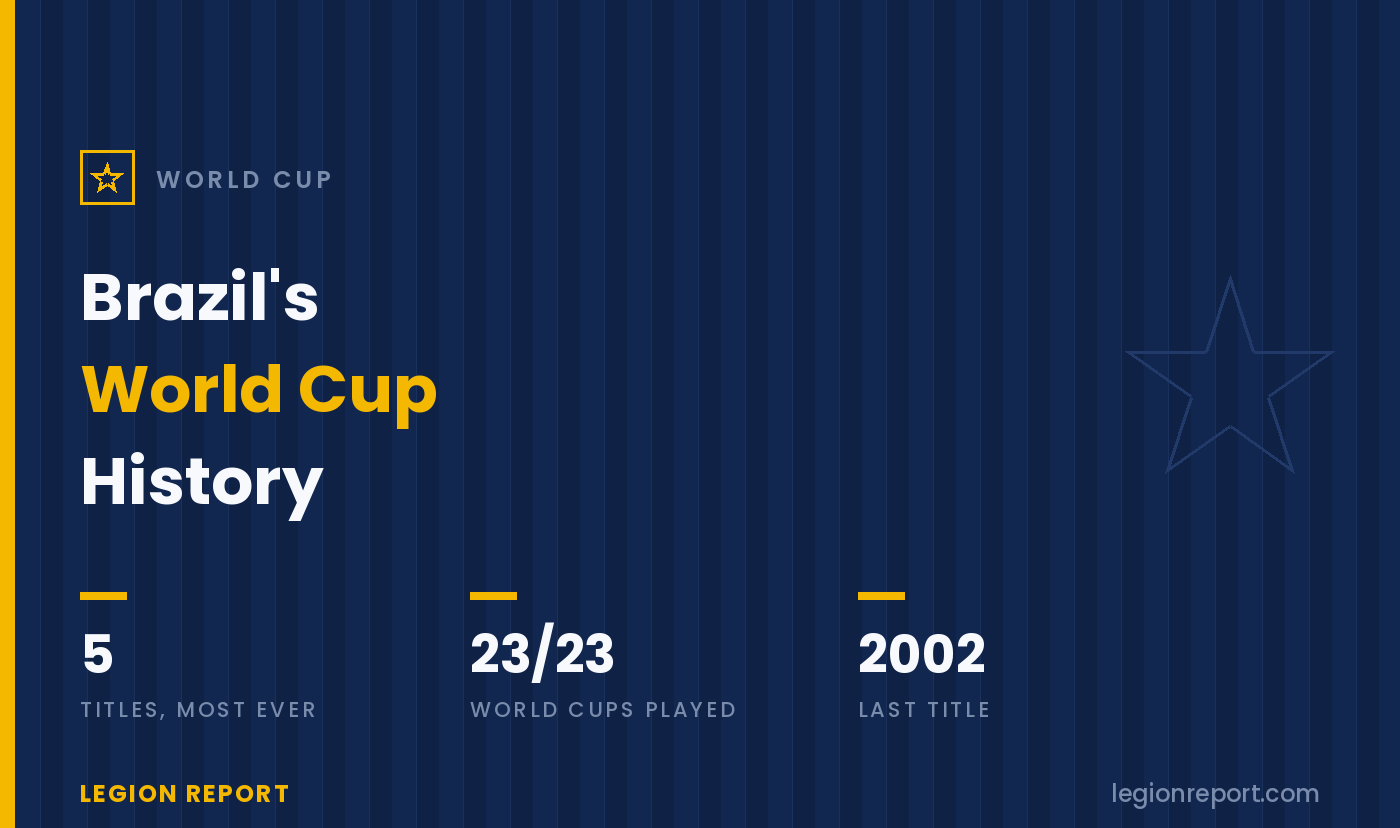

No nation and no tournament belong to each other like Brazil and the World Cup. Brazil has won it five times, more than anyone; played in all 23 editions, the only country with perfect attendance; and supplied the tournament’s sacred texts, from a 17-year-old Pele in 1958 to the 1970 team still used as the sport’s definition of beauty. The World Cup’s greatest champion is also its greatest tragedian: the two most traumatic defeats in soccer history, the 1950 Maracanazo and the 7-1, both happened to Brazil, at home, with the world watching.
And right now, the story is live. Brazil hasn’t lifted the trophy since 2002, a 24-year drought spanning five straight eliminations by European teams, and the 2026 campaign to end it, under Carlo Ancelotti, the first foreign coach of Brazil’s modern era, faces Norway in the Round of 16 this weekend, one win from the quarterfinals and four from a sixth star.
The chart below covers all of it: the five titles, Brazil’s finish at every World Cup ever played, the national traumas, the records only Brazil holds, and where the 2026 run stands right now. Take a look, then we’ll break it all down.
The dynasty: 1958 to 1970
Brazil’s World Cup history splits at 1958. Before it: two decades of underachievement crowned by the Maracanazo, the 1950 home final lost to Uruguay in front of the largest crowd ever assembled for a soccer match, a defeat so scarring Brazil abandoned its white shirts for the yellow the world now knows. After it: the dynasty. A 17-year-old Pele scored twice in the 1958 final in Sweden, Garrincha carried the injured Pele’s team to a repeat in 1962, and the 1970 side in Mexico, Pele, Jairzinho, Tostao, Rivellino, Carlos Alberto, won all six matches and produced the final’s iconic fourth goal, a team performance still cited as the sport’s high-water mark. Three titles in twelve years earned Brazil the Jules Rimet trophy outright; Pele remains the only player with three World Cup winner’s medals.
The beautiful failures and the second empire
What makes Brazil’s history singular is that even its failures are canonical. The 1982 team of Socrates, Zico, and Falcao, eliminated 3-2 by Italy at Sarria, is routinely called the greatest side never to win the World Cup, and its death is treated as the day romantic soccer lost to pragmatism. The 1978 team went home unbeaten, out on goal difference. Redemption came pragmatically: Romario’s 1994 team ended a 24-year drought in the United States, winning the first final decided by penalties, and after the haunted 1998 final, when Ronaldo suffered convulsions hours before kickoff and Brazil lost 3-0 to France, the same Ronaldo authored the perfect ending in 2002, scoring eight goals including both in the final, the most prolific individual World Cup since 1970.
The drought: 24 years and a wall of Europeans
Nobody in 2002 would have believed it was the last one. Since then, Brazil has been eliminated by a European team five World Cups running: France in 2006, the Netherlands in 2010, Germany in 2014, Belgium in 2018, and Croatia on penalties in 2022. The 2014 edition produced the second national trauma with its own name, the Mineirazo: a home semifinal against Germany that stood 5-0 after 29 minutes and ended 7-1, the worst defeat in Brazil’s history, in a World Cup Brazil was hosting. The pattern pushed the federation to a rupture with a century of tradition: hiring Carlo Ancelotti, the most decorated club coach alive, as the first foreign manager of the modern Selecao, with one assignment.
2026: the rhyme Brazil is chasing
Which brings the story to this weekend. Brazil’s 2026 campaign has reached the Round of 16, a Sunday date with Norway at the New York New Jersey Stadium, the same building that hosts the final on July 19. The superstitious have their material: the drought stands at exactly 24 years, the same length as the one Romario ended in 1994, at the last World Cup held in the United States. Four wins separate Brazil from a sixth star and the definitive answer to two decades of European eliminations. The World Cup’s greatest character is, as always, central to its plot.
Final Word
Brazil’s World Cup history: five titles (1958, 1962, 1970, 1994, 2002), the most of any nation; perfect attendance at all 23 tournaments; seven finals; the only three-time champion player in Pele; and the sport’s two most famous wounds, the Maracanazo and the 7-1, both self-inflicted at home. The current chapter is a 24-year drought, a foreign legend in the dugout, and a live knockout run in the country where Brazil last broke a drought this long. The five stars on the shirt are history. The sixth is this month’s business.
Brazil’s story is woven through the coverage we’ve built this tournament: every final they’ve played in World Cup finals history, the marks they own in World Cup records, and the fixture their 2014 team would rather forget, the third place match explained.