
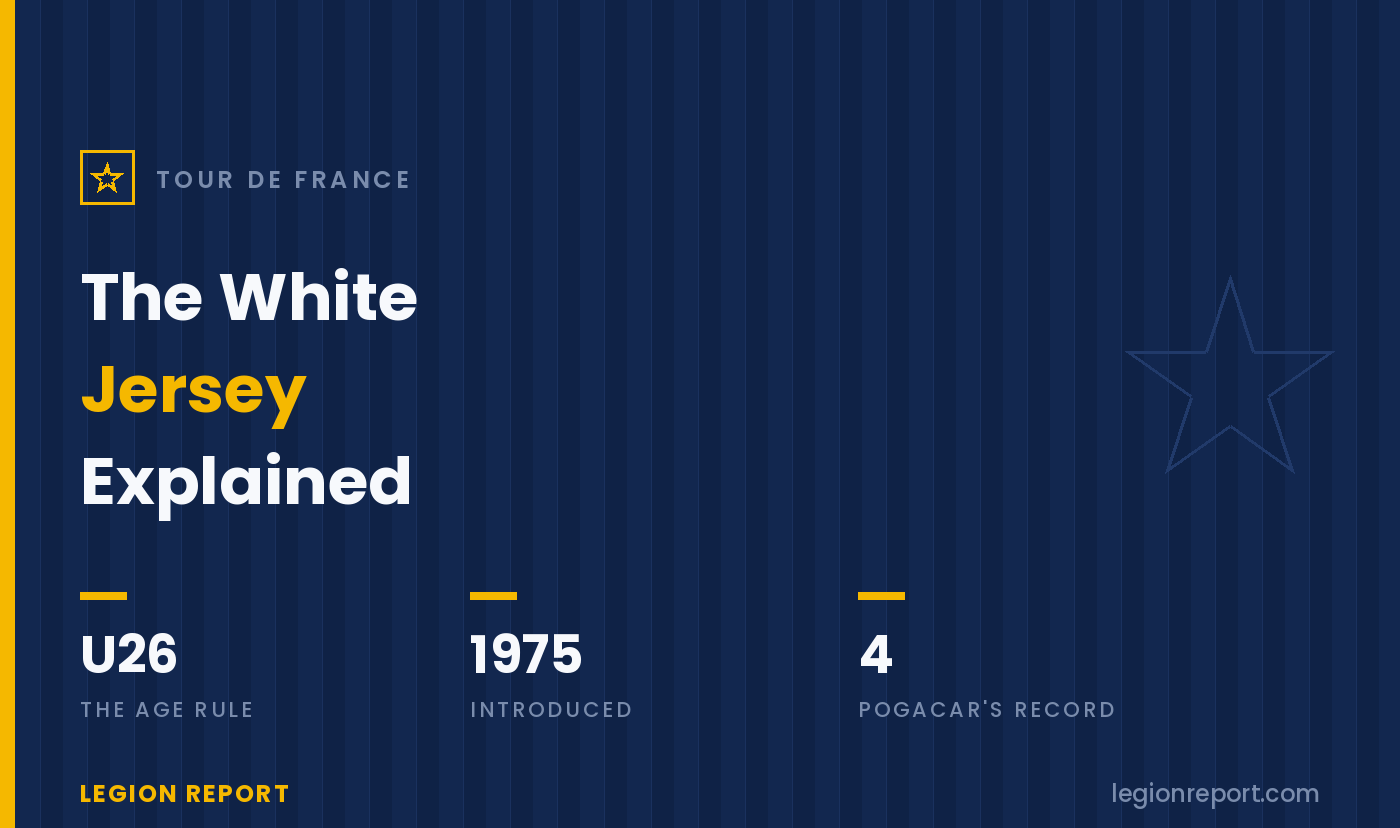

Everyone knows the yellow jersey. Most people know the polka dots. But the fourth jersey at the Tour de France, the plain white one, confuses more viewers than any of them, because the rider wearing it often isn’t leading anything you can see. The white jersey, the maillot blanc, belongs to the best young rider: the highest-placed rider in the overall standings who is under 26, which for the 2026 Tour means born on or after January 1, 2001.
It sounds like a consolation prize. It’s actually the Tour’s crystal ball. The white jersey has been won by Laurent Fignon, Jan Ullrich, Alberto Contador, Egan Bernal, and Tadej Pogacar, all of whom also won the yellow jersey, several of them in the same July. Winning white doesn’t mean you’re the best of the kids; historically, it tends to mean you’re about to be the best of everyone.
The chart below covers the whole classification: exactly how it works, the prize money attached, its odd on-off history since 1975, the record holders, and the riders who wore white and yellow at once. Take a look, then we’ll break it all down.
The rule: yellow’s math, youth’s filter
The white jersey is the simplest classification at the Tour once you see it: it’s the yellow jersey competition run through an age filter. Every rider’s total time accumulates identically; the white jersey simply belongs to whoever sits highest in the overall standings while being under 26 in the race year, for 2026, that means born on or after January 1, 2001. No sprint points, no climbing categories, no bonuses unique to it. That purity is what makes it predictive: a rider high enough on GC to lead the youth standings is, by definition, already beating most of the grown-ups at their own game. The winner collects 20,000 euros in Paris, 500 euros per day along the way, and, far more valuably, the attention of every team budget in the sport.
A jersey that disappeared for a decade
The classification debuted in 1975, the same year as the polka-dot mountains jersey, and then produced one of the Tour’s strangest bureaucratic quirks: from 1989 through 1999, the best-young-rider competition continued to exist, with winners crowned in the results, but no actual jersey was awarded. Riders “won white” without ever wearing it, Jan Ullrich’s first youth title came shirtless, so to speak, before the garment returned for good in 2000. The record book survived the wardrobe gap intact: Pogacar’s four consecutive white jerseys (2020-2023) stand as the all-time mark, ahead of Ullrich’s and Andy Schleck’s three apiece. And because the age rule forces turnover, the classification refreshes itself constantly: 2024 winner Remco Evenepoel and 2025 winner Florian Lipowitz, third overall on debut, were both born in 2000 and aged out together, guaranteeing a brand-new name on the 2026 podium, with prodigies like Isaac del Toro (born 2003) leading the new class.
The crystal ball: white today, yellow tomorrow
The white jersey’s real function is prophecy. Five men have won white and yellow in the same Tour, Laurent Fignon (1983), Jan Ullrich (1997), Alberto Contador (2007), Egan Bernal (2019), and Tadej Pogacar, who did it twice consecutively (2020, 2021), announcing himself at 21 as the youngest postwar champion. Beyond the same-year doubles, the alumni list reads like a hall of fame in waiting: the pattern for half a century has been that the rider collecting the “junior” prize is frequently the man the whole sport will orbit within a few Julys. That’s the answer to the viewer’s eternal question about the kid in plain white riding near the front: he isn’t leading a consolation category. Statistically speaking, you may be looking at the next winner of everything.
Final Word
The Tour de France white jersey, explained: the best-young-rider prize, awarded since 1975 (with a shirtless decade in the 1990s) to the highest-placed rider under 26, scored purely on time, worth 20,000 euros and a fortune in future contracts. Pogacar owns the record with four; five men have paired it with yellow in the same summer; and 2026’s edition is guaranteed a new champion by birthday math alone. Yellow tells you who’s the best rider in the world this July. White has a habit of telling you who it’ll be next July.
It’s part of our Tour de France launch alongside Tour de France teams explained and the full money story, 1903 to today, in Tour de France prize money.