
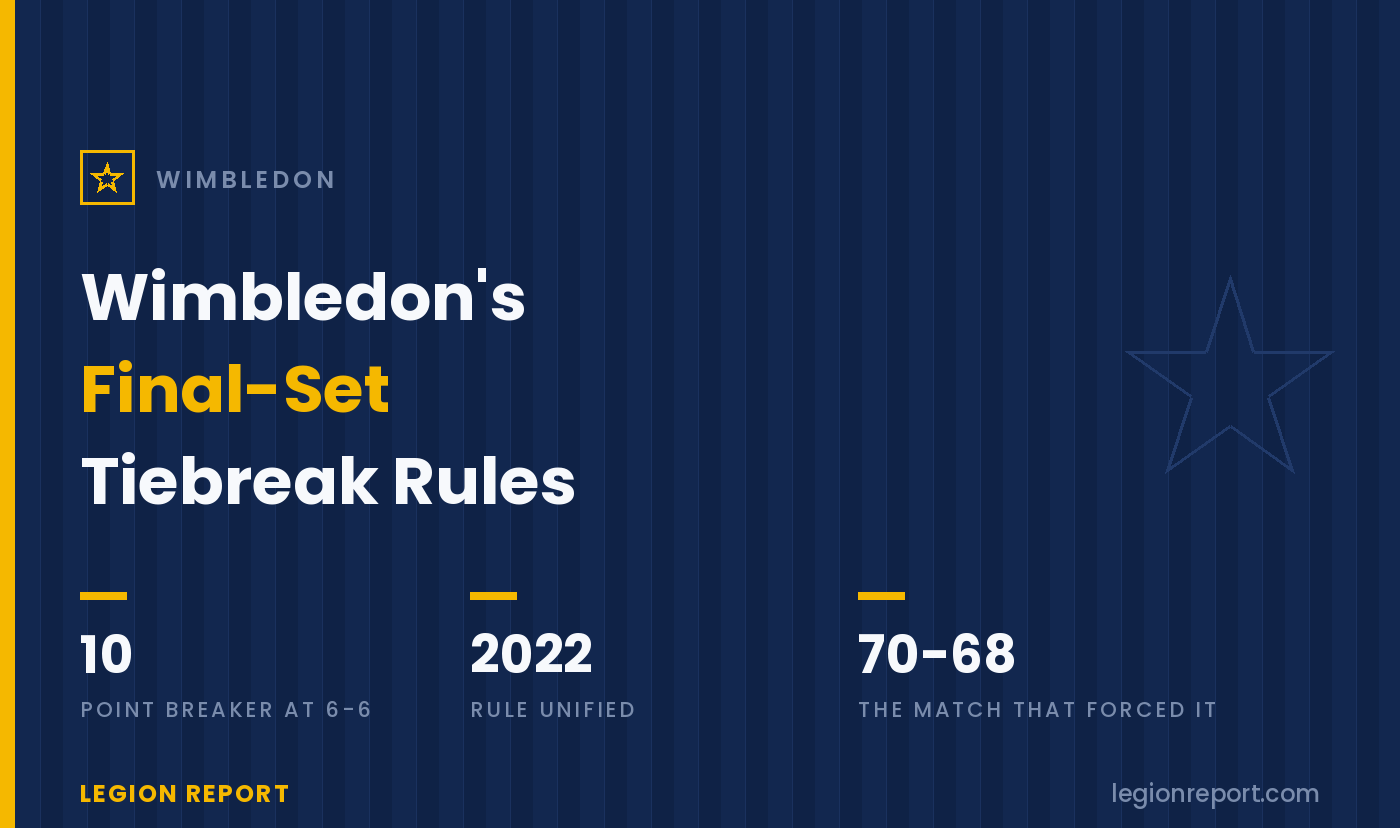

For 141 years, a Wimbledon match could theoretically last forever, and in 2010, one nearly did. Final sets at the Championships were played to a two-game advantage with no tiebreak of any kind, which is how John Isner and Nicolas Mahut produced the most famous scoreline in tennis: 70-68 in the fifth, eleven hours and five minutes across three days. Today, that match is impossible. Wimbledon’s final sets now end in a 10-point tiebreak at 6-6, a rule with a short, dramatic history and a very specific list of matches to blame.
The current system is actually Wimbledon’s third format in seven years: infinity until 2018, a tiebreak at 12-12 from 2019 (used in a final within six months of existing), and the unified 10-point breaker at 6-6 since 2022, when all four Grand Slams finally agreed on one rule after decades of four different answers to the same question.
The chart below covers everything: the current rules, exactly how the 10-point tiebreak works, the three-era timeline, the matches that forced each change, and how the other majors handled it. Take a look, then we’ll break it all down.
The rule today: 10 points at 6-6, everywhere
Wimbledon’s deciding sets, the fifth for men, the third for women, now end with a 10-point tiebreak when the games reach 6-6: first to 10 points, win by 2, one serve then two apiece alternating, ends changed every 6 points, recorded as 7-6 with the breaker’s score in brackets. Every earlier set keeps the ordinary 7-point tiebreak. Since 2022 this exact format applies at all four Grand Slams, ending a genuinely comic era in which the same sport concluded its biggest matches four different ways: the US Open with a 7-pointer, the Australian with a 10-pointer, Roland Garros with nothing at all, and Wimbledon with its own invention, a tiebreak that waited until 12-12 to exist.
Blame Court 18: how infinity died
The rule’s origin story is unusually traceable. For its first 141 years, Wimbledon’s final sets ran to a two-game advantage without limit, which produced legend after legend and then, in 2010, the reductio ad absurdum: Isner-Mahut, 70-68 in the fifth, eleven hours and five minutes across three days, suspended twice by darkness, outlasting the scoreboard’s programming, and commemorated today by a plaque on Court 18. Wimbledon absorbed that as a glorious anomaly and changed nothing, until 2018, when Kevin Anderson needed 26-24 in the fifth to beat Isner (again) in a semifinal and was too spent to compete in the final two days later. The 12-12 tiebreak was announced within months, and the tennis gods reviewed it immediately: in its first year, the new rule decided the 2019 Djokovic-Federer final, the longest singles final in Wimbledon history, at 13-12 in the fifth. Three years later the Slams unified on the 10-point breaker at 6-6, first as a trial, then for good.
What was lost, what was kept
The traditionalist objection was real: infinite final sets built monuments, and there’s an old-soul logic to demanding a champion win the final game by serve or break rather than by sprint. The counterarguments won on the evidence, marathon winners kept losing their next matches, schedules kept collapsing, and the health cost was visible, but the compromise preserved more drama than purists feared. A 10-point tiebreak for an entire Grand Slam match is its own pressure chamber, the win-by-2 clause means even the breaker can spiral (a nod to the infinity it replaced), and the old records are now permanently untouchable: nothing will ever again approach 70-68, which converts the Isner-Mahut scoreline from an outlier into an eternal monument. If a semifinal this weekend reaches 6-6 in the fifth, you’ll know exactly what happens next, and exactly which three matches to thank.
Final Word
Wimbledon’s final-set tiebreak rules: a 10-point breaker at 6-6 in the deciding set, win by 2, unified across all four majors since 2022, the third format in seven years after 141 years of infinity (until 2018) and the short-lived 12-12 rule (2019-21) that decided a Djokovic-Federer final in its first season. The changes trace to named matches, 70-68 in 2010, 26-24 in 2018, and their legacy is double: no more three-day fifth sets, and records that can never be broken. The plaque on Court 18 marks where forever used to live.
The match that forced all of this lives in the longest Wimbledon match ever, the clock that suspends late drama is in the curfew and roof rules, and the champions these breakers crown are in Wimbledon champions by year.