
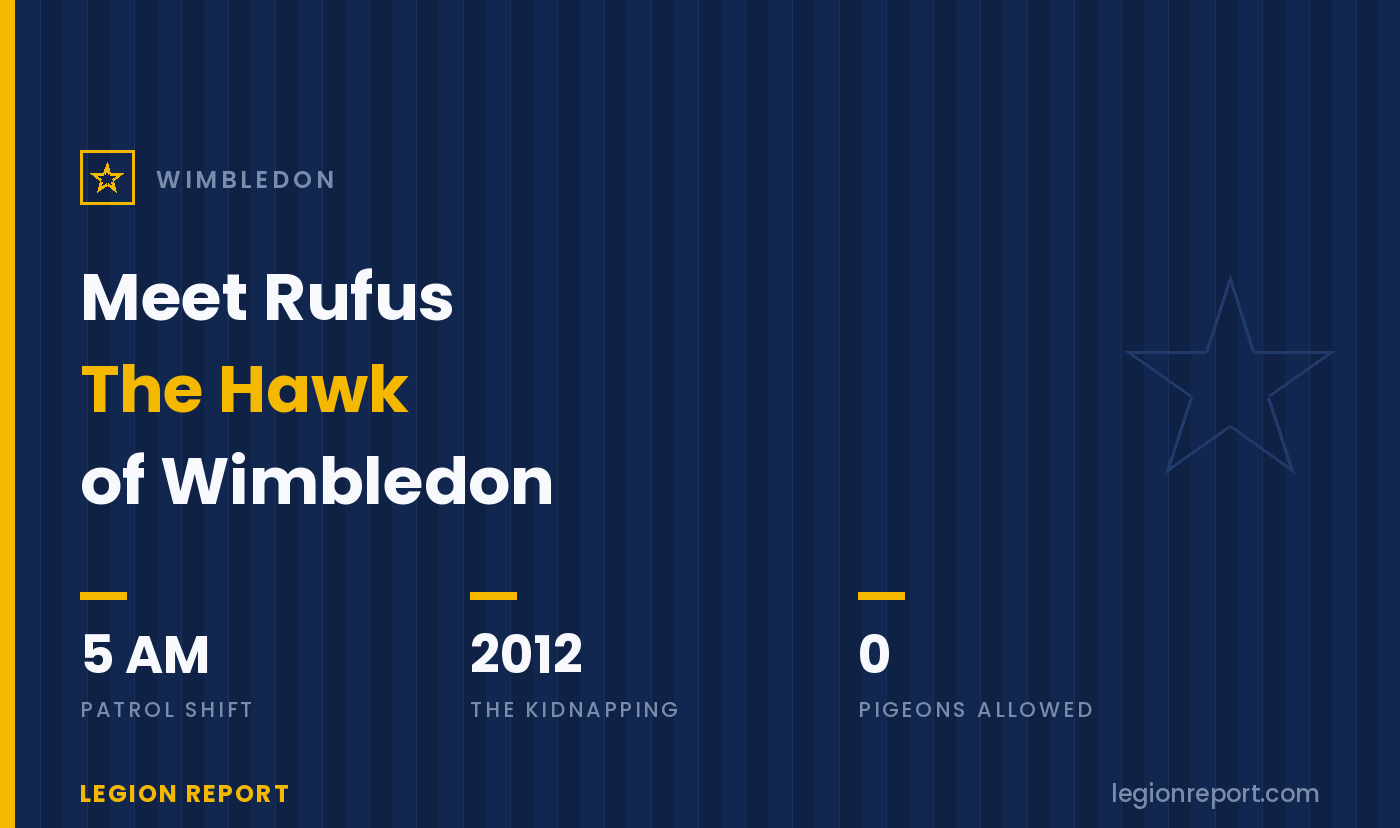

Wimbledon employs a hawk. His name is Rufus, he’s a Harris’s hawk, he reports for work before dawn during the Championships, he carries his own security accreditation, and his job title, printed on the pass, is “Bird Scarer.” Every morning before the gates open, Rufus flies patrol over Centre Court and the grounds to convince the local pigeons that the most famous lawns in tennis are hawk territory, so that play can proceed un-pecked and un-interrupted.
He is also, quietly, one of the most famous animals in sports: a social media star, a celebrity with his own interviews (conducted via his handler), and the victim of one of the strangest crimes in Wimbledon history, a 2012 kidnapping that made national news and ended in a recovery worthy of a caper film. Here’s the full story of the Championships’ feathered head of security.
The chart below covers the job, the daily routine, the great 2012 theft, and the Rufus file. Take a look, then we’ll break it all down.
Why a Grand Slam needs a bird of prey
The problem Rufus solves is deliciously mundane: pigeons. The most manicured lawns in sports are, from a pigeon’s perspective, a buffet, freshly sown ryegrass seed, quiet mornings, endless perches, and a pigeon strutting across Centre Court mid-rally is both a play stoppage and a groundskeeping insult. Wimbledon’s answer is older than any technology: a Harris’s hawk on dawn patrol makes the entire grounds read, in pigeon cognition, as an active predator’s territory, and the pigeons simply choose to live elsewhere. Crucially, it’s deterrence rather than hunting, Rufus scares, he doesn’t catch, which is why the arrangement delights rather than horrifies: no nets, no spikes, no harm, just a few million years of instinct deployed before breakfast.
The dawn shift and the family firm
Rufus works falconer’s hours. During the Championships he arrives before dawn and flies the grounds, Centre Court included, for a few hours before the gates open, then clocks out as the humans arrive, invisible to the crowds whose tournament he quietly protects. His handler is Imogen Davis of Avian Environmental Consultants, the family firm that has run Wimbledon’s bird patrol across two hawks, Rufus inherited the beat from his predecessor, Hamish, and his client list extends beyond SW19: the same bird works Westminster Abbey, giving him comfortably the most distinguished résumé in British pest control. He also holds genuine Wimbledon accreditation: a photo security pass, much photographed by delighted media, listing his occupation as “Bird Scarer.”
The kidnapping that made him a star
Rufus’ celebrity has a precise origin: crime. During the 2012 Championships he was stolen overnight from a car, cage and all, a theft that escalated instantly into national news, complete with police appeals and a tournament suddenly, absurdly, hawkless. Days later he was handed in anonymously, unharmed, and returned to patrol; the thief was never identified, and the case remains one of sport’s strangest unsolved crimes. The fame stuck: the social media accounts, broadcast cameos, and celebrity “interviews” (conducted, diplomatically, through his handler) all date from the heist, making Rufus that rare victim whose kidnapping launched a media career. He remains, by any engagement metric, one of the most popular figures at the Championships, and unlike the players, he has never lost here.
Final Word
Rufus the Hawk, explained: a Harris’s hawk employed by Wimbledon to fly dawn patrols during the Championships, scaring (never harming) the pigeons off the world’s most famous lawns; handled by Imogen Davis of the family firm that has run the patrol since his predecessor Hamish; holder of an official security pass reading “Bird Scarer”; moonlighter at Westminster Abbey; and survivor of the 2012 mid-tournament kidnapping that made him a national celebrity. Wimbledon has a hawk, the hawk has a pass, and the pigeons have, wisely, moved on.
The lawns he protects are explained in why Wimbledon is played on grass, the humans queuing outside his patrol zone are in the Wimbledon Queue explained, and the tournament’s other beloved rituals live in strawberries and cream at Wimbledon.