
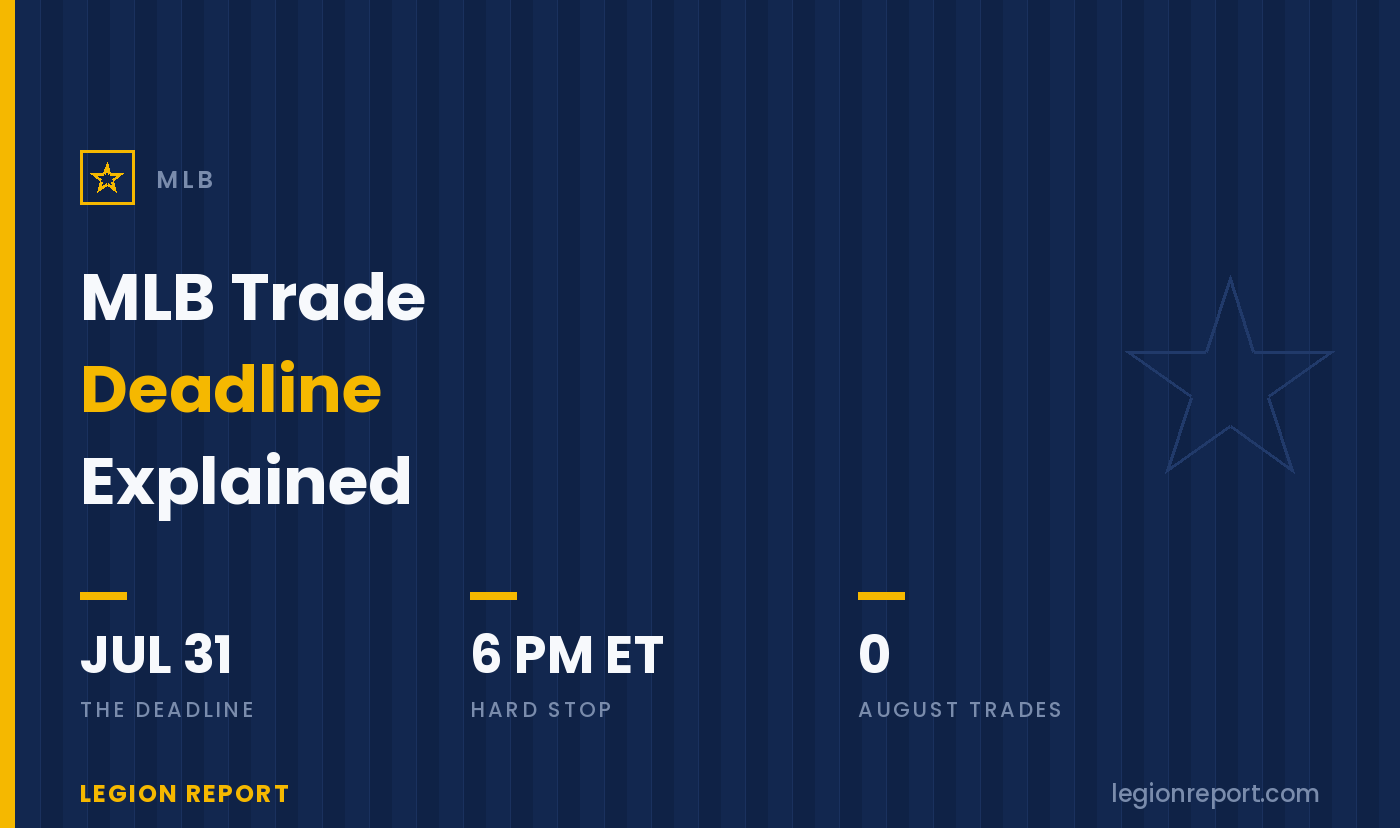

At 6 p.m. ET on July 31, Major League Baseball’s trade market slams shut, completely. Since 2019 there is no August escape hatch, no waiver-trade workaround, no second deadline: the July date is the only one, which is precisely why the final 48 hours have become baseball’s frantic midseason holiday, complete with all-night front-office phone banks, flight-tracking fans, and stars learning mid-game that they’ve been dealt.
The rules underneath the frenzy are more interesting, and more misunderstood, than the rumor mill suggests: draft picks mostly can’t be traded, “players to be named later” are governed by a real clock, and there’s a hidden second date (August 31) that quietly decides who’s eligible for the postseason. Here’s the complete machinery, three weeks before it matters.
The chart below covers the deadline itself, what can and can’t be traded, what changed in 2019, the buyer/seller playbook, and the most famous deadline deals ever. Take a look, then we’ll break it all down.
One bell, no loopholes
The modern deadline’s defining feature is its finality. Until 2019, July 31 was merely the “non-waiver” deadline: August offered a shadow market where players who cleared revocable waivers could still be dealt, producing legendary midnight heists like Justin Verlander to Houston at 11:59 p.m. on August 31, 2017, five weeks before he helped win a World Series. That loophole is gone. Since 2019 there is one deadline, and after 6 p.m. ET on July 31 the only ways to add talent are waiver claims on players other teams cut loose and free-agent signings, which is where the calendar’s hidden second date matters: a player must be in his new organization by August 31 to be eligible for that team’s postseason roster. The single bell compressed all of baseball’s midseason strategy into one week, and turned deadline day itself into the sport’s best non-playoff television.
The machinery: prospects as currency, picks off the table
What makes MLB’s deadline unlike the NBA’s or NFL’s is what’s not tradeable: draft picks, with the lone exception of competitive-balance round selections, meaning July’s market runs almost entirely on prospects-for-veterans exchanges and farm-system rankings function as the real currency. The supporting rules shape every rumor you’ll read: “players to be named later” are governed by a six-month naming clock (often chosen from a pre-agreed list); teams can attach cash to pay down bad contracts, converting salary relief into prospect value; and players hold real veto power through no-trade clauses and 10-and-5 rights (ten years in the majors, five with the current club). The strategic vocabulary follows from the structure, buyers ship tomorrow for today, sellers reverse it, and the “rental” (an expiring-contract star offering ten weeks and a playoff run) remains the deadline’s signature gamble, priced somewhere between a title and a Bagwell-for-Andersen disaster.
Three weeks out: how to watch 2026’s market form
The deadline’s rhythm is predictable even when the names aren’t. Early July sorts the league into buyers, sellers, and the bubble teams whose next two weeks of games decide which; the single deadline forces the bubble to commit with two months of season left, which is exactly the honesty the 2019 rule change intended. Relievers will be overpaid (they always are, October bullpens win titles), rentals will move latest (their price only drops as the bell nears), and at least one contender will make the kind of controllable-years mega-trade the Soto and Scherzer-Turner deals templated. Our deadline coverage will track the moves as they land, and this page gets its 2026 postscript the night of July 31, when baseball’s loudest quiet day goes final at 6 p.m. sharp.
Final Word
The MLB trade deadline, explained: one hard stop, July 31 at 6 p.m. ET, with no August waiver-trade escape since 2019 (the Verlander heist is now impossible); a prospects-for-veterans market where draft picks stay off the table, PTBNLs run on a six-month clock, and 10-and-5 rights give veterans veto power; an August 31 shadow date governing postseason eligibility; and a strategic playbook, buyers, sellers, rentals, written in equal parts by the 2004 Nomar gamble that ended a curse and the 1990 Bagwell trade that warns every buyer still. Three weeks to the bell.
How the prospects being traded got here is in the MLB Draft explained, the midsummer stage the deadline shares is in the 2026 All-Star Game guide, and the exhibition it follows is decoded in does the All-Star Game count?.