
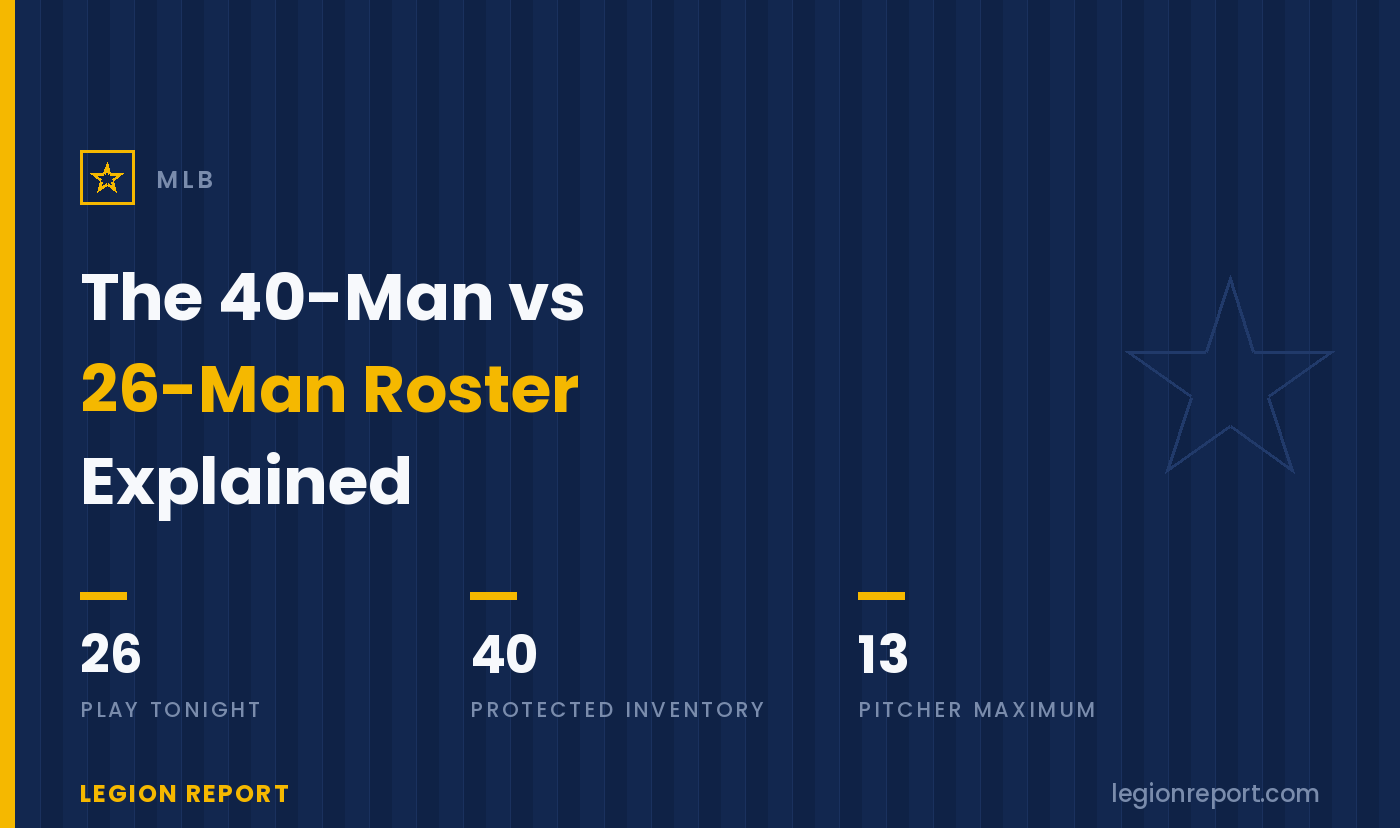

Every MLB team runs on two rosters at once, and the difference between them explains half the transactions you’ll ever read. The 26-man roster is the team you watch: the players in uniform tonight, eligible to play. The 40-man roster is the organization’s protected inventory: everyone under a major-league contract, including a dozen-plus prospects and injured players you won’t see for months, shielded from the annual talent raid known as the Rule 5 Draft.
Adding a player to the 40-man starts clocks, options, waivers, eventually free agency, which is why teams guard those last few spots like vault space, and why a November transaction adding six minor leaguers you’ve never heard of can matter more than a July trade.
The chart below covers both rosters and their rules, the September expansion, the Rule 5 protection game, and how the two lists interact in every roster move. Take a look, then we’ll break it all down.
Two lists, two jobs
The 26-man roster is the answer to “who can play tonight”: the active players, expanded from the century-old 25 in 2020, hard-capped at 13 pitchers (a rule installed to halt the ever-expanding-bullpen arms race, and the reason benches shrank to four or five players and versatile utility men became gold). A 27th man is granted for doubleheaders; in September, the limit rises to 28 with a 14-pitcher max, the tamed modern descendant of the old anything-goes September call-up era, when entire 40-man rosters could suit up for pennant races. The 40-man roster answers a different question: “who does the organization own at the major-league level?” It contains the 26, plus optioned prospects riding the Triple-A shuttle, plus injured players, and membership is a legal status, not a location: a 40-man player in Double-A holds a union card, big-league pay rates when up, and, most importantly, protection from the Rule 5 Draft.
The Rule 5 squeeze: why November matters
The 40-man’s reason for existing is theft prevention. Minor leaguers left unprotected after four or five professional seasons (depending on signing age) become eligible for December’s Rule 5 Draft, where any rival can take them for a modest fee, subject to the draft’s famous catch: a Rule 5 pick must remain on his new team’s 26-man roster all season or be offered back. That catch deters most raids, but the escapes are legendary, Johan Santana and Jose Bautista both slipped through as Rule 5 picks and became stars elsewhere, so each November brings the protection squeeze: teams must decide which prospects get the last few 40-man chairs, often by cutting useful veterans to make room, in a transaction flurry casual fans skip and evaluators study like scripture. The 40-man also runs on a pressure valve worth knowing: the 60-day injured list removes players from the 40 count entirely, which is why “transferred to the 60-day IL” so often appears in the same sentence as an unrelated addition, one move is paying for the other.
The arithmetic behind every transaction
Once you see both rosters, every confusing wire item resolves into arithmetic. Calling up a prospect not yet on the 40-man requires two openings, a 40-man spot and a 26-man spot, so somebody gets optioned, somebody else gets designated for assignment, and the announcement reads like a small chain reaction because it is one. Adding a player to the 40 also starts his option clock (three years of frictionless demotions before waivers guard the elevator) and his march toward arbitration and free agency, since service time accrues on the 26-man and big-league injured list but not on option in the minors, which is why teams delay 40-man additions as long as the Rule 5 calendar allows. The exit is never quiet: leaving the 40-man means DFA limbo, waivers, or release. Forty chairs, no standing room, and a December draft waiting to punish anyone who counts wrong, that’s the system, and “to make room, [player] was designated for assignment” is its entire philosophy in nine words.
Final Word
The 40-man vs. the 26-man roster, explained: the 26 (13 pitchers max, 28 in September, a 27th for doubleheaders) is who can play tonight; the 40 is the protected major-league inventory, guarding prospects from December’s Rule 5 Draft, starting every option clock, vented by the 60-day IL, and squeezed hard each November when protection deadlines force teams to choose between futures and depth. Every call-up is two moves, every addition evicts someone, and half of baseball’s transaction wire is just these two lists balancing their books in public.
The elevator between the rosters is covered in minor league options, explained, how players enter the inventory is in the MLB Draft, explained, and how they eventually leave it is in MLB free agency, explained.