
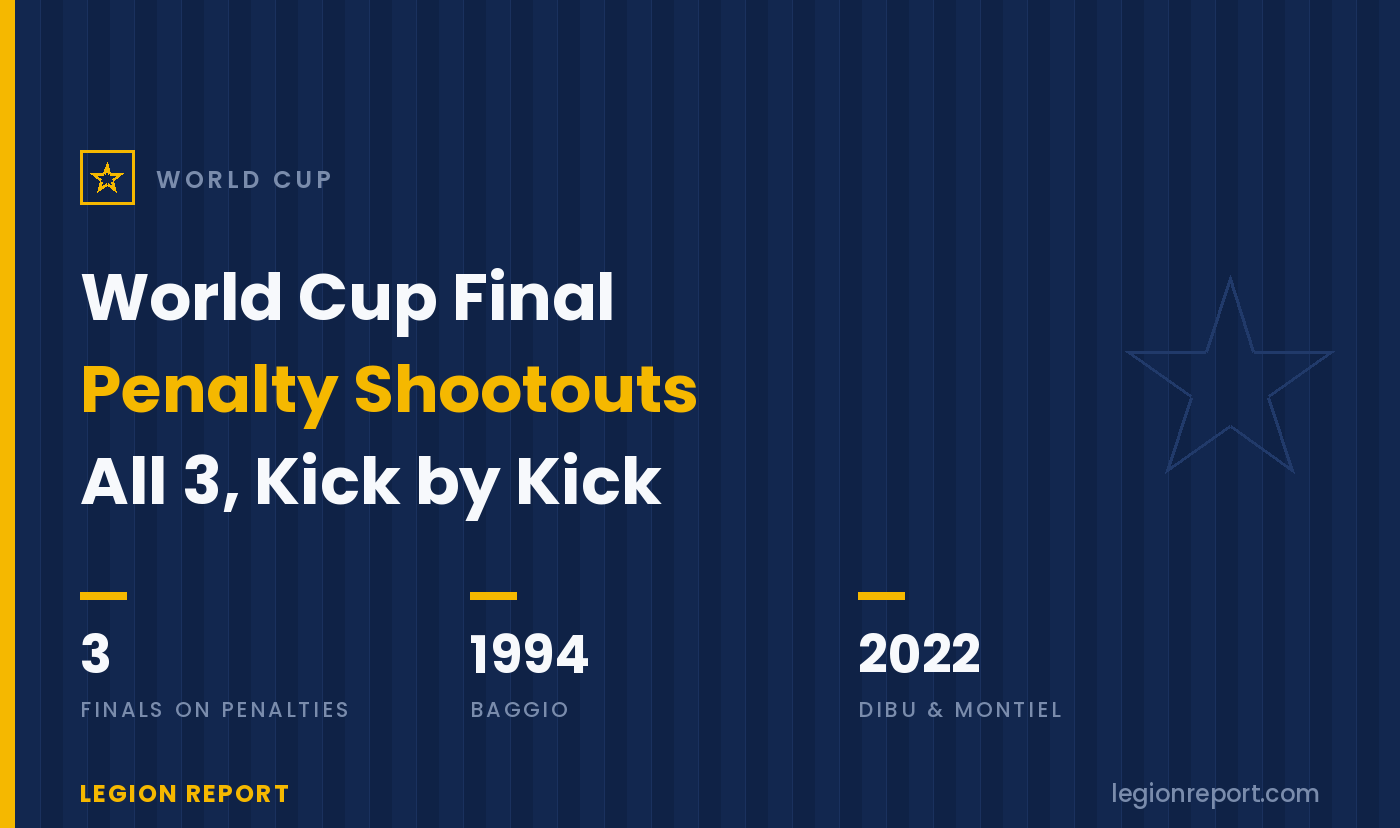

Three World Cup finals have gone all the way to penalty kicks, and between them they contain the most famous miss in soccer history, the strangest ending any final has produced, and the greatest save sequence ever performed with a trophy on the line. With the 2026 final at MetLife nine days away, and the last final having gone to a shootout, here is the complete history of what happens when the biggest game of all can’t find a winner.
Roughly one in seven finals now ends from twelve yards, and the format’s evolution, from replays to sudden death to today’s ABBA-debated five-round duel, is its own story.
The chart below covers all three final shootouts kick by kick, the heroes and the haunted, and the rules that will govern one at MetLife if it comes to that. Take a look, then we’ll break it all down.
Baggio, Zidane, Martínez: How Each Shootout Made a Legend (or Unmade One)
The three final shootouts function as a triptych of what penalties do to people. The 1994 edition made a martyr: Roberto Baggio, the ponytailed genius who had dragged Italy through the knockout rounds nearly alone, put the decisive kick over the crossbar in Pasadena, and the image of him standing motionless, head bowed, at the penalty spot became perhaps the most famous photograph in the sport’s history, a career of brilliance compressed by memory into one miss. The 2006 edition made an absence: Zinédine Zidane had already authored the final’s audacious opening, a chipped Panenka off the crossbar and in, before his career ended with the extra-time headbutt of Marco Materazzi, so soccer’s best player watched from the tunnel as David Trezeguet’s kick hit the bar and Fabio Grosso won Italy its fourth title. And the 2022 edition made a new archetype: Emiliano Martínez, Argentina’s goalkeeper, turned the shootout into performance art, the outstretched-leg save from Kingsley Coman, the delays, the psychological warfare that sent Tchouaméni’s kick wide, establishing the modern truth that shootouts are no longer luck but a craft with its own specialists. Three shootouts, three completely different lessons, one common thread: nobody involved was ever remembered the same way again.
Why the Format Exists, and the Edge Nobody Talks About
For most of World Cup history, a drawn final would simply have been replayed, the 1930s did exactly that with early knockout matches, and the specter of asking exhausted squads for a second final days later hung over every close final into the 1970s. FIFA adopted the shootout for the knockout rounds in 1978, and it took until 1994 for a final to need one; since then the rate has accelerated, with two of the last three finals decided from the spot, a function of how tactically tight finals have become. The mechanics at MetLife would be the classic best-of-five: alternating kicks by players still on the pitch after extra time, sudden death beyond five rounds, with two coin flips setting the end and the order. That second flip matters more than casual fans realize: the team kicking first wins roughly 60% of shootouts historically, a pressure asymmetry (the second kicker is more often shooting to survive rather than to lead) that analytics folks have lobbied FIFA about for years, spawning the “ABBA” alternating-order experiments in other competitions. The World Cup has kept tradition, which means if July 19 finishes level, a coin will quietly hand one team the biggest small advantage in sports before a single ball is struck.
Final Word
World Cup final penalty shootouts, all three: 1994’s Brazil-Italy at the Rose Bowl, the first goalless final, immortalized by Baggio’s miss; 2006’s Italy-France in Berlin, where Zidane’s Panenka and headbutt bookended Trezeguet’s crossbar and a perfect five-for-five from Italy; and 2022’s Argentina-France at Lusail, the greatest final ever played, settled by Dibu Martínez’s theater and Montiel’s clincher. Roughly one final in seven now ends from twelve yards, the kicking-first coin flip is worth about a 60-40 edge, and with a possible 2022 rematch looming at MetLife on July 19, the fourth entry in this list might be nine days away.
The full mechanics live in penalty shootout rules, explained, the 30 minutes that come first are covered in how extra time works, and every final result is listed in World Cup finals history.