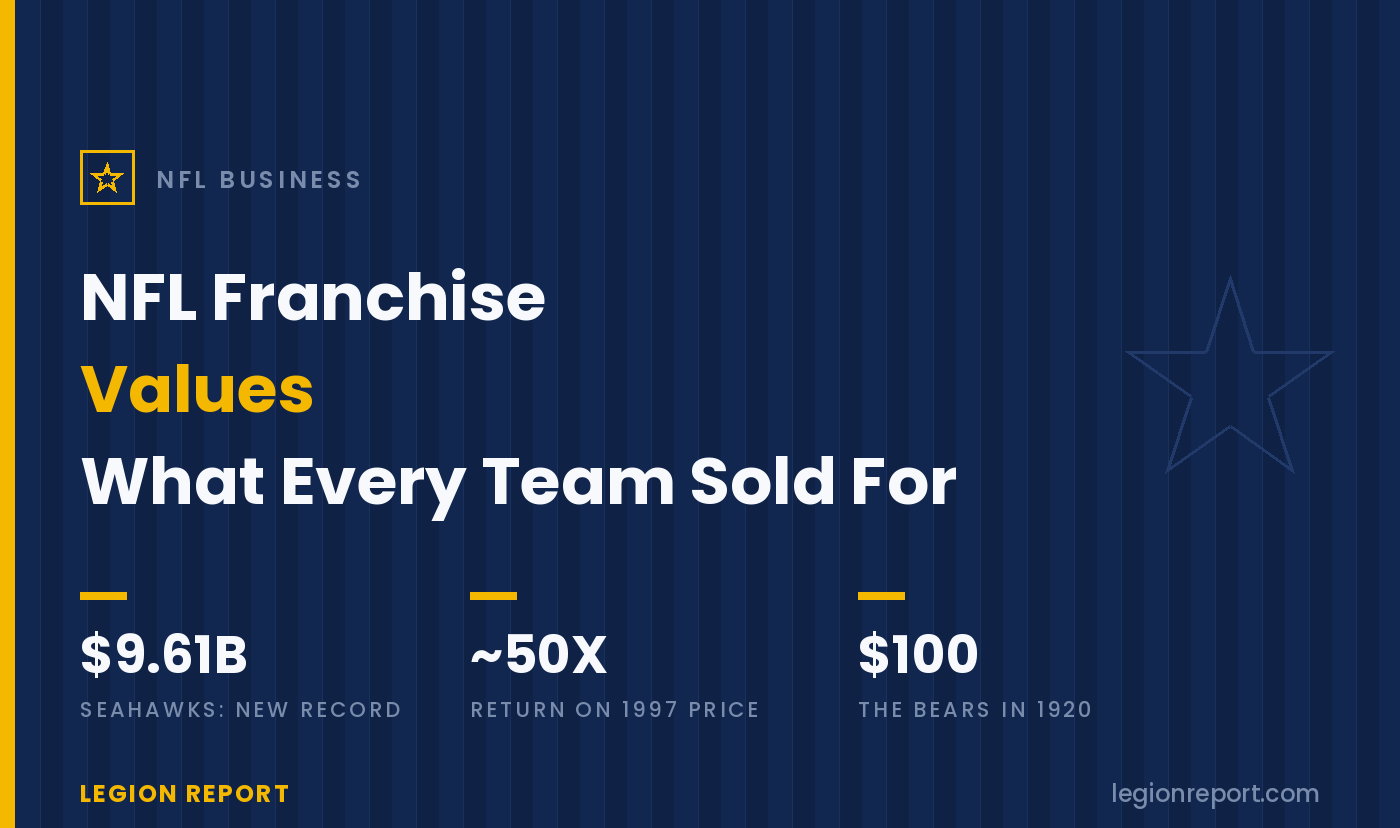
The Seattle Seahawks just sold for $9.612 billion — the most ever paid for an NFL franchise, obliterating the Washington Commanders’ $6.05 billion record by more than 50%, and nearly 50 times what the late Paul Allen paid for the same team in 1997. The buyer: the family of tech billionaire Vinod Khosla, the Sun Microsystems co-founder, purchasing the defending Super Bowl champions from Allen’s estate, with the sale of his teams to fund charity written into Allen’s own will.
It’s the perfect moment to look at the strangest investment class in America. Below: what all 32 NFL franchises last sold for, what they’re worth now, and why the gap between those two numbers has minted more billionaires than almost any asset on Earth.
The chart below covers the record sale, the full 32-team ledger of purchase prices and current values, and the economics underneath. Take a look, then we’ll break it all down.
NFL Business
NFL franchise values: what every team sold for vs. today
$9.61B
Seahawks: the new record
~50x
return on Allen’s 1997 buy
$100
what the Bears cost in 1920
32/32
teams worth $4B+ & profitable
All 32 franchises: last control sale vs. value today
| Team |
Last control sale |
Price then |
Est. value now |
| Dallas Cowboys |
1989 — Jerry Jones buys from Bum Bright |
$150M |
Est. $12.8B |
| Los Angeles Rams |
2010 — Stan Kroenke takes full control |
$750M |
Est. $10.4B |
| Las Vegas Raiders |
1966 — Al Davis’s original stake; Davis family control ever since |
$18.5K stake |
Est. $9.9B* |
| Seattle Seahawks |
2026 — the Khosla family buys from the Paul Allen estate (Allen paid $194M in 1997) |
$9.612B |
$9.612B — SOLD JULY 2026 |
| San Francisco 49ers |
1977 — the DeBartolo family buys in |
$13M |
Est. $9.9B |
| New England Patriots |
1994 — Robert Kraft buys the team he’d been a season-ticket holder of |
$172M |
Est. $9.1B |
| New York Giants |
1925 — Tim Mara’s founding fee (Mara family ever since) |
$500 |
Est. $8.6B |
| Philadelphia Eagles |
1994 — Jeffrey Lurie buys from Norman Braman |
$185M |
Est. $8.4B |
| New York Jets |
2000 — Woody Johnson outbids Cablevision |
$635M |
Est. $7.7B |
| Miami Dolphins |
2008-09 — Stephen Ross completes his buyout |
$1.1B |
Est. $7.7B |
| Washington Commanders |
2023 — Josh Harris’s group buys from Dan Snyder (then the NFL record) |
$6.05B |
Est. $7.5B |
| Houston Texans |
1999 — Bob McNair’s expansion fee |
$700M |
Est. $7.4B |
| Chicago Bears |
1920 — George Halas & the Staleys’ league entry fee (McCaskey family since) |
$100 |
Est. $7.0B |
| Green Bay Packers |
Never sold — community-owned via public stock since 1923 |
— |
Est. $6.8B |
| Denver Broncos |
2022 — the Walton-Penner group buys from the Bowlen trust |
$4.65B |
Est. $6.7B |
| Atlanta Falcons |
2002 — Arthur Blank buys from the Smith family |
$545M |
Est. $6.6B |
| Pittsburgh Steelers |
1933 — Art Rooney’s founding fee (Rooney family ever since) |
$2,500 |
Est. $6.5B |
| Kansas City Chiefs |
1959 — Lamar Hunt’s AFL founding fee (Hunt family ever since) |
$25K |
Est. $6.4B |
| Baltimore Ravens |
2000-04 — Steve Bisciotti’s staged buyout from Art Modell |
Est. $600M |
Est. $6.4B |
| Los Angeles Chargers |
1984 — Alex Spanos buys majority control |
Est. $48M |
Est. $6.3B |
| Cleveland Browns |
2012 — Jimmy Haslam buys from Randy Lerner |
$1.05B |
Est. $6.3B |
| Minnesota Vikings |
2005 — the Wilf family buys from Red McCombs |
$600M |
Est. $6.2B |
| Detroit Lions |
1963 — William Clay Ford buys sole control (Ford family since) |
$4.5M |
Est. $5.9B |
| Tennessee Titans |
1959 — Bud Adams’ AFL founding fee (Adams family since) |
$25K |
Est. $5.8B |
| Tampa Bay Buccaneers |
1995 — Malcolm Glazer buys from the Culverhouse estate |
$192M |
Est. $5.7B |
| Indianapolis Colts |
1972 — Robert Irsay lands the Colts via the great Rams franchise swap |
Est. $12M |
Est. $5.7B |
| Jacksonville Jaguars |
2011 — Shad Khan buys from Wayne Weaver |
$770M |
Est. $5.6B |
| Arizona Cardinals |
1932 — Charles Bidwill’s purchase (Bidwill family ever since) |
$50K |
Est. $5.6B |
| New Orleans Saints |
1985 — Tom Benson buys the team (Gayle Benson inherited in 2018) |
$70M |
Est. $5.5B |
| Buffalo Bills |
2014 — the Pegulas buy from the Ralph Wilson estate |
$1.4B |
Est. $5.5B |
| Carolina Panthers |
2018 — David Tepper buys from Jerry Richardson |
$2.275B |
Est. $5.4B |
| Cincinnati Bengals |
1967 — Paul Brown’s AFL expansion group (Brown family ever since) |
Est. $7.5M |
Est. $5.3B |
Sorted by estimated current value. “Estimated value” figures (estimated) are rounded from the latest published CNBC/Forbes-style valuations and vary by outlet; two are anchored to actual 2026 transactions — the Seahawks’ $9.612B sale and the Raiders’ $9.9B valuation set when Egon Durban bought a 25% stake in March. Founding-era fees (Bears $100, Giants $500, Steelers $2,500) are league entry fees, the closest thing those never-sold franchises have to a purchase price.
The Seahawks deal, in brief
| The price |
$9.612 billion — an NFL record by $3.5B+, and just shy of the Lakers’ $10B all-sports record |
| The buyers |
The Khosla family — Sun Microsystems co-founder & VC Vinod Khosla, with wife Neeru as controlling owner — beating a group tied to the Mittal steel dynasty |
| The seller |
Paul Allen’s estate: his will directed his teams be sold for charity — the Trail Blazers went for $4.1B last fall |
| The timing |
Sold as DEFENDING SUPER BOWL CHAMPIONS, five months after beating the Patriots 29-13 — championship equity, priced in |
| The fine print |
Khosla must divest his 3.1% 49ers stake; NFL owners vote on approval, expected in August; the Lumen Field lease runs through 2032 |
Pattern worth noting: the last three NFL buyers (Tepper, Harris, Khosla) were all minority owners of other teams first — the league grooms its billionaires.
Why the numbers only go up
| The media machine |
$125.5B in national TV/streaming deals through 2033 — roughly $380M per team, per year, before selling a single ticket |
| The floor |
Every one of the 32 teams is profitable and worth $4B+ — no other league on Earth can say either |
| The scarcity |
Just three teams have formally hit the market in a decade — 32 assets, near-zero supply, a growing billionaire class |
| The new money |
Private equity can now own up to 10% of a franchise — widening the bidder pool exactly as prices leave individual net worths behind |
The one asterisk in the sport’s economics: even at these prices, buyers keep paying above the published valuations — the Seahawks “were worth” $7B on paper and sold for $9.6B.
Sale prices via league records and contemporary reporting; current values rounded from the latest published valuations. The Seahawks sale (agreed July 11, 2026) awaits NFL owner approval, expected in August; this page updates as sales and valuations move.
How the valuations get made: CNBC’s Michael Ozanian unveils the official NFL team valuations — the framework behind the right-hand column above.
The Greatest Asset Class Nobody Can Buy
Read the table’s left and right columns together and the story tells itself: Jerry Jones paid $150 million for the Cowboys in 1989 and was mocked for overpaying — the franchise is worth roughly 85 times that now. Robert Kraft’s $172 million for the Patriots and Jeffrey Lurie’s $185 million for the Eagles, both in 1994, look like typos next to today’s estimated $9.1B and $8.4B. And the founding-era rows read like fiction: the Bears entered the league for $100, the Giants for $500, the Steelers for $2,500, sums that wouldn’t buy a club seat at the stadiums those fees eventually built. The engine underneath is the most reliable in sports business: $125.5 billion in national media contracts through 2033 hands every team roughly $380 million a year before a single ticket is sold, which is why all 32 franchises are profitable, all 32 are worth at least $4 billion, and the “worst” investment in the table has outperformed nearly every index fund in American history. What keeps prices accelerating is scarcity: only three teams have formally come to market in a decade, so each sale is an auction among the world’s richest people for an asset that essentially cannot lose money — and each auction resets the comps for the other 31.
What the Seahawks Sale Just Reset
Saturday’s deal moved every benchmark at once. At $9.612 billion, the Khosla family paid 59% above the Commanders’ three-year-old record, roughly $2.6 billion above the Seahawks’ own published valuation, and within sight of the Lakers’ $10 billion all-sports record, for a franchise Paul Allen bought in 1997 for $194 million — a ~50x return that will now fund charitable causes, per the will Allen wrote before his 2018 death. The details sketch the modern playbook: Vinod Khosla, like David Tepper and Josh Harris before him, was already a minority owner elsewhere (a 3.1% 49ers stake he must now divest), the winning bid beat a group tied to the Mittal steel dynasty, and control formally lands with Neeru Khosla, who becomes one of the league’s few women controlling owners. The knock-on effects hit the rest of the table immediately: the Raiders’ $9.9 billion March valuation suddenly looks conservative, the Dolphins’ recent minority-stake sale at a $12.5 billion implied valuation looks prophetic, and every future estate sale — and the NFL’s aging ownership ranks guarantee more — starts its bidding from the number Seattle just printed. The Commanders’ record lasted three years. Nobody in the league office expects this one to last much longer.
Final Word
NFL franchise values, the full ledger: the Seahawks’ record $9.612 billion sale to the Khosla family tops a 32-team table that runs from founding fees of $100 (Bears), $500 (Giants), and $2,500 (Steelers) through Jerry Jones’s $150M Cowboys, the expansion checks of the 90s, and the modern mega-sales — Panthers $2.275B, Broncos $4.65B, Commanders $6.05B — against current valuations that start at roughly $5.3 billion and top out near $13 billion in Dallas, powered by $125.5 billion in guaranteed media money and the scarcest supply in global sports. The chart above updates with every sale, stake, and valuation cycle — and if the last decade is precedent, the record row won’t stay gold for long.
For more of the money side, see how the NFL salary cap works, the most valuable football cards ever sold, and NFL Hall of Famers by team.