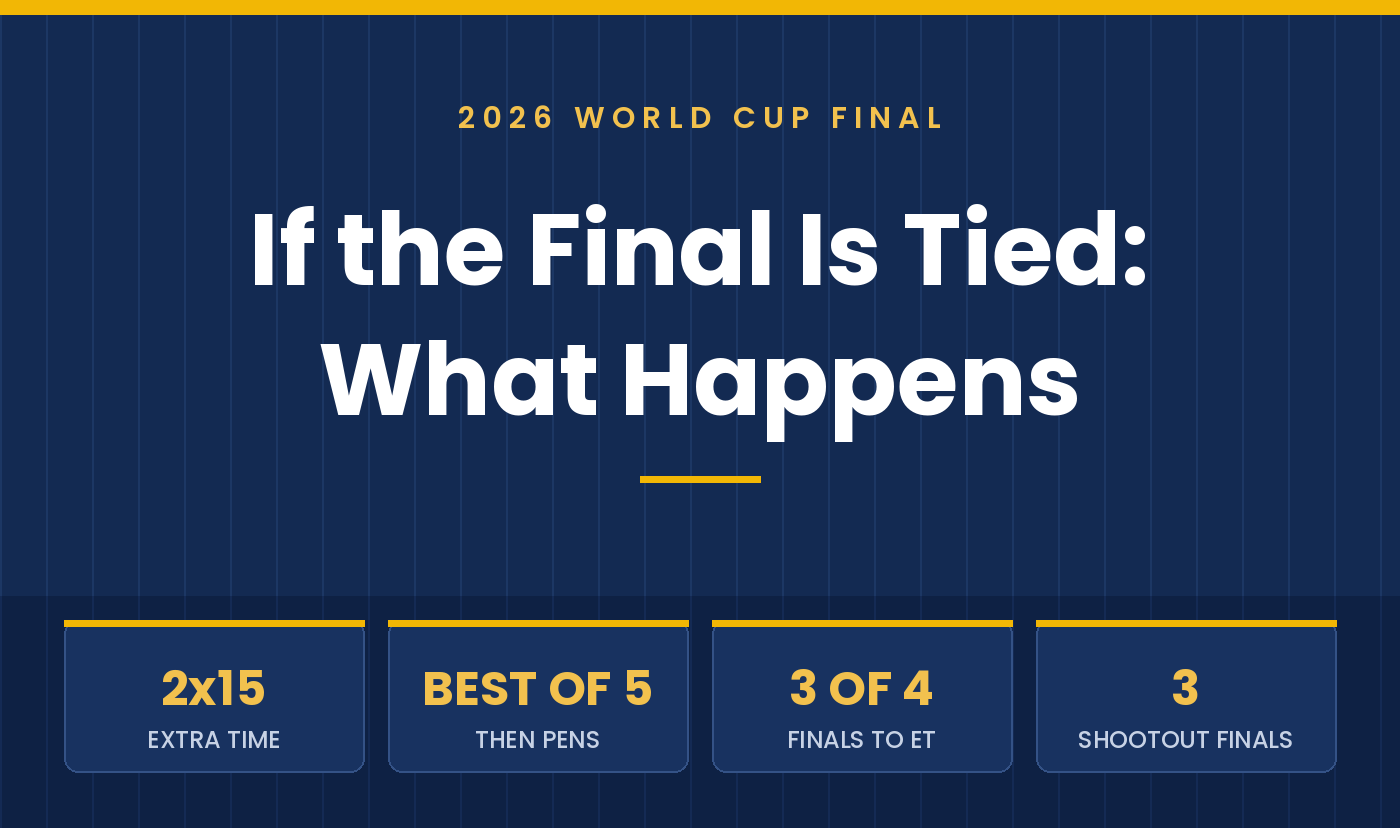
If the World Cup final ends in a tie after 90 minutes, the teams play 30 minutes of extra time — two 15-minute periods, with stoppage time added to each and a sixth substitution unlocked. If it’s still level after 120 minutes, the champion is decided by a penalty shootout: best-of-five kicks, then sudden death. There are no replays and no shared trophies; Sunday’s Spain-Argentina final at MetLife Stadium ends with one winner, however long it takes.
And recent history says pack patience: three of the last four finals needed extra time, and three finals in history have gone all the way to penalties — 1994 (Brazil over Italy), 2006 (Italy over France) and 2022, when Argentina beat France 4-2 in a shootout after a 3-3 classic. Argentina, in other words, won its current title this exact way, with Emiliano Martínez playing shootout hero.
2026 World Cup Final
If the Final Is Tied: The Full Procedure
Extra time, then penalties — and how often it’s actually happened
2×15Extra Time
Best of 5Then Shootout
3 of 4Recent Finals to ET
3Shootout Finals Ever
The Procedure, Step by Step
FIFA regulations for the 2026 final.
| Situation |
What Happens |
Detail |
| Tied after 90 minutes |
Extra time |
Two 15-minute periods, stoppage time added to each, plus a sixth substitution allowed |
| Tied after 120 minutes |
Penalty shootout |
Best-of-five kicks from the spot, then sudden death rounds |
| Replays |
Never |
The champion is crowned Sunday night, whatever it takes |
Every Final That Needed More Than 90 Minutes (Modern Era)
| Year |
Score |
How It Ended |
| 2022 |
Argentina 3, France 3 |
Argentina won the shootout 4-2 — the epic Messi-Mbappé final |
| 2014 |
Germany 1, Argentina 0 (AET) |
Götze’s 113th-minute winner |
| 2010 |
Spain 1, Netherlands 0 (AET) |
Iniesta in the 116th minute |
| 2006 |
Italy 1, France 1 |
Italy won the shootout 5-3 after Zidane’s red card |
| 1994 |
Brazil 0, Italy 0 |
The first shootout final; Baggio’s miss decided it |
The 2026 Wrinkles
A long final showcases this tournament’s new rules: mandatory hydration breaks 22 minutes into each half, the 10-second substitute exit rule, the 8-second goalkeeper rule, and expanded VAR — plus a connected match ball feeding data to the review booth.
Why This Matchup Could Go Long
Spain has conceded once in seven games; Argentina has scored in every match. If those cancel out at 1-1 or 0-0, the defending champs hold the shootout pedigree — and Spain hasn’t faced a single penalty situation all summer.
Watch the Clock
Regulation ends around 5 p.m. ET; a shootout finish pushes the trophy lift toward 6:30 p.m. ET — roughly midnight in Spain and 7:30 p.m. in Buenos Aires.
The Bottom Line
Tie the final and you get extra time; tie extra time and you get penalties — a path Argentina knows by heart from 2022. The common misconception that it skips straight to kicks is covered in does the final go straight to penalties?, and the card rules that shape a tense final in the yellow card rules.