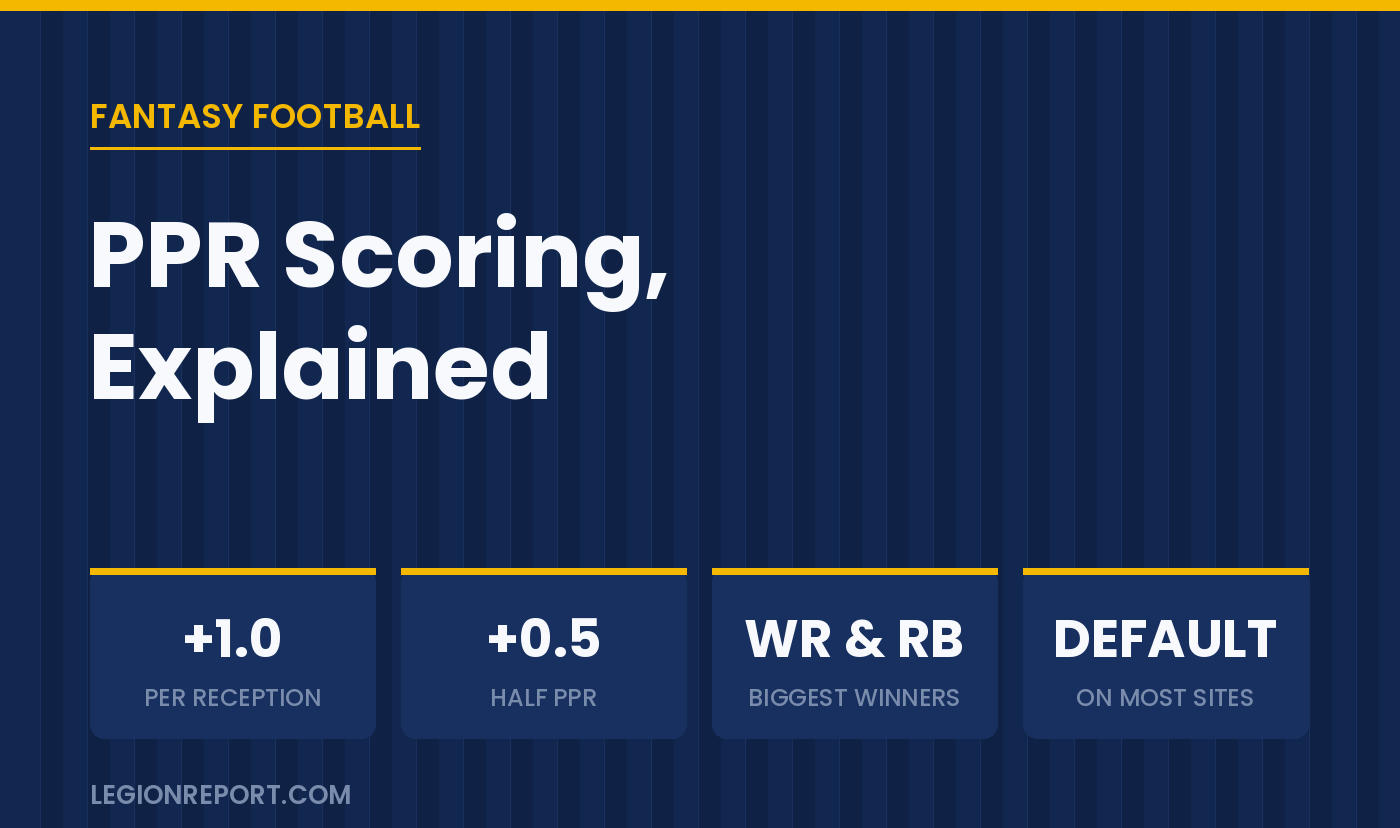
PPR stands for “points per reception,” and it’s the scoring wrinkle that reshaped fantasy football over the last 15 years. In a standard league, a player scores for yards and touchdowns. In a PPR league, he also earns a point every time he catches a pass — a full point in full PPR, half a point in half-PPR. That one rule redistributes value across the entire player pool, turning slot receivers and pass-catching running backs into weekly assets and knocking touchdown-dependent players down a peg.
It’s now the default format on most major platforms. ESPN, Yahoo, and Sleeper all default to some form of PPR, and the shift shows up everywhere from ADP to trade values to which running backs get drafted in the first round. If you’re in a PPR league and drafting off a standard-scoring cheat sheet, you’re working with the wrong numbers.
The chart below covers how PPR scoring works, who wins and loses under it, and how to adjust your draft. Take a look, then we’ll get into strategy.
FANTASY FOOTBALL
PPR Scoring, Explained
What points per reception changes — and how to draft for it
FULL PPR
+1.0
Per reception
HALF PPR
+0.5
Per reception
BIGGEST WINNERS
WR & pass-catching RB
Volume is king
BIGGEST LOSERS
TD-only players
Floor disappears
How the scoring works
Standard vs. half vs. full, side by side
| Category |
Standard |
Half-PPR |
Full PPR |
| Reception |
0 |
0.5 |
1.0 |
| Rushing / receiving yard |
0.1 (1 pt per 10 yds) |
0.1 |
0.1 |
| Rushing / receiving TD |
6 |
6 |
6 |
| Passing yard |
0.04 (1 pt per 25 yds) |
0.04 |
0.04 |
| Passing TD |
4 (some leagues 6) |
4 |
4 |
| Interception / fumble lost |
-2 / -2 |
-2 / -2 |
-2 / -2 |
| Example: 8 catches, 80 yds, 0 TD |
8.0 |
12.0 |
16.0 |
| Example: 12 carries, 80 yds, 1 TD, 0 catches |
14.0 |
14.0 |
14.0 |
Base values shown are the most common defaults; check your league’s settings.
Who rises and who falls
The redistribution of value
| Player type |
PPR effect |
| Target-hog WR1 (140+ targets) |
Biggest winners — 100 catches is 100 bonus points, a full round of extra value |
| Pass-catching RB (60+ catches) |
Rises sharply; often outscores ‘better’ rushers who never catch the ball |
| Slot / possession WR |
Goes from waiver fodder to weekly flex — volume beats explosiveness |
| Elite TE (90+ targets) |
Gap to the field widens; TE1 becomes an early-round pick |
| Early-down / goal-line RB |
Falls — touchdowns still count, but he’s now behind backs with half his rushing yards |
| Deep-threat WR (few catches, big plays) |
Falls — boom weeks still happen, but the floor collapses |
| Quarterback |
Barely moves — QBs don’t catch passes; the position’s relative value drops slightly |
How to adjust your draft
The strategy shift
| Draft adjustment |
Why |
| Wide receivers gain relative value |
The best WRs pile up catches; expect WR-heavy first two rounds |
| Prioritize target share over yards per catch |
Volume is the stat PPR pays for |
| Rethink ‘RB1’ definitions |
A committee back with 70 catches can be a top-12 RB; check receiving usage, not just carries |
| Wait longer on QB |
The gap between QB1 and QB12 shrinks relative to skill positions |
| Half-PPR splits the difference |
All effects apply at half strength — WRs still rise, just less |
PPR FACTS
Why it was invented
To reduce touchdown variance and reward consistent involvement — receptions are far more predictable week to week than scores.
It’s the default now
ESPN, Yahoo, and Sleeper all default to full or half PPR; ‘standard’ leagues are the minority.
TE Premium takes it further
Some leagues give tight ends 1.5 per catch to close the gap with WRs — a format worth knowing before you draft.
The Strategy Shift in Practice
The clearest sign of PPR’s impact is the first round: in standard leagues it’s almost all running backs, in full PPR the top wide receivers go just as early and sometimes earlier. The second effect is at running back, where the question shifts from “who gets the goal-line work?” to “who’s on the field on third down?” A back with 12 carries and 6 catches beats one with 18 carries and none most weeks. The third is at the flex, where possession receivers with 6-8 targets a game become reliable starters. None of this changes what makes a player good — it changes what makes him valuable in your league, and that’s what a draft is pricing.
The Bottom Line
PPR adds a point (or half a point) per catch, and that single rule shifts value toward volume: target-hog receivers, pass-catching backs, and elite tight ends rise, while touchdown-dependent players fall. Draft off PPR rankings, prioritize target share, and re-think what an RB1 looks like. For how the market prices those shifts, see our guide to Average Draft Position; for how to structure the draft itself, fantasy football tiers explained; and for the schedule detail that catches everyone once a year, NFL bye weeks.