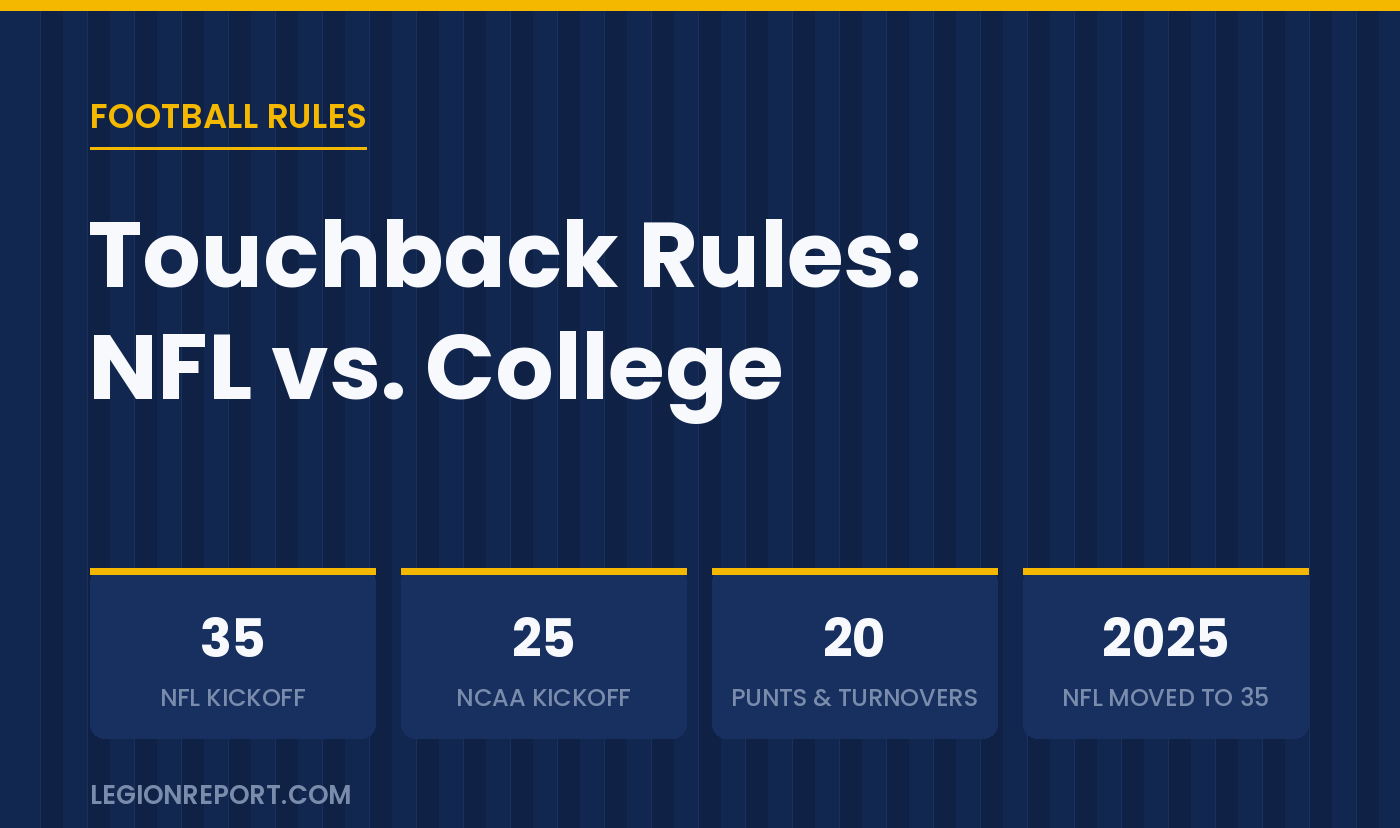
A touchback is what happens when a kick, punt, or turnover ends in the end zone without a return: the play is dead and the receiving team takes over on its own side of the field. It’s one of the most common outcomes in football and one of the least understood, because the spot where the ball comes out — the 20, the 25, the 30, the 35 — has changed repeatedly over the past decade and now differs between the NFL and college football depending on how the touchback happened.
The reason it keeps changing is player safety and return incentives. Leagues have moved touchback spots forward to discourage kick returns (fewer high-speed collisions), then moved them again when returns nearly vanished. The result in 2026: an NFL kickoff touchback comes out to the 35, a college kickoff touchback to the 25, and a punt or turnover touchback to the 20 at both levels — with a few special cases in between.
The chart below lays out every touchback scenario at each level. Take a look, then we’ll get into why the yard lines keep moving.
FOOTBALL RULES
Touchback Rules: NFL vs. College Football
Where the ball comes out — and why the yard line keeps changing
PUNT / TURNOVER
20
Both levels
BIGGEST CHANGE
2024-25
NFL dynamic kickoff
Touchback spot by scenario
Every case, both levels
| Scenario | NFL | College (NCAA) |
|---|
| Kickoff into the end zone, not returned | 35-yard line (2025-); it was the 30 in 2024 and the 25 from 2018-2023 | 25-yard line (since 2012) |
| Kickoff fair caught inside the 25 | N/A — under the dynamic kickoff a fair catch in the landing zone or end zone is a touchback to the 35 | 25-yard line (since 2018) |
| Kickoff out of bounds | Receiving team’s 40 or the spot it went out, whichever is better; kickoff short of the landing zone is also spotted at the 40 | Receiving team’s 35 or 30 yards from the kick spot, whichever is better |
| Punt into the end zone | 20-yard line | 20-yard line |
| Interception or fumble recovered in own end zone and downed | 20-yard line | 20-yard line |
| Fumble out of bounds through the opponent’s end zone | Touchback — defense gets the ball at the 20 (the ‘fumble through the end zone’ rule) | Same — touchback for the defense at the 20 |
| Missed field goal | Spot of the kick (or the 20 if snapped inside the 20) — technically not a touchback | Spot of the kick or the 20, whichever is farther out |
| Kickoff safety kick / free kick after safety | Touchback comes to the 20 (not 35) on kicks after a safety | 20-yard line |
Rules current for the 2026 seasons.
How the touchback line moved
A decade of tinkering
| Year | Change |
|---|
| 2011 | NFL moves kickoffs from the 30 to the 35 to increase touchbacks (safety) |
| 2012 | NCAA moves kickoffs to the 35 and kickoff touchbacks to the 25 |
| 2016 | NFL kickoff touchbacks move from the 20 to the 25 (initially a one-year trial) |
| 2018 | NCAA allows kickoff fair catches inside the 25 to be touchbacks at the 25 |
| 2024 | NFL ‘dynamic kickoff’ — kicking team lines up at receiving 40, touchback moves to the 30 |
| 2025 | NFL touchback moves to the 35 to further push returns; the format made permanent |
Common questions
The edge cases
| Question | Answer |
|---|
| Is a kneel-down in the end zone always a touchback? | On kickoffs and punts, yes. On a fumble or interception, a player who catches or recovers in his end zone and takes a knee gets a touchback — but if he runs out and back in, it’s a safety |
| What’s the difference between a touchback and a safety? | Who put the ball in the end zone: if the opponent’s kick/turnover put it there, touchback; if the possessing team’s own action put it there, safety |
| Why is the NFL touchback further out than college? | The NFL wanted returns back after the 2018-2023 25-yard rule cut them to record lows; the 35 penalizes kicking teams for booting it deep |
| Does the ball have to be downed? | No — a kick that lands in the end zone and rolls out, or one the returner never touches, is a touchback automatically |
TOUCHBACK FACTS
The 35 was on purpose
Moving the NFL touchback to the 35 makes a deep kick a bad outcome for the kicking team — the whole point is to force kickers to keep it short and in play.
College hasn’t followed
The NCAA still uses the 25 for kickoff touchbacks and lets returners fair-catch inside the 25 for the same spot — a safety-first design that suppresses returns.
Fumbling through the end zone
The most-hated touchback: an offensive fumble that rolls out of the opponent’s end zone gives the defense the ball at the 20. Both levels keep it, and both debate it every offseason.
Why the Yard Line Keeps Moving
Kickoffs are the most dangerous play in football, and every touchback change of the last 15 years has been a lever on that risk. Moving touchbacks to the 25 (college 2012, NFL 2016) made kneeling the smart play and cut returns — and injuries — dramatically. But returns nearly disappeared, so the NFL rebuilt the play in 2024 with the dynamic kickoff, then moved the touchback to the 35 in 2025 to make deep kicks costly again. College has stayed at the 25 with the fair-catch option, prioritizing fewer returns over more. Expect more adjustment: the NFL reviews the kickoff every offseason, and the NCAA is watching how the 35 plays out.
The Bottom Line
In 2026, an NFL kickoff touchback comes out to the 35 and a college one to the 25; punts and turnovers into the end zone come out to the 20 at both levels. The kickoff numbers are the ones that keep changing, always in service of balancing return excitement against player safety. For the signal that often decides whether a touchback happens at all, see our guide to fair catch rules, and for the passing rule with the biggest NFL-college split, intentional grounding explained.