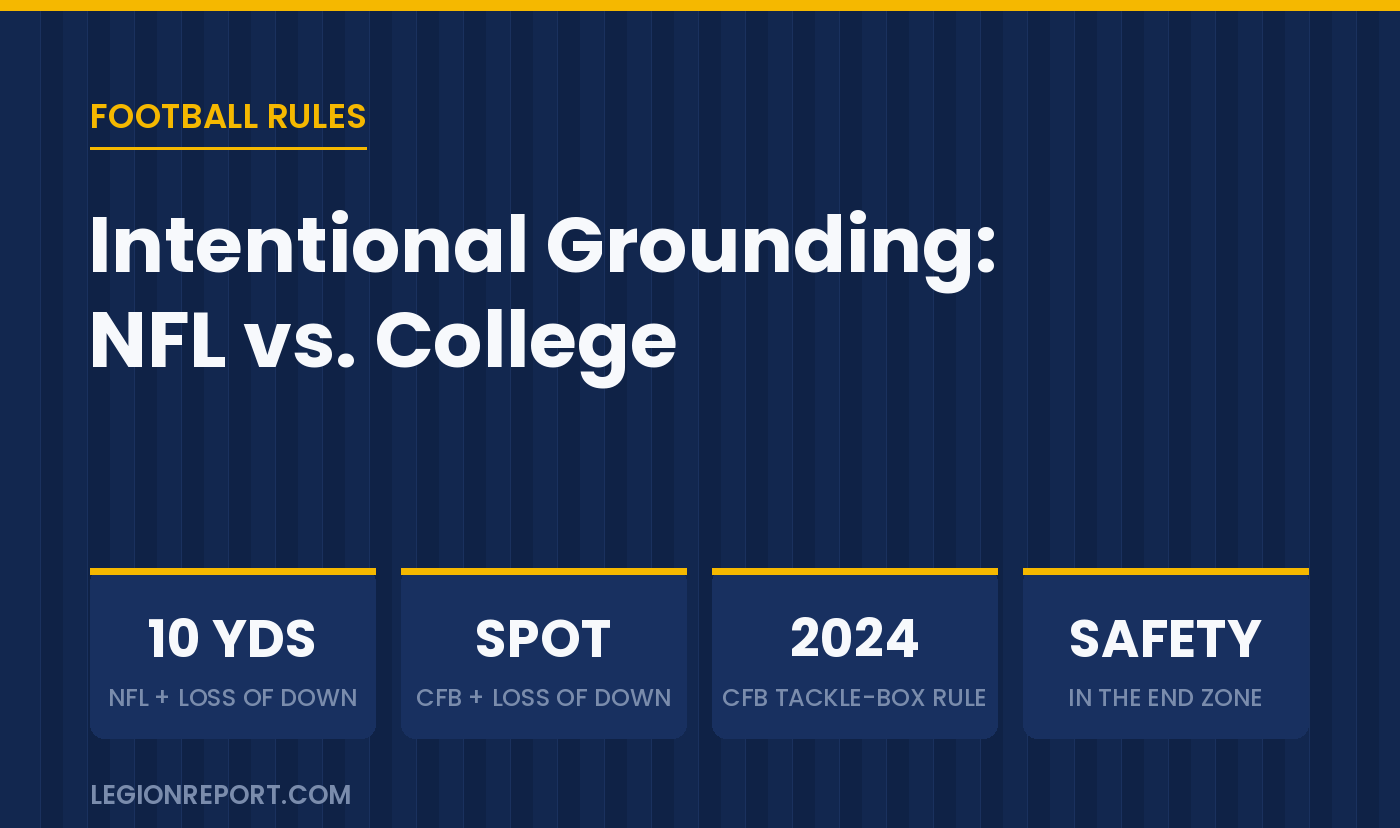
Intentional grounding is the penalty for a quarterback throwing the ball away to avoid a sack when he isn’t allowed to — and the definition of “allowed to” is where the NFL and college football part ways. Both rulebooks agree on the principle: a passer facing pressure can’t just fling the ball into the dirt with no receiver nearby to escape a loss. But the NFL carves out a big exception once the quarterback is outside the tackle box, while college football, since a 2024 rule change, has moved closer to the pro standard after years of being stricter.
The penalty is one of the more punishing in the game because it combines yardage with a loss of down, and in the NFL the spot is wherever the pass was thrown from — which is why a grounding call on a scramble backward can cost 15 or 20 yards. In the end zone, it’s a safety at both levels.
The chart below breaks down the definition, the exceptions, and the penalties side by side. Take a look, then we’ll get into the gray areas that make it the most-argued call on any given Sunday.
FOOTBALL RULES
Intentional Grounding: NFL vs. College Football
The definition, the tackle-box exception, and the penalty
NFL PENALTY
10 yds + loss of down
Or spot of the foul
CFB PENALTY
Spot + loss of down
No fixed yardage
TACKLE BOX
Both levels
College joined in 2024
END ZONE
Safety
Both levels
The rule, side by side
Where the definitions match and diverge
| Element |
NFL |
College (NCAA) |
| Definition |
A passer, facing an imminent loss of yardage due to pressure, throws a pass without a realistic chance of completion to an eligible receiver |
A passer throws a forward pass with no eligible receiver in the area, to save loss of yardage or conserve time — ‘imminent pressure’ is not required in the college definition |
| ‘Receiver in the area’ |
A receiver must be close enough to have a realistic chance; officials judge whether a receiver was ‘in the vicinity’ |
Same standard — an eligible receiver in the area of the pass |
| Outside the tackle box |
Legal to throw the ball away past the line of scrimmage — no receiver needed — if the passer is outside the tackle box (2007 rule) |
Since 2024, legal to throw the ball away past the line of scrimmage if the passer is outside the tackle box (matching the NFL); before 2024 college had no tackle-box exception |
| Spiking the ball |
Legal to spike immediately after the snap to stop the clock (must be from under center; from shotgun it’s a legal spike only if immediate) |
Legal to spike immediately after the snap to stop the clock |
| Pass tipped at the line |
Not grounding if the ball is tipped or batted by a defender |
Same |
| Contact affecting the throw |
Not grounding if a defender’s contact caused the ball to come out short or off target |
Same |
College’s tackle-box exception took effect for the 2024 season.
The penalty
What it costs
| Penalty |
NFL |
College |
| Yardage |
10 yards from the previous spot, or the ball placed at the spot of the foul if that’s a greater loss |
Loss of down at the spot of the foul (no set yardage — the ball goes to where the pass was thrown from) |
| Loss of down |
Yes |
Yes |
| From the end zone |
Safety — 2 points and a free kick |
Safety |
| Clock |
10-second runoff if grounding occurs in the final 2 minutes of a half (unless the offense takes a timeout) |
10-second runoff in the final minute of a half if the clock was running |
| Grounding + defensive foul |
Fouls offset unless the defensive foul is a personal foul |
Same offset logic |
Common scenarios
How officials rule
| Situation |
Ruling |
| QB in the pocket, throws it at a receiver’s feet 5 yards away |
Legal — a receiver was in the area, even if uncatchable |
| QB in the pocket, throws it 20 yards away from any receiver |
Grounding — no realistic chance of completion |
| QB rolls out past the tackle box, throws it 10 yards downfield out of bounds |
Legal at both levels — outside the tackle box and past the line |
| QB rolls out past the tackle box, throws it 3 yards short of the line |
Grounding — the outside-the-tackle-box exception requires the ball to reach the line of scrimmage |
| QB is hit as he throws, ball goes 15 yards away |
Not grounding if the contact caused it |
| QB throws it away while being tackled in the end zone |
Grounding — safety |
GROUNDING FACTS
The tackle box
The area between the offensive tackles’ original positions, extending back to the end line — once the passer leaves it, the throwaway is legal if the ball crosses the line of scrimmage.
The ‘in the area’ test
There’s no fixed distance. Officials ask whether a receiver could reasonably have caught it — which is why a ball thrown at a receiver’s feet is legal and one thrown into the third row isn’t.
Why college was stricter
For decades the NCAA required a receiver in the area no matter where the passer was; the 2024 change was made partly to protect quarterbacks from taking sacks on scrambles.
The Gray Areas That Get Argued Every Week
Two judgment calls generate most of the controversy. The first is ‘imminent pressure’ in the NFL: if a quarterback with time throws the ball into the dirt, that’s not grounding — the foul requires he be under threat of a sack. The second is ‘in the area’: there’s no yardage standard, so a ball that sails ten yards from the nearest receiver can be ruled either way depending on how the official reads the route. The tackle-box exception cleaned up a lot of it — a rolling quarterback simply needs to get the ball past the line — but the pocket throwaway remains the most subjective penalty in the passing game.
The Bottom Line
Intentional grounding punishes a passer for throwing the ball away with no receiver nearby to escape a loss. Both levels now allow a throwaway once the quarterback is outside the tackle box and the ball reaches the line of scrimmage — the NFL since 2007, college since 2024 — and both call a safety if it happens in the end zone. The NFL adds a 10-yard minimum; college spots the ball where the pass was thrown. For the other two big NFL-vs-college rulebook splits, see our guides to fair catch rules and touchback rules.