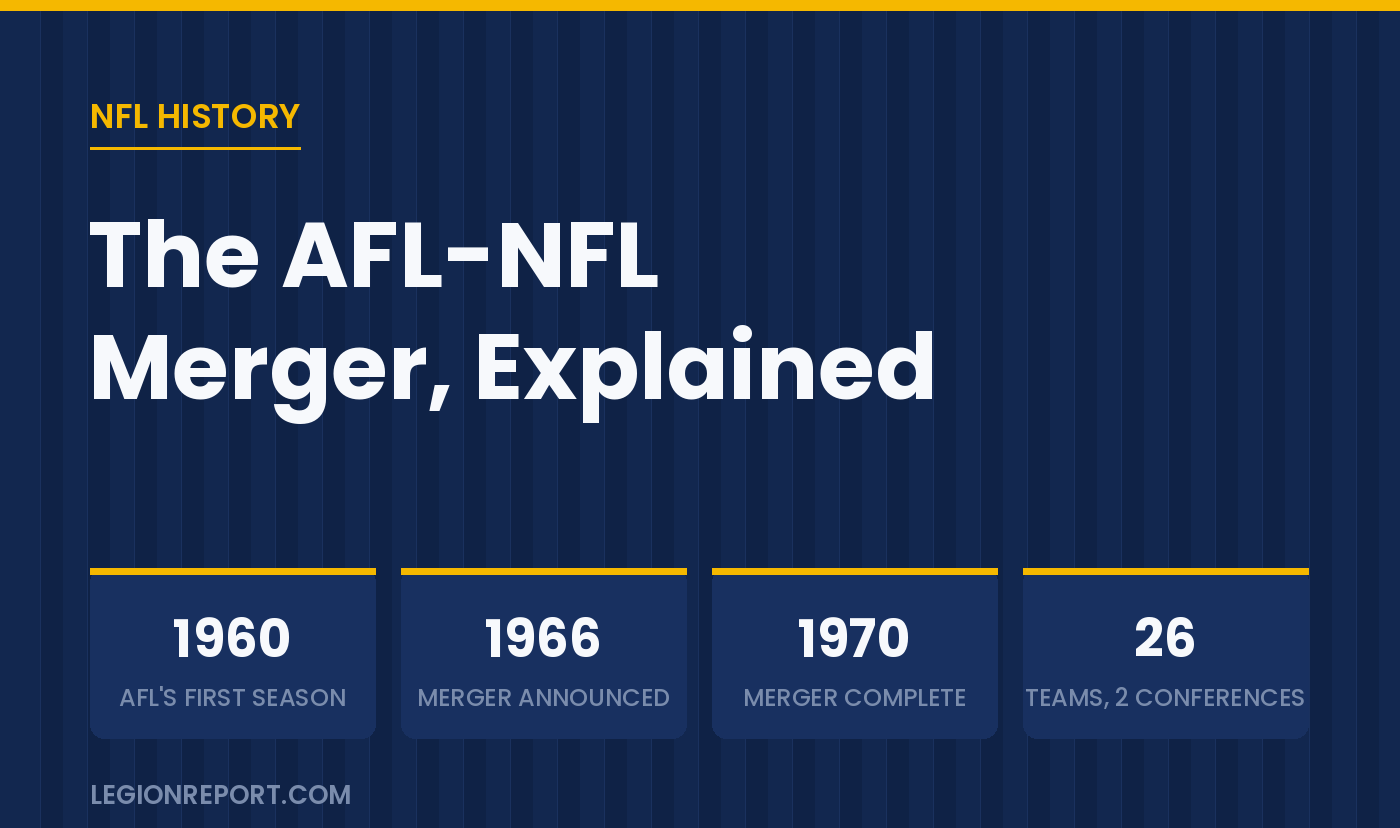
The AFL-NFL merger is the single most important business deal in American sports history. Announced on June 8, 1966 and completed for the 1970 season, it ended a six-year war between the established National Football League and the upstart American Football League, created the Super Bowl, produced the two-conference structure that still governs the sport, and turned pro football into the country’s dominant television property. Every element of the modern NFL — 32 teams in the AFC and NFC, a common draft, a shared TV contract, one champion — traces to it.
The AFL was born from rejection. In 1959, Texas oil heir Lamar Hunt was turned down for an NFL expansion franchise and responded by founding a rival league with seven other owners — the “Foolish Club” — that began play in 1960 with eight teams. The NFL dismissed it, then fought it: a bidding war for college talent sent rookie salaries soaring (Joe Namath’s $427,000 Jets contract in 1965 was the tipping point), and the AFL’s 1964 NBC television deal made it clear the new league wasn’t going away. By 1966, both sides were bleeding money and quietly talking.
The chart below covers the AFL’s rise, the merger’s terms and timeline, and what the combined league looked like on day one. Take a look, then we’ll get into why the AFL won the war it supposedly lost.
NFL HISTORY
The AFL-NFL Merger, Explained
How a six-year war built the modern NFL
AFL FOUNDED
1959
First season 1960
MERGER ANNOUNCED
June 8, 1966
Completed 1970
FIRST SUPER BOWL
Jan. 1967
Packers 35, Chiefs 10
RESULT
26 teams
AFC 13, NFC 13
Timeline of the war and the peace
1959 to 1970
| Date | Event |
|---|
| Aug. 14, 1959 | Lamar Hunt announces the American Football League with charter franchises in Dallas, Houston, Denver, Los Angeles, Minneapolis, New York, Boston, and Buffalo (Minneapolis defected to the NFL; Oakland replaced it) |
| Sept. 9, 1960 | First AFL game: Broncos 13, Patriots 10. The AFL adopts the two-point conversion and puts names on jerseys |
| 1961 | AFL wins an ABC TV deal; the NFL signs CBS. Both leagues now on national television |
| Jan. 1964 | AFL signs a 5-year, $36 million contract with NBC — the money that guaranteed its survival |
| Jan. 1965 | Jets sign Joe Namath for $427,000, the richest rookie contract in football; the bidding war escalates |
| Spring 1966 | Giants sign kicker Pete Gogolak away from the AFL’s Bills — the first raid on a signed player — and the AFL retaliates by targeting NFL quarterbacks |
| April-May 1966 | Secret talks between Hunt and Cowboys GM Tex Schramm, partly in a parked car at Dallas Love Field |
| June 8, 1966 | Merger announced: common draft in 1967, a championship game between the leagues starting January 1967, full merger for 1970 |
| Oct. 21, 1966 | Congress passes an antitrust exemption (attached to a budget bill) allowing the merger to proceed |
| Jan. 15, 1967 | First AFL-NFL World Championship Game: Packers 35, Chiefs 10 — later called Super Bowl I |
| Jan. 12, 1969 | Super Bowl III: Jets 16, Colts 7. Namath’s guarantee delivers the AFL’s first title and legitimacy |
| Jan. 11, 1970 | Super Bowl IV: Chiefs 23, Vikings 7. The AFL wins its last game as a separate league |
| 1970 season | Full merger: 26 teams in two conferences — AFC (10 AFL teams + Colts, Browns, Steelers) and NFC (13 NFL teams). Monday Night Football debuts on ABC |
Terms of the merger
What each side got
| Term | Detail |
|---|
| Commissioner | NFL commissioner Pete Rozelle led the combined league; AFL commissioner Al Davis, who had escalated the war by raiding NFL QBs, was left out and returned to the Raiders |
| Franchises | All 10 AFL teams (Bills, Bengals, Broncos, Chargers, Chiefs, Dolphins, Jets, Oilers, Patriots, Raiders) admitted with no relocations |
| Indemnity | AFL teams paid $18 million total to the NFL over 20 years, mostly from the Jets and Raiders for sharing markets with the Giants and 49ers |
| Common draft | Began January 1967; ended the bidding war for college players immediately |
| Championship game | AFL champion vs. NFL champion each January starting Jan. 1967; became ‘Super Bowl’ officially with Super Bowl III |
| Interleague preseason | Started 1967; regular-season interleague play only after 1970 |
| Realignment | Baltimore, Cleveland, and Pittsburgh moved to the AFC for $3 million each to balance the conferences at 13-13 |
| Rules | The NFL rulebook governed the merged league; the AFL’s two-point conversion was dropped (the NFL didn’t adopt it until 1994) |
The merged league, 1970
The first AFC-NFC alignment
| Conference | Division | Teams (1970) |
|---|
| AFC | East | Bills, Colts, Dolphins, Jets, Patriots |
| AFC | Central | Bengals, Browns, Oilers, Steelers |
| AFC | West | Broncos, Chargers, Chiefs, Raiders |
| NFC | East | Cardinals, Cowboys, Eagles, Giants, Washington |
| NFC | Central | Bears, Lions, Packers, Vikings |
| NFC | West | 49ers, Falcons, Rams, Saints |
The 1970 structure grew to 32 teams and 8 divisions by 2002.
MERGER FACTS
The AFL’s innovations survived
Names on jerseys, the two-point conversion (eventually), the official-time stadium clock, and revenue-sharing of TV money were AFL ideas the NFL absorbed.
Al Davis wanted to win, not merge
As AFL commissioner in 1966, Davis launched a raid on NFL quarterbacks; the merger was negotiated around him, and he never forgave the league.
The Colts got the worst of it
Baltimore won the last NFL title in 1968, lost Super Bowl III to the AFL, then was moved into the AFC — and won Super Bowl V as an AFC team two years later.
Why the AFL Won the War It ‘Lost’
On paper, the AFL was absorbed. In practice, it got everything it wanted: every franchise kept, full parity in the new structure, and — after Super Bowls III and IV — proof it could beat the NFL’s best. The merger’s real winners were the fans and the owners, who stopped fighting over talent and started sharing the largest television contracts in sports. The AFL’s insistence on splitting TV revenue equally among all teams (a Hunt principle from day one) became the NFL’s operating model and the reason a market the size of Green Bay can compete with New York. The upstart didn’t just survive; it rewrote the economics of the league that swallowed it.
The Bottom Line
The AFL-NFL merger, announced in 1966 and completed in 1970, ended a bidding war, created the Super Bowl and the AFC-NFC structure, and established shared television revenue as the NFL’s foundation. The AFL’s ten teams all survived intact and its two Super Bowl wins before the merger made the combined league a genuine union rather than an acquisition. For the title game the merger absorbed, see our companion history of the NFL Championship Game, and for the modern schedule structure that grew out of the 1970 alignment, how the NFL schedule formula works.