
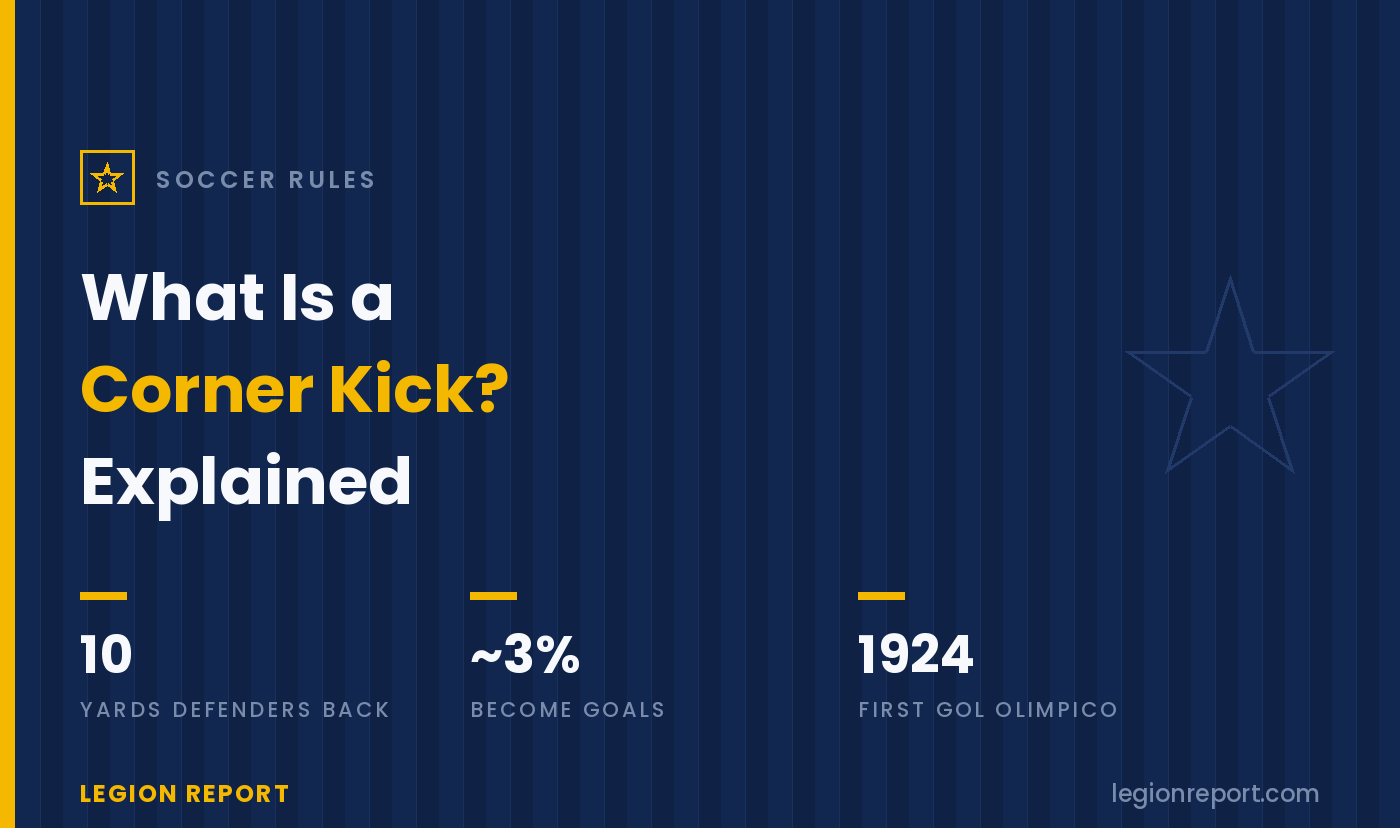

A corner kick is soccer’s reward for pressure: when the defending team puts the ball over its own goal line, whether a desperate clearance, a deflection, or a goalkeeper’s save pushed wide, the attacking team restarts play with a free kick from the corner of the pitch. It’s one of the game’s oldest rules, one of its best scoring chances, and the source of an entire tactical sub-industry of inswingers, near-post flicks, and giant defenders jogging forward like siege towers.
The corner also carries some of the rulebook’s best-kept secrets: you can score directly from one (it has a name, and a 101-year history), you cannot be offside from one, defenders must retreat exactly 10 yards from a kick many fans don’t realize is a free kick at all, and the corner flag itself is legally untouchable.
The chart below covers the whole subject: what earns a corner and the exact rules, how it differs from a goal kick and throw-in, the tactical playbook, and the famous corners and numbers. Take a look, then we’ll break it all down.
What a corner kick is, exactly
A corner kick is the restart awarded when the ball wholly crosses the goal line, on the ground or in the air, without a goal being scored, and the last touch came from the defending team. The attacking side places the ball inside the corner arc nearest to where it went out, the one-yard quarter circle painted at each corner of the pitch, and kicks it back into play with every defender required to retreat at least 10 yards until the ball moves. Governed by Law 17, it’s technically a direct free kick, which carries the detail many fans miss: a corner can be scored directly, no touch from anyone else required. The referee’s signal is simple, an arm pointed at the arc, and the geography is simple too: put it out on the left of your goal, the corner comes from the left.
The fine print worth knowing
Three clauses make corners quietly strange. First, offside is switched off: a player cannot be offside directly from a corner kick, which is why attackers can legally camp on the goal line and why corners produce the penalty area’s famous wrestling matches. Second, the kicker is bound by the double-touch rule, no second touch until another player has touched the ball, the technicality behind every “corner taken quickly” trick. And third, the rulebook covers even the absurd: a corner kicked directly into the taker’s own goal (a 100-yard impossibility, but codified anyway) results in a corner for the opponents. Meanwhile the corner flag itself is legally protected furniture: it cannot be removed, moved, or bent out of the way, no matter how much it interferes with the taker’s run-up.
The playbook: 3% and the fight to raise it
Only about three corners in a hundred end in a goal, and the entire modern set-piece industry exists to move that number. The basic menu: the inswinger, curling toward goal to create keeper chaos; the outswinger, bending away for attackers to attack at full speed; the short corner, sacrificing the cross to drag defenders out of shape; and the near-post flick, redirecting the ball across a keeper set for the far post. The defense counters with man-marking, zonal marking, or hybrids, and the last-minute desperation version sends the goalkeeper forward, soccer’s version of pulling the goalie. Analytics departments turned all of this into a profession; several top clubs now employ full-time set-piece coaches whose job performance is measured largely in corner conversion.
The corners that made history
The corner’s greatest hits argue it deserves the crowd’s roar. The goal scored directly from a corner has its own name, the gol olimpico, coined when Argentina’s Cesareo Onzari curled one straight in against Olympic champions Uruguay in 1924, and it has been soccer’s flashiest party trick for a century since. The 1999 Champions League final was decided entirely from corners, Manchester United scoring twice in stoppage time from them to steal the trophy from Bayern Munich. And the most famous corner of the modern era wasn’t even crossed: Trent Alexander-Arnold’s quickly taken corner to Divock Origi in 2019, while Barcelona’s defense organized itself, completed one of the greatest comebacks in Champions League history and entered the language as “corner taken quickly.”
Final Word
A corner kick, explained: the attacking restart earned when a defender puts the ball over his own goal line, taken from the corner arc under Law 17, with defenders 10 yards back, no offside in effect, and a direct goal fully legal, as it has been since the gol olimpico of 1924. It converts only about 3% of the time, which hasn’t stopped it from deciding Champions League finals and launching a coaching industry. The corner is soccer’s recurring promise: pressure, applied long enough, earns you a free swing at the goal.
It’s the latest entry in our soccer rules library: the discipline side lives in our guide to yellow and red cards in soccer, the tactical side in what is a false 9, and the theatrical side in why soccer players fake injuries.