
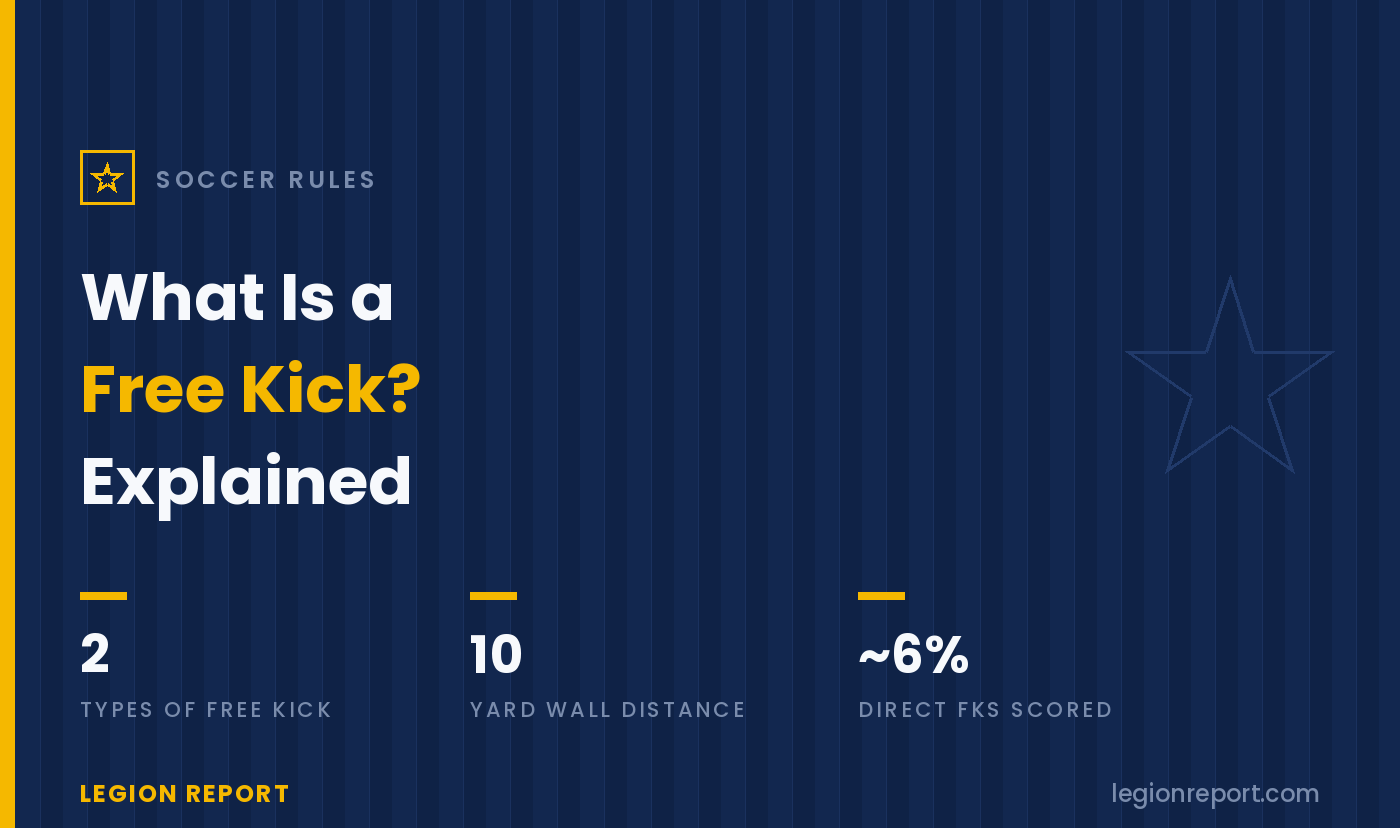

A free kick is soccer’s justice system in miniature: commit an offense, and the other team gets the ball, stationary, unopposed, from the scene of the crime. It’s the game’s most common restart after throw-ins, and its most misunderstood, because “free kick” is actually two different awards wearing one name. A direct free kick can be blasted straight into the net. An indirect free kick cannot; someone else must touch the ball first, and the difference between the two decides how every dangerous set piece in a match unfolds.
Around that split has grown soccer’s most theatrical furniture: the 10-yard wall, the vanishing spray, the player lying behind the wall like a draft excluder, and a century of physics-defying strikes, from Roberto Carlos bending one around a wall in 1997 to Beckham against Greece to Messi turning the free kick into a late-career art form.
The chart below covers all of it: what a free kick is, direct versus indirect in full, which offenses earn which kick, the wall rules, and the greatest free kicks and numbers. Take a look, then we’ll break it all down.
What a free kick is
A free kick is the restart awarded when a team commits an offense during play: the fouled team gets the ball, dead and unopposed, at the spot where the crime occurred, with every opponent required to retreat at least 10 yards. It’s governed by Law 13, fed by the offense list in Law 12, and bound by the same double-touch rule as every restart, the kicker can’t play the ball twice in a row. The taker can go quickly without waiting for a whistle (unless the referee has ordered a “ceremonial” restart to set the wall), which is where half of soccer’s sneakiest goals come from. And one geographic exception towers over everything: commit a direct-free-kick offense inside your own penalty area, and the free kick is upgraded to a penalty kick.
Direct vs. indirect: the whole ballgame
The single most useful thing to know about free kicks is that there are two kinds. A direct free kick can be struck straight into the goal, no other touch required; it’s the reward for physical offenses, kicking, tripping, pushing, holding, striking, reckless tackles, and for handball. An indirect free kick cannot score on its own; the ball must touch another player, from either team, before crossing the line, or the “goal” becomes a goal kick. Indirect kicks punish soccer’s technical crimes: offside, dangerous play without contact, impeding, dissent, and the goalkeeper’s paperwork violations like handling a deliberate back-pass. The referee announces the difference with his arm, held straight up for an indirect kick until the second touch, the signal most casual fans have watched a thousand times without decoding. (One modernization worth noting: the old keeper time-wasting indirect kick is gone; holding the ball beyond 8 seconds now hands the opponents a corner.)
The wall, the spray, and the man lying down
Give professionals a stationary ball 25 yards out and the defense responds with architecture. The wall, a line of defenders at the legal minimum 10 yards, exists to block the direct route, and it has spawned its own arms race: referees marking the line with vanishing spray; a defender lying flat behind the wall to block the low shot under the jumping wall; and, until 2019, attackers infiltrating the wall to bulldoze gaps, a tactic the Laws killed by requiring attackers to stay a meter away from any three-man wall. The strangest set piece in soccer follows from the indirect kick’s geography: an indirect offense inside the box produces an indirect free kick from that spot, sometimes six yards out, with the entire defense legally packed on its own goal line like a firing-squad audience.
The 6% club
Direct free kicks convert at roughly 6%, twice a corner, a third of a penalty, but the survivors are immortal. Roberto Carlos’s 1997 strike against France bent around the wall from an angle so improbable that physicists have published papers on its aerodynamics. David Beckham’s stoppage-time equalizer against Greece in 2001 sent England to a World Cup and canonized “put it on Beckham’s right foot” as national policy. The volume king is Juninho Pernambucano, whose knuckleball technique, striking through the ball’s valve with no spin, produced roughly 77 career free-kick goals, the most ever, and rewired how every subsequent taker hits them. And Lionel Messi supplied the late-career masterclass, transforming from an ordinary free-kick taker into the most reliable one of his generation after age 30, proof that the 6% is a skill, not a lottery.
Final Word
A free kick, explained: the unopposed restart awarded for an offense, taken from the spot of the foul with defenders 10 yards back, and split into two species, the direct kick, scoreable and earned by physical fouls and handball, and the indirect kick, which needs a second touch and punishes technical offenses, signaled by the referee’s raised arm. Add the wall, the spray, the 1-meter rule, and the penalty-area upgrade, and you have the full machinery behind soccer’s most cinematic moments: one ball, one wall, and about a 6% chance of forever.
It joins our growing rules library: the restart next door in what is a corner kick, the fouls that earn the most famous free kicks in DOGSO explained, and the full discipline system in our guide to yellow and red cards in soccer.