
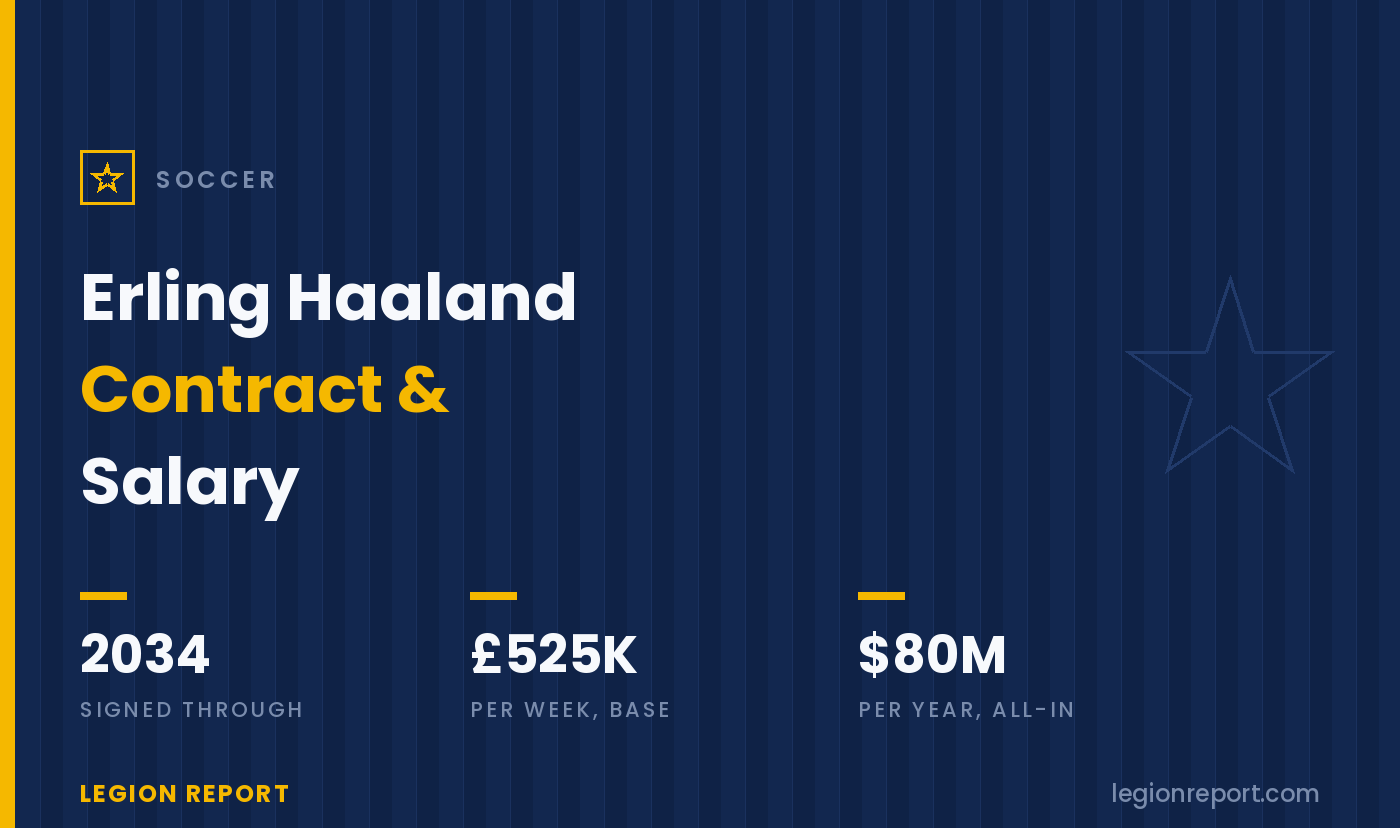

Erling Haaland is playing this World Cup on the longest contract in Premier League history: a nine-and-a-half-year Manchester City deal signed in January 2025 that runs to June 2034, pays a reported £525,000 per week in base wages, and can swell toward £875,000 a week once his near-automatic goal bonuses kick in. Forbes ranks him the fifth-highest-paid footballer on earth at roughly $80 million a year, and the deal’s fine print, the removal of his old release clause, may be its most valuable line.
The structure tells you how modern superstar contracts work: a base salary that leads the Premier League, an incentive layer built on things Haaland does almost by reflex (score), a Nike-anchored endorsement portfolio, and a time horizon no English club had ever committed to before.
The chart below covers the full contract details, the earnings breakdown, where he ranks among the world’s highest-paid players, and the business empire off the pitch. First, the January 2025 announcement that reset football’s contract landscape, via Sky Sports:
The deal that ended the transfer rumors
The January 2025 extension was less a contract than a fortress. Nine and a half years, through June 2034, made it the longest deal in Premier League history (passing the nine years Chelsea gave Cole Palmer), and its most consequential clause was one that vanished: the reported £173 million release clause from Haaland’s original 2022 contract was removed entirely, closing the escape hatch that Real Madrid-sized suitors had been eyeing since the day he arrived. The wage structure explains why he signed: a reported £525,000 per week in base salary, the Premier League’s highest, layered with goal, appearance, and trophy bonuses reported at up to £350,000 more per week, meaning a fully-firing season pays him toward £875,000 weekly, and since “fully firing” for Haaland is the default state (three Golden Boots in four English seasons), the incentives function as near-guaranteed money. Total base value runs past £245 million; with bonuses, reports put the full package well beyond £300 million. City, for their part, bought certainty: the sport’s most reliable goal machine, secured through his entire athletic prime, un-poachable at any price. The fortress got its first real stress test this June, when a Real Madrid presidential candidate claimed mid-campaign that Haaland would join if he won the election, and City’s response demonstrated exactly what the 2025 deal built: a flat public denial, a threat of legal action, and one sentence that ended the story, because there is no clause left to trigger:
🚨⚠️ OFFICIAL: Manchester City statement. “The stories which have emerged from Spain regarding the future of Erling Haaland are FALSE”. “There is NO chance of this happening and there is no contractual clause to enable it”. “We are considering LEGAL ACTION for the use of our player’s image”.
— Fabrizio Romano (@FabrizioRomano) June 2026
“No contractual clause to enable it” is the January 2025 negotiation, paying off in a single sentence.
The $80 million year, itemized
Forbes’ October 2025 ranking placed Haaland fifth among the world’s highest-paid footballers at roughly $80 million a year, split about $60 million on the pitch and $20 million off it, and the off-pitch portfolio is its own study in modern athlete economics. The anchor is a 10-year Nike deal signed in 2023, flanked by Breitling and Beats by Dre; the interesting margins are stranger and more Norwegian: a partnership promoting Norwegian seafood to Chinese consumers, a co-founded company holding a stake in the Norway Chess tour, and, in the newest wrinkle, equity instead of fees, an ownership stake in Db, the Scandinavian luggage brand backed by luxury giant LVMH. (Net-worth figures floating around, $80-100 million, come from celebrity-wealth aggregators, not audited accounts; his income is the number that’s actually sourced.) The comparison table above carries the real headline, though: everyone ranked above him, Ronaldo’s $235 million Saudi salary, Messi’s $140 million Miami-plus-endorsements empire, Mbappé’s Madrid package, is in his thirties. Haaland is the only member of the top five whose peak earning years haven’t happened yet.
What the length really means
A 9.5-year contract for a footballer is an actuarial statement: City underwrote Haaland’s entire prime, ages 24 through 33, betting that the goals-per-game rate travels intact across a decade. The bet has logic on its side, his scoring has survived every league change, manager change (including Guardiola’s departure), and tactical era so far, and the contract’s structure hedges it anyway, with the bonus-heavy design meaning the club pays peak money only for peak output. For Haaland, the deal bought generational security without sacrificing upside (the incentives) or leverage (a player this good renegotiates when he wants, 2034 or not). And this month it’s buying something less tangible: he’s leading Norway through a historic World Cup with zero career noise, no expiring deal, no transfer saga, no release-clause countdown, just the world’s fifth-highest-paid footballer, playing the tournament of his life, with eight guaranteed years of runway behind him. The next contract story won’t arrive for years; the goals arrive Saturday.
Final Word
Haaland’s contract and salary, in short: a 9.5-year Manchester City deal signed January 2025 and running to 2034, the longest in Premier League history, paying a reported £525,000 a week in base wages (the league’s highest) with bonuses reaching toward £875,000, worth £245 million-plus in base value, with his old £173 million release clause deleted; all-in earnings of roughly $80 million a year per Forbes, fifth in world football and first in the Premier League, split $60 million on the pitch and $20 million off it via Nike, Breitling, and an equity-flavored portfolio, and every name ahead of him on the money list is 30-plus. The machine is paid like one, through 2034.
What the money buys is tallied in Haaland’s career goals and stats, his squad’s collective price tag is ranked in the most expensive World Cup squads, and what Norway could win this month is broken down in World Cup prize money, explained.