
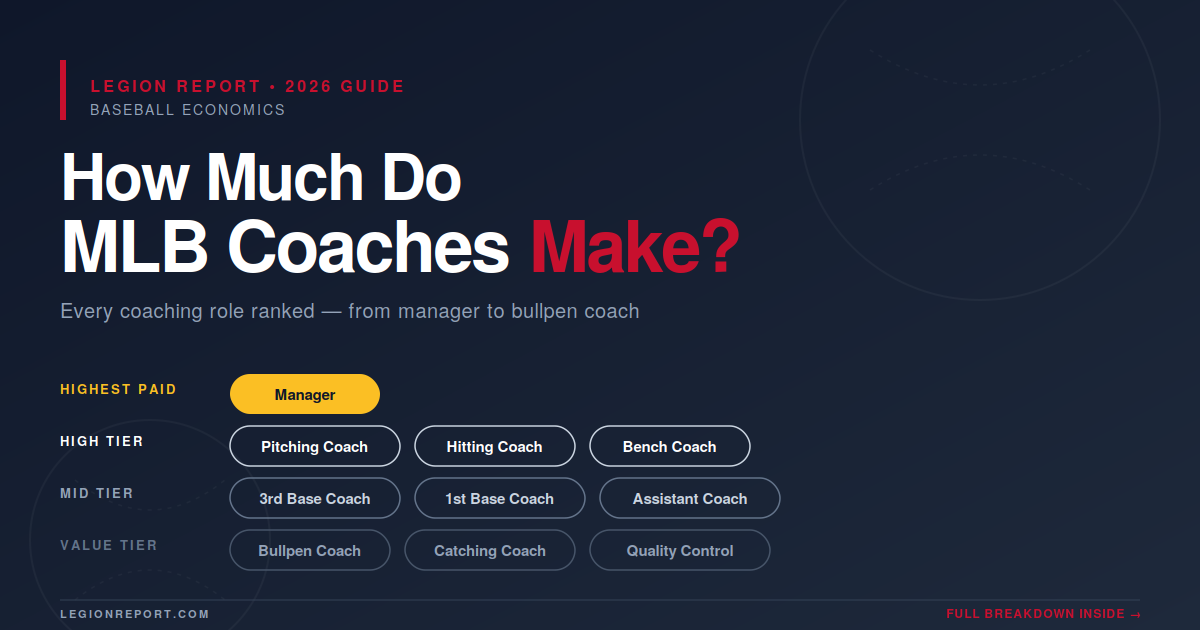

MLB coaching salaries vary wildly by role. The highest-paid manager in 2026 is Dave Roberts of the Los Angeles Dodgers at $8.1 million per year, while a typical first base coach earns around $125,000-$175,000 — a 65x difference in pay between two members of the same coaching staff. The average MLB manager salary in 2026 sits at approximately $2.5-3 million annually, but that figure is heavily skewed by a small group of elite managers (Roberts at $8.1M, Craig Counsell at $8M, Alex Cora at $7.3M). The rest of the coaching staff — pitching coach, bench coach, hitting coach, base coaches, bullpen coach — typically earn six-figure salaries that range from $90,000 for entry-level positions up to $1 million+ for elite pitching and hitting coaches. Here’s the full breakdown of MLB coaching salaries by role, the top-paid managers in 2026, and how the coaching career path actually progresses.
What actually drives MLB coaching salaries in 2026
The manager position has experienced rapid salary inflation over the past five years. In 2018, the average MLB manager earned $1.3 million per year. In 2026, that average has nearly doubled to $2.5-3 million. Three factors drove this growth: the success of analytics-first managers (Roberts, Counsell, Cora) winning multiple World Series, the demand for managers who can handle high-pressure markets (Boone in New York), and the precedent set by Counsell’s $40 million Cubs contract in 2023, which redefined what teams were willing to pay for proven leadership. When Roberts signed his $32.4 million extension in March 2025 after winning his second World Series, it cemented the $8M annual tier as the new ceiling. The Yankees responded by giving Aaron Boone a raise to $5M in 2026 and $5.5M in 2027 — recognizing that managers were being underpaid relative to roster value.
Assistant coaching salaries haven’t grown nearly as fast. Pitching coaches and hitting coaches at the top of their craft can earn $500,000 to $1 million in 2026, but the average is closer to $200,000-$350,000. The reason: managers have a finite supply (30 MLB jobs), while pitching and hitting coaches have more candidates competing for similar roles. Bench coaches — who function as the manager’s right hand and often become managers themselves — earn $200,000-$350,000. Bullpen coaches at the entry tier of major league coaching make around $100,000-$150,000, which is roughly comparable to a mid-tier college assistant coach. The path from bullpen coach to manager often takes 10-15 years and several team changes.
Coaching is one of the only career paths in MLB where former players can earn comparable money to their playing careers. Former big-leaguers transitioning to coaching typically start as minor league hitting or pitching coordinators (earning $75,000-$125,000) and work up through the system. Most current MLB managers were former players — Aaron Boone, Bruce Bochy, Stephen Vogt, Joe Espada, and Carlos Mendoza all had MLB playing careers before coaching. The exception is increasing: Tony Vitello, who becomes the San Francisco Giants manager in 2026, comes from college baseball (Tennessee head coach) without an MLB playing career. He’s part of a growing trend of analytical-minded college coaches moving directly to MLB management roles.
The coaching staff size has expanded significantly over the past decade. In 2010, a typical MLB team had 6-7 coaches. In 2026, most teams employ 10-13 uniformed coaches, including specialized roles like quality control coach, run prevention coach, infield coach, catching coach, and analytics-focused assistant hitting/pitching coaches. The total coaching budget for a single MLB team now ranges from $3 million (smaller markets like Marlins, A’s) to $12 million+ (Dodgers, Yankees, Mets). For the Dodgers specifically, Roberts’ $8.1M manager salary plus the rest of the coaching staff likely exceeds $13 million annually — a notable but small fraction of the team’s $310 million player payroll.
For continuously updated MLB manager and coaching salary news, Front Office Sports’ Highest-Paid Managers list tracks contract details and salary updates with verified reporting from MLB sources. For deeper analysis on coaching career paths, hiring trends, and minor league coaching economics, FanGraphs’ Sunday Notes regularly publishes the most detailed insights on the business side of MLB coaching.
The honest takeaway on MLB coaching salaries in 2026: the manager position has crossed into legitimate executive-tier compensation, with the top 5 managers earning $5M+ annually and even mid-tier managers making $2M-$3M. But for the rest of the coaching staff, the salaries are more modest than fans typically assume. A bullpen coach at $100K-$150K earns less than the average MLB player ($5.1M) by a factor of 30. Pitching and hitting coaches do better, with top names crossing $500K, but they’re still well below player salaries despite often having greater long-term influence on team performance. The gap between manager pay and assistant coach pay has grown wider than any other coaching staff in major American professional sports.
— Drew, Legion Report