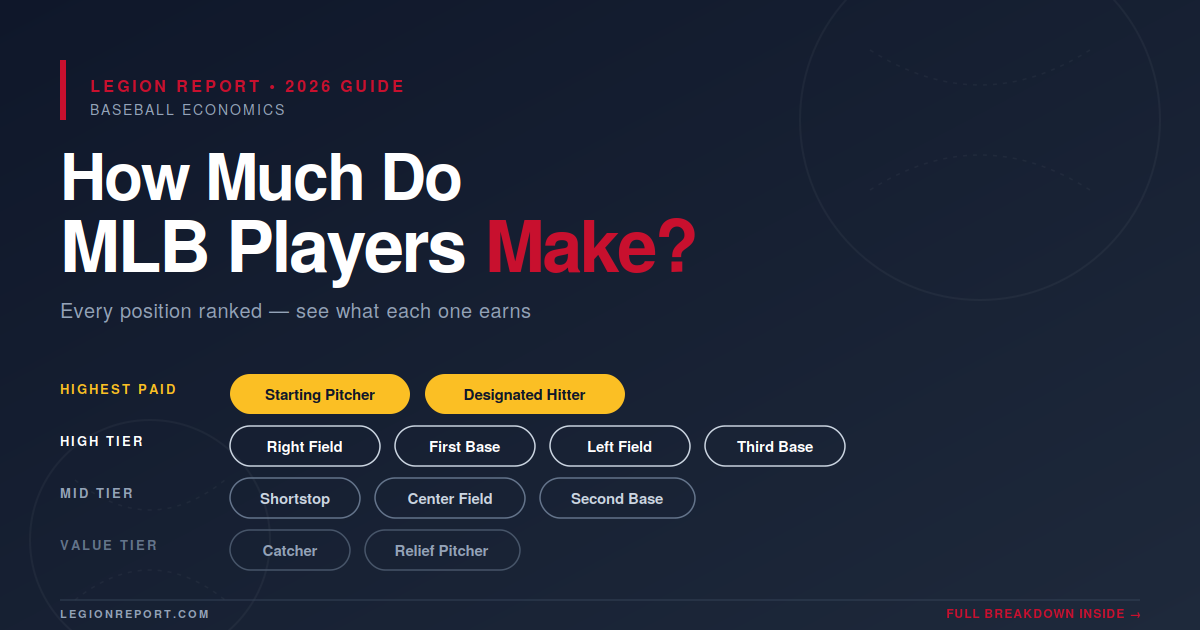
The average MLB player salary in 2026 is approximately $5.1 million per year, while the league minimum salary has risen to $780,000 — meaning even the lowest-paid player in Major League Baseball earns more than 99% of Americans. But the gap between average and median tells the real story. While the average is around $5.1 million, the median MLB salary is closer to $1.5 million, because a small number of superstar contracts (Juan Soto at $61.875M, Shohei Ohtani’s $70M peak, Aaron Judge at $40M) pull the league average dramatically upward. Starting pitchers and designated hitters earn the most on average, with relief pitchers and catchers earning the least. Here’s the full breakdown of MLB salaries by position for 2026, the top earner at each spot on the field, and how service time creates the biggest salary gap in baseball.
MLB player salaries 2026 complete breakdown
Average pay by position, top earners, service time tiers, and historical league average growth.
By the numbers (2026)
$5.1M
Avg salary
$1.5M
Median salary
$780K
Minimum
$61.9M
Top 2026 deal
Average MLB salary by position (2026)
Position-by-position averages across all 30 MLB teams. Starting pitchers and DHs lead, relief pitchers earn least.
Rank
Position
Avg salary
Avg roster spots
Why this position pays this much
1
Starting Pitcher (SP)
$6.8M
5 per team
Scarcity + injury risk + uniquely high impact per game.
2
Designated Hitter (DH)
$6.5M
1 per team
Position reserved for elite offensive specialists.
3
Right Field (RF)
$5.2M
1 per team
Premium offensive position. Aaron Judge ($40M) sets the ceiling.
4
First Base (1B)
$4.8M
1 per team
Power-hitting position. Vladimir Guerrero Jr. tops at $40.2M.
5
Left Field (LF)
$4.5M
1 per team
Juan Soto’s $61.875M deal makes him the highest LF ever.
6
Third Base (3B)
$4.2M
1 per team
Power + defense premium. Rendon at $38.57M tops.
7
Shortstop (SS)
$3.8M
1 per team
Defense-first position with rising offensive value.
8
Center Field (CF)
$3.6M
1 per team
Range and athleticism premium. Mike Trout was top.
9
Second Base (2B)
$3.1M
1 per team
Lower power expectations than corner infield spots.
10
Catcher (C)
$2.7M
2 per team
High physical attrition limits long-term contract value.
11
Relief Pitcher (RP)
$2.4M
7-8 per team
Most roster spots = most supply = lowest average.
Top earner at each position (2026)
The highest-paid MLB player at each position, by 2026 salary. Source: Spotrac
Position
Player (Team)
2026 salary
Contract details
Left Field
Juan Soto (NYM)
$61.875M
15-year, $765M total — largest in sports history.
Starting Pitcher
Zack Wheeler (PHI)
$42.0M
3-year extension signed 2024.
First Base
Vladimir Guerrero Jr. (TOR)
$40.21M
14-year, $500M extension.
Right Field
Aaron Judge (NYY)
$40.0M
9-year, $360M deal signed 2022.
Third Base
Anthony Rendon (LAA)
$38.57M
Considered worst MLB contract due to injuries.
Center Field
Mike Trout (LAA)
$37.12M
12-year, $426.5M from 2019. Now plays RF.
Designated Hitter
Shohei Ohtani (LAD)
$70.0M
10-year, $700M (deferred to $46.1M present value).
Shortstop
Carlos Correa (MIN)
$36.0M
6-year, $200M from 2023.
Second Base
Marcus Semien (TEX)
$26.0M
7-year, $175M from 2022.
Catcher
J.T. Realmuto (PHI)
$23.88M
5-year, $115.5M from 2021.
Relief Pitcher
Edwin Diaz (NYM)
$21.95M
5-year, $102M (highest reliever deal in history).
Salary tiers by service time
The single biggest factor in MLB pay isn’t position — it’s how long you’ve been in the league
Service tier
Years
Pay range
How it works
Pre-arbitration
Years 0-3
$780K-$1M
League minimum mandatory. Even MVP-level rookies earn the minimum.
Arbitration eligible
Years 3-6
$1M-$25M
Salary determined by performance + comparable contracts. Modest raises.
Free agent
Years 6+
$780K-$70M+
Market rate. Mega-deals happen here. Most lucrative tier.
By 2026 base salary, all positions. Source: Spotrac Opening Day rankings.
Rank
Player
Pos
Team
2026 salary
Notes
1
Juan Soto
LF
Mets
$61.875M
Largest contract in sports history.
2
Zack Wheeler
SP
Phillies
$42.0M
Top SP salary in 2026.
3
Vladimir Guerrero Jr.
1B
Blue Jays
$40.21M
14-year, $500M extension.
4
Aaron Judge
RF
Yankees
$40.0M
2022 AL MVP. 9 years, $360M.
5
Anthony Rendon
3B
Angels
$38.57M
Considered one of worst MLB contracts.
6
Mike Trout
OF
Angels
$37.12M
12-year, $426.5M signed in 2019.
7
Carlos Correa
SS
Twins
$36.0M
6 years, $200M from 2023.
8
Max Scherzer
SP
Free Agent
$35.0M
2025 contract expired.
9
Bryce Harper
1B
Phillies
$30.0M
13-year, $330M signed 2019.
10
Manny Machado
3B
Padres
$30.0M
11-year, $350M extension from 2023.
11
Trea Turner
SS
Phillies
$29.10M
11-year, $300M signed 2023.
12
Francisco Lindor
SS
Mets
$28.85M
10-year, $341M extension.
13
Marcus Semien
2B
Rangers
$26.0M
7-year, $175M from 2022.
14
Mookie Betts
2B/SS
Dodgers
$25.0M
12-year, $365M extension from 2020.
15
J.T. Realmuto
C
Phillies
$23.88M
Highest paid catcher in MLB.
MLB average salary growth 2010-2026
How MLB salaries have grown over 16 years
Year
Avg salary
Min salary
Notable events
2010
$3.3M
$400K
A-Rod top earner at $33M.
2015
$3.8M
$507K
Clayton Kershaw $32M top.
2020
$4.4M
$563K
Pandemic-shortened season.
2023
$4.5M
$720K
+7% YoY. New CBA boosted minimum.
2025
$5.0M
$760K
Ohtani at $70M tops league.
2026
$5.1M
$780K
Soto’s $61.9M tops. +55% growth since 2010.
The takeaway
The average MLB player earns $5.1 million in 2026, but the median is closer to $1.5 million — that gap reveals how top-heavy MLB salaries really are. Starting pitchers and designated hitters lead position averages, while relief pitchers and catchers rank lowest. The single biggest factor isn’t position — it’s service time. Pre-arbitration players (years 0-3) earn the $780K minimum no matter how good they are, which is why elite young players like Paul Skenes and Jackson Holliday are massively underpaid relative to value. Once players hit free agency in year 6+, the mega-deals start: Juan Soto’s $61.875M annual salary on a 15-year, $765 million deal is the largest in sports history. The MLB minimum has nearly doubled since 2010 ($400K to $780K), but elite contracts have grown faster.
Sources: Spotrac, FanGraphs RosterResource, MLB CBA. Position averages estimated from Spotrac positional payroll data. 2026 salaries verified through Opening Day.
What actually determines MLB player salaries in 2026
The single biggest factor in MLB player pay isn’t position — it’s service time. A player’s first three years in MLB are governed by the league minimum ($780,000 in 2026), regardless of performance. Mike Trout earned $510,000 during his 2012 MVP-runner-up rookie season because of this rule. After three full years of service, players enter salary arbitration, where modest raises begin (typically $1-5 million depending on performance). After six full years, players reach free agency, where the mega-contracts happen. This service time structure explains why a 23-year-old superstar prospect can earn the league minimum while a journeyman 32-year-old veteran earns $10 million. It’s also why the new generation of stars like Paul Skenes, Jackson Holliday, and Wyatt Langford are earning $780,000 in 2026 despite producing All-Star value.
Starting pitchers are the highest-paid position group on average. Zack Wheeler’s $42 million salary is the highest among non-Ohtani earners in 2026, and starting pitcher averages have risen to $6-7 million across MLB. The reason: starting pitchers are uniquely scarce. A team needs five starting pitchers to maintain a rotation, and roughly 150 starting pitcher slots exist across all 30 MLB teams. Combined with the injury risk and physical toll of pitching, that scarcity creates the highest position-level pay floor in baseball. Designated hitters earn similarly high averages because the position is reserved for elite offensive specialists — teams don’t carry replacement-level DHs.
Relief pitchers and catchers earn the least on average despite being two of the most important positions on the field. Relief pitchers average around $2.4 million because teams carry 7-8 relievers per roster (compared to 4-5 starters), creating much more supply. Catchers average around $2.5 million because the position has the highest physical attrition rate in baseball — bodies break down by their early 30s, which limits long-term contract value. Top catchers like J.T. Realmuto at $23.9 million per year remain outliers; the average MLB catcher earns closer to the league minimum than the league average.
Position-based pay gaps have widened significantly over the past 15 years. In 2010, the average MLB salary was $3.3 million. In 2026, it’s around $5.1 million — a 55% increase over 16 years, but lagging behind NFL ($3.1M avg in 2026) and NBA ($11M avg in 2026) per-player pay growth. MLB salaries also vary more team-by-team than any other major sport due to the lack of a salary cap. The Dodgers’ 2026 payroll exceeds $310 million while the A’s and Marlins are below $90 million. Players on the Dodgers, Mets, and Yankees average significantly more than players on smaller-market teams — but those big-market deals also skew league averages much higher than median pay reflects.
For continuously updated MLB salary data by player, team, and position, Spotrac’s MLB Salary Rankings is the industry standard — it powers data used by ESPN, MLB Trade Rumors, and most major sports media. For payroll breakdowns by team and detailed roster financial analysis, FanGraphs’ RosterResource Payroll Breakdown shows every team’s complete contract structure with future-year projections.
The honest takeaway on MLB player salaries in 2026: the headlines focus on Juan Soto’s $765 million contract and Shohei Ohtani’s $700 million deal, but those represent fewer than 20 players in the entire league. The actual median player earns $1.5 million, the league minimum is $780,000, and roughly 40% of MLB players earn under $2 million per year. Even at the league minimum, MLB players earn 26 times the median US household income — but the popular perception of “every MLB player is rich” is misleading. The middle tier of MLB players are well-paid professionals, not multi-millionaires. The mega-deals belong to a small elite.