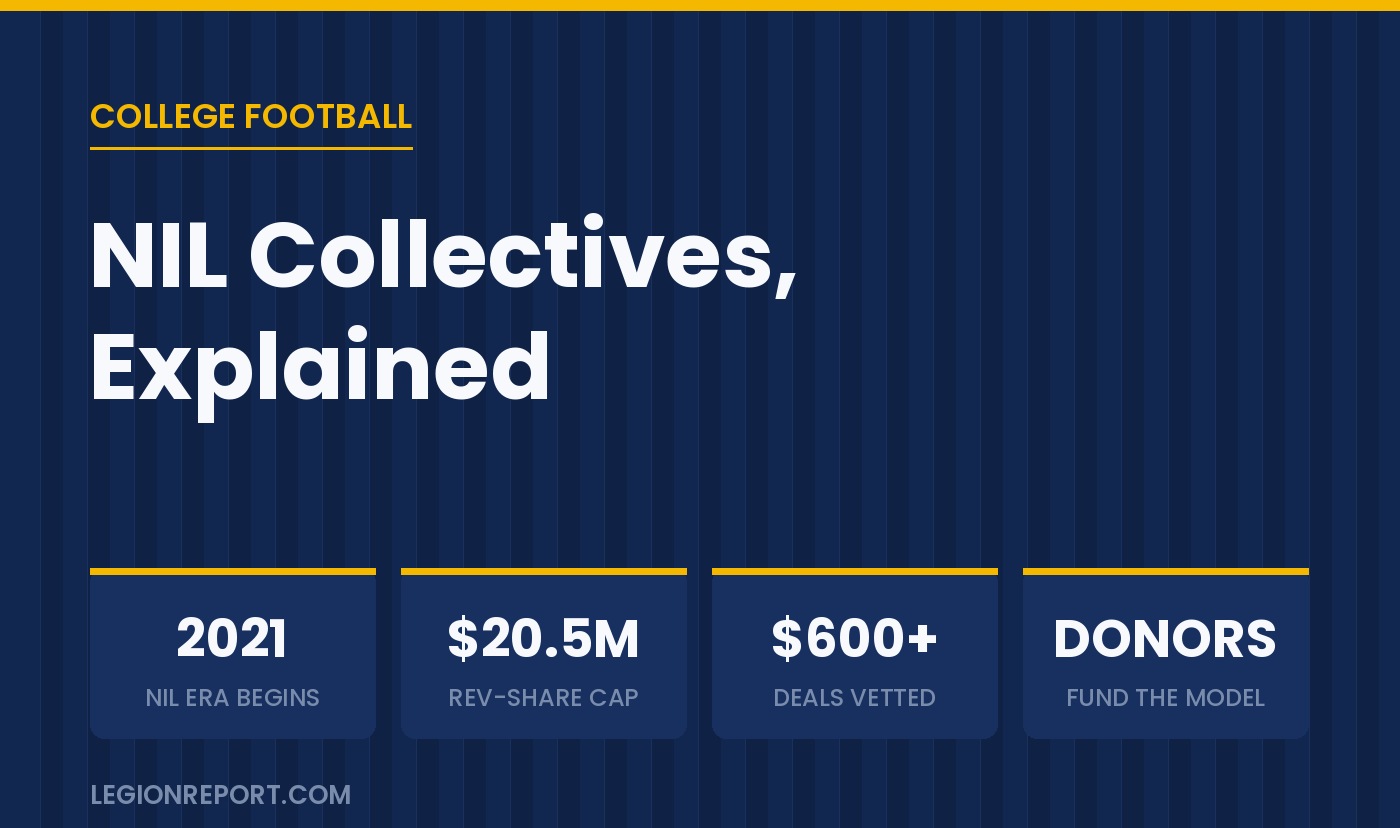
NIL collectives are the organizations that turned name, image, and likeness rights into college football’s player-payment system. When the NCAA lifted its NIL ban on July 1, 2021, the theory was endorsement deals — a car dealership ad here, a jersey sale there. What actually emerged were collectives: donor-funded organizations, formally independent of the universities, that pool money from boosters and businesses to pay a school’s athletes through structured deals. Within two years, virtually every Power conference program had at least one, and collectives — not brand endorsements — became the dominant source of athlete pay.
The 2025 House settlement rewired the landscape without eliminating them. Schools can now share revenue with athletes directly — up to a cap of roughly $20.5 million per school in year one, rising annually — and third-party NIL deals above $600 must clear an approval process (the “NIL Go” clearinghouse run by the College Sports Commission) that tests whether they’re real endorsements at fair market value rather than disguised pay-for-play. Collectives adapted: some folded into athletic departments as in-house marketing arms, others remain outside funnels for money above the cap.
The chart below covers how collectives work, how the post-settlement rules changed them, and what the money actually buys. Take a look, then we’ll get into where the model goes next.
COLLEGE FOOTBALL
How NIL Collectives Work
The donor-funded engines of college football’s player market
LEGAL SINCE
July 2021
NCAA lifted NIL ban
REV SHARE CAP
$20.5M
Per school, 2025-26
CLEARINGHOUSE
$600+
Deals vetted by NIL Go
STATUS
Evolving
Post-House settlement
The collective model
Structure, funding, and function
Element
How a collective works
Structure
An LLC or (formerly) nonprofit, legally separate from the university, run by boosters, alumni, or professional operators
Funding
Donor contributions, membership subscriptions, business sponsorships, and events — pooled into a player-payment budget
The deals
Athletes sign NIL agreements: appearances, social posts, autograph signings, charity work — the activity justifies the payment
Recruiting role
Collectives can’t technically offer money to recruits as inducement, but published ‘roster budgets’ shape every recruitment and portal battle
Coordination
Formally independent; in practice, most work hand-in-glove with the athletic department on priorities and retention
Scale
Top programs’ collective-plus-revenue-share football budgets run well into eight figures per roster
The post-settlement rules
Revenue sharing and the clearinghouse
Rule (post-House settlement, 2025)
Detail
Direct revenue sharing
Schools may pay athletes directly from athletic revenue — capped around $20.5M per school in 2025-26, escalating annually over the 10-year settlement
The $600 clearinghouse
Third-party NIL deals over $600 must be reported to NIL Go, which vets for a valid business purpose and fair-market-value range
What gets rejected
Deals judged to be pay-for-play with no real endorsement value — the rule aimed directly at booster-collective checks
Enforcement
The College Sports Commission (created by the settlement) polices the cap and clearinghouse, replacing NCAA enforcement for these rules
Collectives’ new roles
Absorbed as in-house NIL agencies, converted to marketing intermediaries, or continuing as above-the-cap funders willing to test the clearinghouse
Legal status
Ongoing lawsuits and state laws continue to challenge pieces of the framework — the rules remain a moving target
Figures per the 2025 House v. NCAA settlement terms; the cap escalates annually.
Common questions
The practical answers
Question
Answer
Are collectives legal?
Yes — pooling money for NIL deals is lawful; the constraint is the clearinghouse’s fair-market-value test on each deal
Do players negotiate?
Increasingly through agents; portal-window negotiations resemble free agency, with collectives and revenue-share offices setting budgets
Is it pay-for-play?
Functionally, roster compensation; formally, every dollar must attach to NIL activity or the revenue-share agreement
What about non-revenue sports?
Collectives concentrate overwhelmingly on football and men’s basketball; revenue-share allocation across sports is each school’s choice within Title IX exposure
Can high schoolers sign?
State law dependent — many states now allow recruits to sign NIL deals that begin at enrollment
NIL COLLECTIVE FACTS
The name is the fig leaf
‘Name, image, and likeness’ implies endorsements; the dominant use is roster compensation with NIL activity attached — everyone in the sport prices it that way.
Retention beats recruiting
The largest collective checks increasingly go to keeping current stars out of the portal, not landing new ones — January is the real signing day.
The cap created the above-cap game
Revenue sharing gave every school the same budget; collectives are how programs compete beyond it, which is exactly what the clearinghouse exists to referee.
The open question is whether the clearinghouse holds. If NIL Go successfully rejects above-market booster deals, collectives shrink into marketing agencies and the capped revenue share becomes the real salary structure. If lawsuits or state legislatures kneecap enforcement — and both are actively trying — the above-cap market reopens and collectives return to being the arms race’s main weapon. Either way, the direction is professionalization: contracts with buyouts, agents at every level, general managers running budgets, and collective bargaining discussed openly. The collective era’s lasting legacy may be proving that the money was always there — the only question was who controlled it.
The Bottom Line
NIL collectives pool donor money to pay a school’s athletes through name-image-likeness deals, and they built college football’s player market years before schools could pay directly. The House settlement added a ~$20.5M revenue-share cap and a clearinghouse for outside deals, pushing collectives to evolve into in-house agencies or above-the-cap funders. For the player-movement system the money steers, see our guide to the transfer portal, and for the signing calendar it dominates, the early signing period.