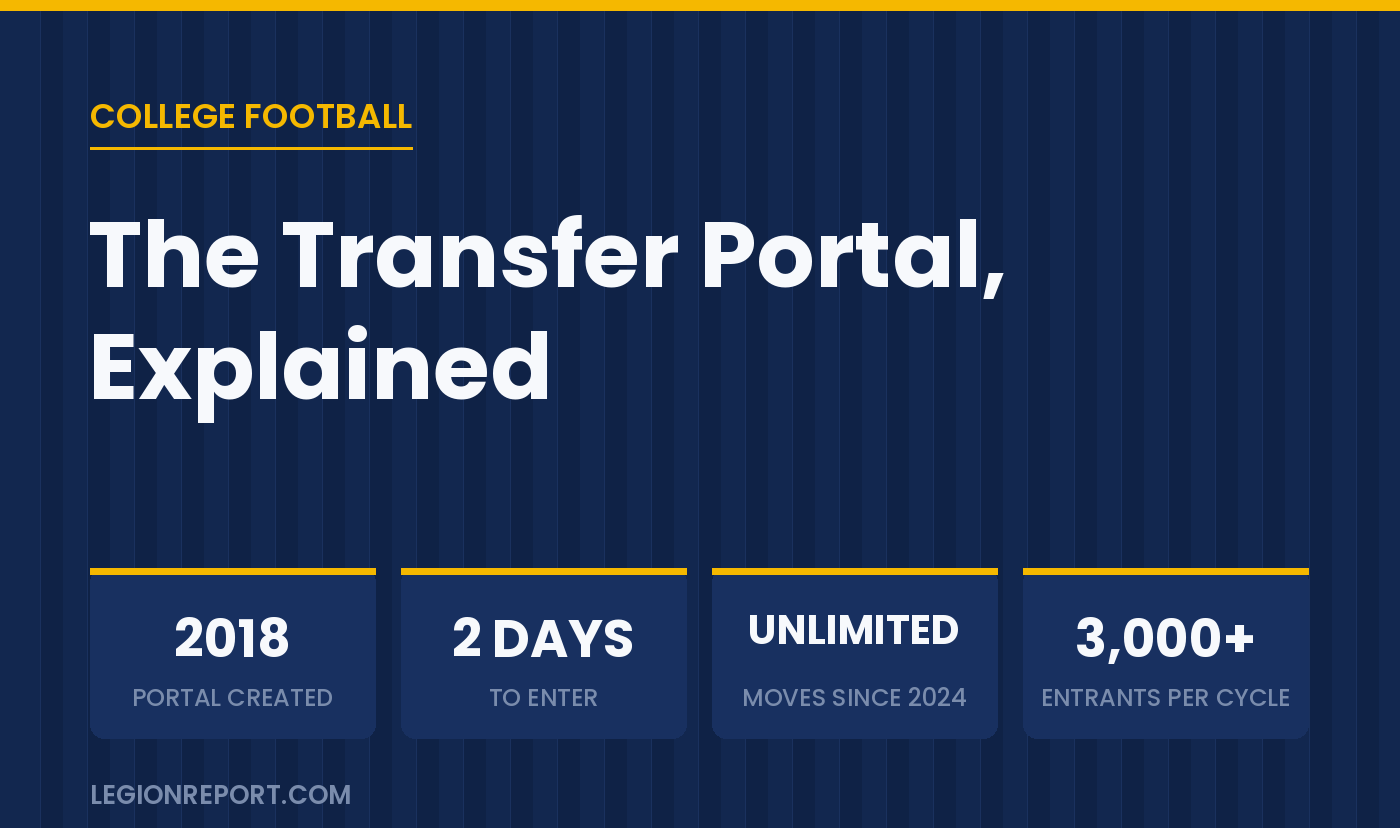
The transfer portal is college football’s free agency — a compliance database, created in October 2018, that a player enters to declare himself available to other schools. Before it existed, transferring required your coach’s permission, and coaches routinely blocked moves to rivals; now a player notifies his school, his name appears in the portal within two business days, and every program in the country can recruit him. Combined with immediate eligibility rules and NIL money, it has rebuilt college rosters into something closer to year-to-year professional teams.
The rules have liberalized in waves. The 2021 one-time transfer rule let players move once without sitting a year; a 2024 legal settlement removed the one-time limit, so any academically eligible player can now transfer as often as windows allow and play immediately. Entry is restricted to designated windows tied to the calendar — a winter window after the season and a spring window after spring practice — though graduate transfers and players whose head coach leaves get exceptions.
The chart below covers how the portal works step by step, the windows and eligibility rules, and what the numbers look like. Take a look, then we’ll get into how roster-building actually works now.
COLLEGE FOOTBALL
How the Transfer Portal Works
College football’s free agency: the process, the windows, the rules
CREATED
Oct. 2018
Compliance database
ENTRY
2 days
School must comply
TRANSFERS
Unlimited
Since 2024
WINDOWS
Winter + spring
Set annually
Entering the portal
The process, step by step
| Step | How entering the portal works |
|---|
| 1. Notification | The player informs his school’s compliance office in writing that he intends to transfer |
| 2. Entry | The school must enter his name in the portal database within two business days — it cannot refuse |
| 3. Open recruitment | Any school may now contact him directly; his current school may pull his scholarship at term’s end |
| 4. The risk | Entering doesn’t guarantee a landing spot — his old school isn’t required to keep him, and hundreds of portal entrants each cycle never find a comparable offer |
| 5. Commitment | He signs financial aid/roster agreements with the new school and enrolls; eligibility is immediate if he’s academically eligible |
| 6. Withdrawal | A player can withdraw from the portal and stay — if his school still wants him |
The rules
Windows, limits, exceptions
| Rule | Current state |
|---|
| Transfer windows | A winter window opening after the regular season (moved to January beginning with the 2025-26 cycle) and a shorter spring window in April; dates and lengths are set annually by the NCAA |
| How often can you transfer? | No limit since the 2024 settlement — immediate eligibility every time, provided academic requirements are met |
| Graduate transfers | May enter and move any time, outside the windows |
| Coach departure exception | A 30-day portal window opens for players when their head coach leaves |
| Eligibility clock | Transferring doesn’t pause the 5-year clock or add seasons — the portal moves players, not eligibility |
| Tampering | Contacting a player before he’s in the portal is against the rules and, by wide consensus, happens constantly through intermediaries |
Window dates change annually; check the NCAA’s current calendar.
The portal economy
What it looks like in practice
| Portal reality | Detail |
|---|
| Volume | Thousands of FBS players enter every cycle — well over 3,000 in recent years, with quarterbacks the most active position |
| The QB carousel | Most contenders’ starting quarterbacks have transferred at least once; the position resets league-wide every January |
| Roster construction | Programs now split recruiting between high school classes and portal classes, with portal budgets driven by NIL and revenue-share money |
| The success stories | Championship rosters are portal-built — Indiana’s 2025 title team was anchored by transfers, including quarterback Fernando Mendoza (from Cal) |
| The other side | A large share of entrants land at lower levels or nowhere; the portal is leverage for stars and a leap of faith for everyone else |
PORTAL FACTS
It was built for paperwork
The portal is literally a database meant to standardize transfer notifications; free agency is what the eligibility rules around it created.
Entering is one-way leverage
The school can pull the scholarship once you enter — players bet their roster spot on the market wanting them.
It pairs with everything
The portal’s power comes from stacking with immediate eligibility, NIL money, and the redshirt rule’s four-game exit ramp — each amplifies the others.
How the transfer portal works, from entry to commitment.
How Roster-Building Actually Works Now
Modern programs run two recruiting operations. High school recruiting still supplies long-term development, but the portal supplies immediate starters — and the January window turns every December into an audit: who’s leaving, who’s staying, and what the NIL and revenue-share budget can buy at the positions of need. General managers (a real title at most major programs now) track other rosters’ logjams the way NFL front offices track cut candidates, tampering flows through agents and collectives before windows open, and a team’s offseason is graded on portal wins as much as signing-day rankings. The stigma is gone entirely: the reigning national champion started a two-time transfer at quarterback.
The Bottom Line
The transfer portal is the database that made player movement a right instead of a permission: enter through compliance, hit the open market within two days, and play immediately wherever you land — as often as the windows allow. It moves players, not eligibility, and its power comes from the rules stacked around it. For those rules, see our guides to college football eligibility and the redshirt rule, and for the money that steers it, NIL collectives.