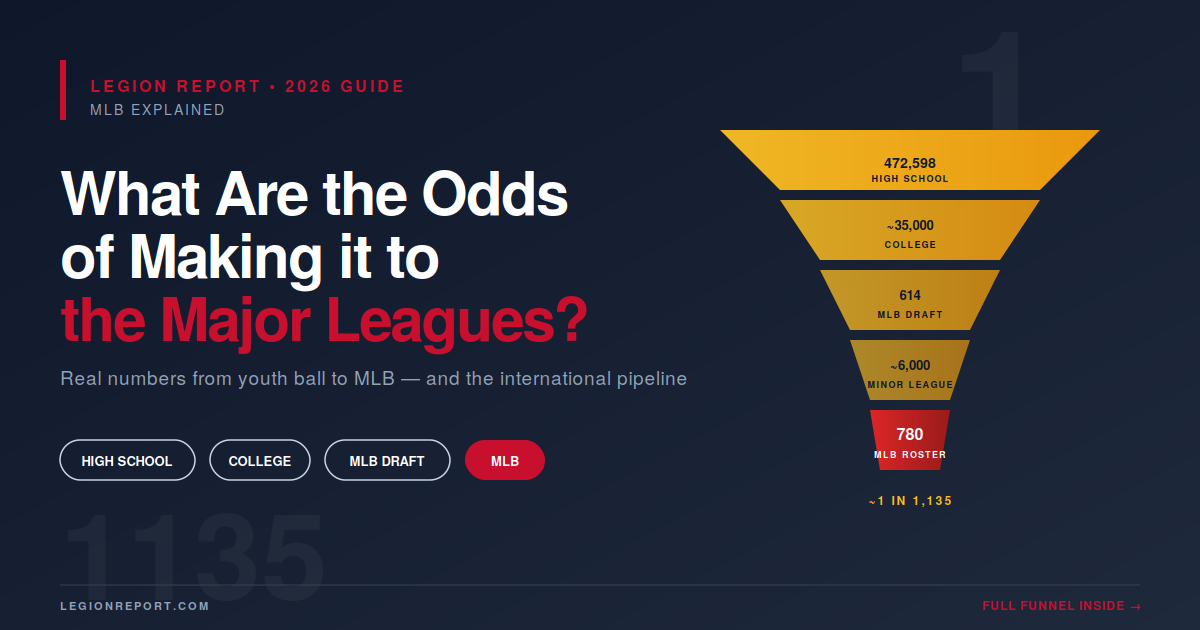

The odds of a high school baseball player ever appearing on an MLB roster are approximately 1 in 1,135 — about 0.09 percent. That’s the honest, math-based reality, even before you factor in how brief most MLB careers actually are. Out of roughly 472,598 high school baseball players in the United States in 2024-25, only about 5.6 percent will play at any college level (NCAA, NAIA, or JUCO), only 0.5 percent will ever be drafted by an MLB team, and only about 17 percent of those draftees will ever play a single inning in the major leagues.
The funnel narrows further at each step: a D1 senior has a 16.4 percent chance of being drafted, but a D1 player at one of the SEC, ACC, Big 12, Big Ten, or Pac-12 has a 43.1 percent draft probability. Meanwhile, 26.3 percent of all 2026 MLB rosters are international-born players — 249 of 948 total players come from 16 countries outside the U.S., with the Dominican Republic alone contributing 93 players. The path to MLB is more accessible than the lottery but vastly more selective than getting into Harvard. Here’s the complete statistical breakdown of every stage in the baseball funnel, the realistic odds by division and draft round, and what parents and players actually need to know.
The baseball funnel: Little League to MLB roster
Approximately 2.4 million American children play organized youth baseball (Little League, Cal Ripken, USSSA, and travel ball combined) at some point between ages 7 and 14. Of those, roughly 472,598 play high school baseball as 8th-12th graders in the 2024-25 school year per NFHS data. That’s an 80 percent dropoff from youth to high school — many kids switch to other sports, suffer career-ending injuries, or simply lose interest in the sport’s increasingly specialized travel/showcase pathway. Of the 472,598 high school players, roughly 26,500 (5.6 percent) will continue baseball at any college level: NCAA Division I (~11,000), Division II (~9,000), Division III (~9,000), NAIA (~5,000), and JUCO (~7,000) — though many players move between levels, so the actual unique-player count is lower.
The MLB Draft is the critical bottleneck. In 2023, there were 614 total draft picks across 20 rounds (the draft was reduced from 40 rounds to 20 in 2021). Of those 614 picks, 444 came from NCAA programs — 428 from Division I, 14 from Division II, and just 2 from Division III. About 5.1 percent of all 8,633 draft-eligible NCAA players were selected. The probability skyrockets at the top conferences: 43.1 percent of draft-eligible players from the autonomous Division I conferences (SEC, ACC, Big Ten, Big 12) got drafted in 2023, compared to just 16.4 percent for all D1 seniors. The other 170 picks came from high school players, JUCO players, NAIA players, and a handful of independent league/foreign professional players. Once drafted, players enter a brutal minor league system — about 6,000 athletes play in MiLB at any given moment, of which 38 percent are foreign-born. The conversion rate from MiLB to MLB is approximately 17 percent overall, though first-round picks reach MLB at a 66 percent rate compared to less than 7 percent for late-round picks.
Why college baseball matters more than ever (and the international pipeline)
MLB teams have shifted dramatically toward college players in recent drafts. In 2023, 72.3 percent of all draft picks came from NCAA programs, compared to roughly 50 percent twenty years ago. The reason is brutal: minor league baseball is now run more efficiently than ever, MLB teams have access to advanced analytics during college games (via Trackman, Rapsodo, and college Statcast equivalents), and the average college senior is closer to MLB-ready than a 17-year-old high school player. For high school players, the path is harder than it used to be unless you’re a top-100 national prospect. Many high school players sign with college programs intending to enter the draft after their junior year, when they’ve gained maturity and exposure while remaining young enough that MLB teams view them as developmental prospects.
The international pipeline tells a parallel story. The Dominican Republic alone contributes 93 of 948 MLB players in 2026 — that’s nearly 10 percent of all MLB players from a country of just 11 million people. Compared to the United States (population 333 million producing about 70 percent of MLB players), Dominican kids are roughly 5 times more likely per capita to start on an MLB Opening Day roster than American kids. Venezuela contributes 60 players, Cuba 20, Puerto Rico 17, Mexico, Japan, Canada, and Colombia all have meaningful representation. MLB teams operate academies in the Dominican Republic and Venezuela where they sign 16-year-old prospects to international free agent contracts — a completely different pathway than the US amateur draft system. The international free agent signing budget for each MLB team in 2026 is approximately $6 million, and elite teenage prospects from Latin America can sign for $3-8 million in bonuses, larger than most American draft picks receive outside the top 50 selections.
The honest reality for parents and players
The most important number for any baseball parent isn’t the odds of making MLB — it’s the odds of getting a college scholarship that meaningfully reduces tuition. About 27,000 college baseball roster spots exist across all NCAA, NAIA, and JUCO divisions combined, but full scholarships are rare in baseball. D1 baseball programs are limited to 11.7 scholarships divided among 27 players, meaning the average D1 baseball “scholarship” covers approximately 40 percent of tuition. D2 baseball offers 9 scholarships split similarly, and Ivy League and D3 programs offer no athletic scholarships at all (though they may offer academic or need-based aid). The realistic outcome for a strong high school baseball player is a partial D1, D2, or NAIA scholarship — not a full ride, and not MLB.
For players who do reach MLB, the financial outcomes are also more variable than commonly assumed. The MLB minimum salary in 2026 is $760,000, but most MLB careers are short. The average MLB career length is approximately 5.6 years, but the median is just 2.7 years — meaning more than half of MLB players spend less than 3 years in the majors. Roughly 30 percent of drafted players never make it past Single-A. The dollar figures associated with elite MLB salaries ($30M+ contracts) apply to a tiny percentage of the 780 MLB roster spots. Most MLB players earn the league minimum or close to it. That’s still excellent compensation for a 6-month season of work, but it’s not the multi-million-dollar lottery that youth players often imagine.
For the most current statistical analysis of NCAA-to-pro baseball pathways with detailed division-by-division breakdowns, the NCAA’s official probability of competing beyond high school report is the authoritative source — they update their methodology regularly with new draft and participation data. For prospect-level analysis, draft tracking, and minor league development data, Baseball America remains the industry’s gold standard, with the most detailed coverage of every drafted player’s professional progress.
The honest summary on the odds of making MLB: it’s harder than most people realize, even for genuinely talented high school players. The math is humbling — about 1 in 1,135 high school baseball players will ever appear on an MLB roster, and most who do make it have very short careers. But the path matters more than the destination. College baseball is itself a great experience that develops leadership, discipline, and lifelong friendships, regardless of whether MLB happens. International players from the Dominican Republic, Venezuela, and increasingly Japan and Korea face their own steep odds but follow a completely different developmental path through MLB-funded academies and the international free agent system. For American parents and players, the realistic goal should be: enjoy high school baseball, work hard enough to play in college if possible, get a meaningful education funded partially by athletics, and let any pro opportunity that follows be a bonus — not the plan.
— Drew, Legion Report