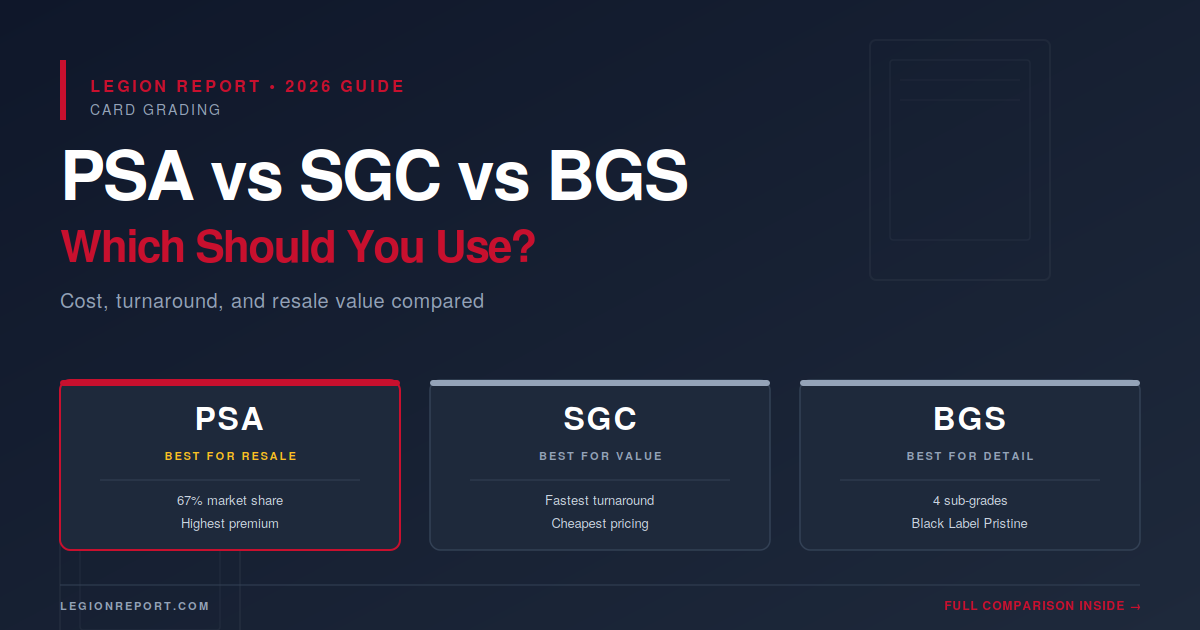

Choosing between PSA, SGC, and BGS for grading your trading cards in 2026 isn’t just about cost — it’s about a fundamentally different grading landscape. The biggest news: PSA’s parent company, Collectors Holdings, acquired SGC in February 2024 and Beckett (BGS) in late 2025, meaning one corporation now owns approximately 90% of the graded card market. PSA dominates with 67% market share and its graded cards command 10-30% higher resale premiums than SGC or BGS-graded equivalents. SGC offers the fastest turnaround (30-50 days) and cheapest standard pricing ($15-20/card), making it the best value play. BGS provides the most detailed grading with subgrades for centering, edges, corners, and surface, plus the prestigious “Black Label” Pristine 10 grade that commands premium prices for modern Chrome cards. After PSA’s February 10, 2026 price increase pushed its cheapest tier to $24.99 (with required $149 membership) and standard pricing to $32.99-$80, the cost gap between PSA and competitors has widened significantly. Here’s the complete breakdown of how PSA, SGC, and BGS compare in 2026 on pricing, turnaround, resale value, and which one to choose for your specific cards.
How to actually choose between PSA, SGC, and BGS in 2026
The decision starts with one question: are you grading for resale or for personal collection? If you’re grading high-value cards ($500+) to flip or sell, PSA is almost always the right choice despite the higher cost. The 10-30% resale premium on PSA-graded cards more than offsets the additional grading fee. A $1,000 card that grades PSA 10 might sell for $2,500, while the same card in an SGC 10 slab sells for $1,800-$2,000. That $500-700 difference dwarfs the $25-30 cost gap in grading fees. PSA’s market dominance creates a self-reinforcing cycle — collectors pay more for PSA slabs because they know other collectors will pay more for PSA slabs.
For mid-value cards ($100-$500), SGC becomes the smartest choice. SGC’s $15-20 per card pricing is roughly half of PSA’s after the February 2026 increase, and the turnaround time is 50-60% faster (30-50 days vs PSA’s 50-95 days). The resale value gap is smaller for mid-value cards because the absolute dollar difference matters less. A $200 card grading SGC 10 might sell for $400, vs $500 in a PSA 10 slab — a $100 difference. After accounting for the $10-15 grading cost savings and faster cash flow from quicker turnaround, the math often favors SGC for cards in this range. SGC’s distinctive black-border “tuxedo” slabs are also visually preferred by many vintage collectors, which can actually boost resale for pre-1970s cards.
BGS occupies a strategic middle ground that works best for two specific use cases. First, modern Chrome cards (Topps Chrome, Bowman Chrome, Optic, Prizm) where centering matters tremendously. BGS provides four sub-grades on every card — centering, edges, corners, surface — that show exactly why a card received its grade. A BGS 9.5 with a “Pristine 10” Black Label (perfect sub-grades) sells for more than a PSA 10 equivalent on modern Chrome cards because it’s harder to achieve and provides verifiable centering data. Second, autograph cards where collectors want detailed authentication of both the card and signature. BGS’s autograph grading is considered the most rigorous in the industry. Outside of these use cases, BGS sits in an awkward position — more expensive than SGC, less resale value than PSA.
The 2024-2025 industry consolidation has created a significant conflict of interest that collectors should understand. Collectors Holdings (which owns PSA) acquired SGC in February 2024 and Beckett/BGS in late 2025. SGC’s longtime president Peter Steinberg stepped down shortly after the acquisition, signaling structural changes. While PSA, SGC, and BGS technically compete in the marketplace, they’re all funded by the same parent company. This raises questions about whether the long-term strategy is to maintain three distinct brands, gradually merge services, or shift submissions toward the higher-margin PSA brand. CGC (backed by Fanatics/Michael Rubin’s investment group) is now the only major grading company outside Collectors Holdings, positioning it as the primary independent alternative for collectors uncomfortable with the consolidation.
For complete current pricing, tier requirements, and submission instructions, PSA’s official services page publishes the most accurate up-to-date fee structure (which they update multiple times per year). For BGS-specific grading details, sub-grade explanations, and Black Label criteria, Beckett’s official grading services is the authoritative source — their grading scale documentation is the most detailed in the industry.
The honest reality on card grading in 2026: there’s no single “best” grading company anymore — it depends entirely on the card you’re submitting and your goals. For high-value vintage cards or flagship rookies you plan to sell, PSA’s resale premium justifies the cost and slow turnaround. For mid-value modern cards, SGC’s combination of low price and fast turnaround offers the best ROI. For modern Chrome cards where centering matters, BGS Black Labels actually outsell PSA 10s. Run the math on every submission: factor in grading cost, expected grade outcome, current resale value of comparable graded cards, and how long you can afford to wait for return. A $30 grading fee that takes 100 days to return is a different calculation than a $15 grading fee that returns in 45 days. The savvy collectors in 2026 don’t use one grading company — they choose strategically based on each card’s characteristics and their financial goals.
— Drew, Legion Report