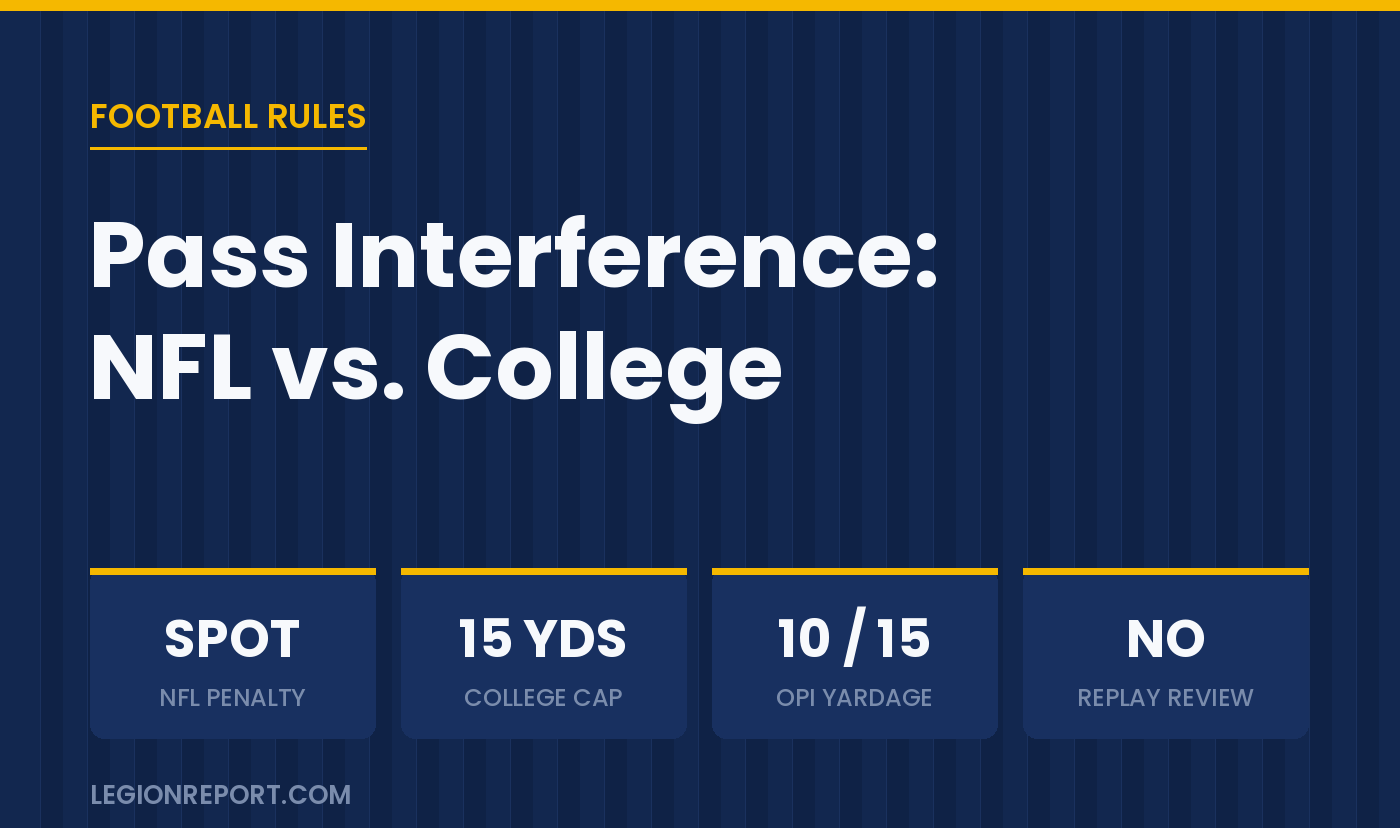
Pass interference is the most consequential penalty in football, and the single biggest rulebook difference between the NFL and college. The foul itself is defined almost identically at both levels — significantly hindering a receiver’s opportunity to catch a catchable pass, with contact more than one yard beyond the line of scrimmage while the ball is in the air. What differs wildly is the price: the NFL marks the ball at the spot of the foul, however far downfield that is, while college caps the penalty at 15 yards.
That one difference changes how the game is played. An NFL cornerback beaten deep faces a choice between a 50-yard spot foul and a 50-yard completion — so he plays the ball. A college corner in the same spot can drag the receiver down for a maximum of 15 yards, which makes the deliberate tackle a rational play on any deep ball. Coaches teach it, announcers name it, and the rulebooks price it completely differently.
The chart below covers the definitions, the penalties, offensive PI, and the acts that draw flags at each level. Take a look, then we’ll get into the strategy the gap creates.
FOOTBALL RULES
Pass Interference: NFL vs. College Football
Same foul, radically different price
NFL DPI
Spot foul
However far downfield
OPI
10 / 15 yds
NFL / college
REVIEWABLE
No
At either level
The rules, side by side
Definition and penalties
| Element | NFL | College (NCAA) |
|---|
| Defensive PI penalty | Spot foul — ball placed where the foul occurred, automatic first down; if in the end zone, ball at the 1 | 15 yards from the previous spot, automatic first down; if the spot of the foul is closer than 15, the ball goes to the spot; inside the 2, half the distance |
| Offensive PI penalty | 10 yards from the previous spot | 15 yards from the previous spot |
| When PI can occur | Only while a forward pass is in the air; contact within 1 yard of the line is exempt | Same — legal contact within 1 yard; restrictions begin when the ball is thrown |
| Catchability | The pass must be ‘catchable’… officials judge whether the receiver had a realistic play on it | Same standard — uncatchable passes can’t draw PI |
| Face guarding | Not a foul by itself — contact is required | Also requires contact under current NCAA rules (pure face guarding was removed as a foul) |
| Reviewable? | No — PI is not reviewable (the 2019 replay experiment was abandoned after one season) | No — judgment fouls aren’t reviewable |
What draws the flag
The acts officials call
| Act | Typically flagged as PI (both levels) |
|---|
| Early contact | Playing through the receiver’s back before the ball arrives |
| Arm restriction | Grabbing or hooking an arm so the receiver can’t raise it to catch |
| Cutoff | Riding a receiver off his route without playing the ball |
| Grab and turn | Holding the receiver’s body or jersey as the ball arrives |
| The deliberate tackle | Dragging down a receiver on a deep ball — the college 15-yard special |
| Not PI | Incidental contact while both play the ball; hand-fighting with eyes on the ball; contact on an uncatchable pass |
Scenarios
Where the gap shows
| Scenario | NFL outcome | College outcome |
|---|
| DPI 45 yards downfield | Ball at the spot — 45-yard penalty | 15 yards, replay the down’s distance advantage |
| DPI in the end zone on a 40-yard throw | Ball at the 1-yard line | 15 yards from the previous spot (or spot if shorter) |
| OPI on a pick play | 10 yards | 15 yards |
| Contact 1 yard past the line before the throw | Legal (and see illegal contact rules beyond 5 yards) | Legal |
| Hail Mary scrum | Officials ‘let them play’ by custom; flags are rare | Same custom |
PI FACTS
The spot foul is the NFL’s biggest penalty
DPI flags of 40-plus yards happen every season — no other foul moves the ball as far, which is why it’s also the most-argued call in the sport.
The 2019 replay disaster
After the missed Saints-Rams call, the NFL made PI reviewable for one season; nearly nothing got overturned, and the experiment died quietly.
College’s cap is a choice
The NCAA has repeatedly considered spot-foul DPI and kept the 15-yard cap, accepting the deliberate-tackle incentive as the cost of protecting defenses from catastrophic penalties.
How pass interference differs between the NFL and college football.
The Strategy the Gap Creates
The penalty structures produce exactly the behavior they price. NFL defensive backs are coached to locate the ball on deep throws because the spot foul makes grabbing a beaten receiver as bad as the completion; the only time the deliberate foul makes sense is preventing a sure touchdown when the spot would be the 1 anyway. College defenders get the opposite lesson: on any ball thrown more than 15 yards, interference is a discount, so the drag-down is a taught, named technique. It’s the clearest case in football of a rulebook difference — not a talent difference — changing how the same position plays the same play.
The Bottom Line
Pass interference is defined the same way at both levels — hindering a receiver on a catchable ball in the air — but the NFL prices it at the spot of the foul while college caps it at 15 yards, and that gap drives entirely different deep-ball defense. Offensive PI costs 10 in the NFL and 15 in college, and neither level lets replay touch it. For the fouls that govern contact before the throw, see our guides to illegal contact and defensive holding.