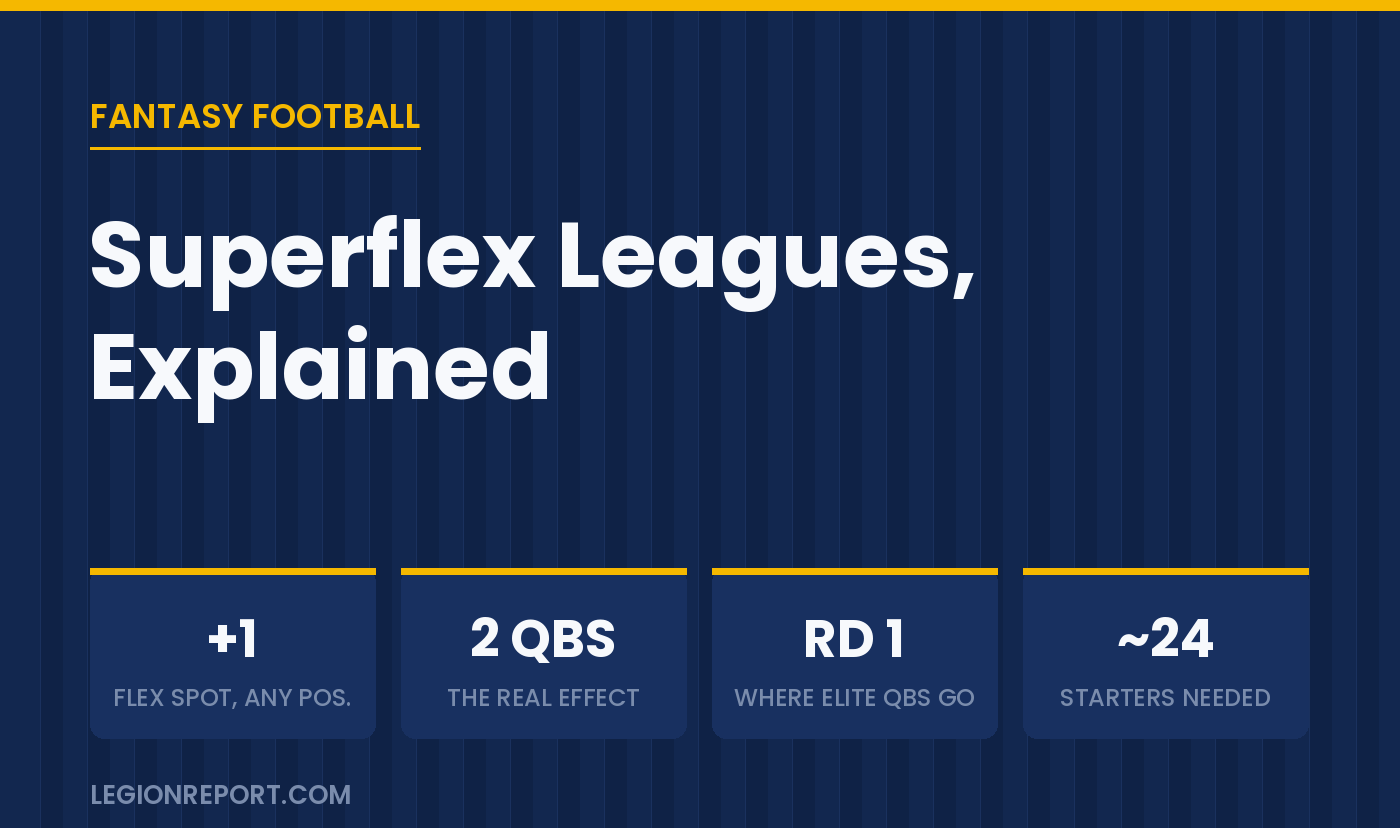
Superflex is the format that finally made fantasy football look like real football. In a standard league, each team starts one quarterback while 20-plus starting-caliber QBs sit on waivers, and the position that decides every real game barely matters in fantasy. Superflex fixes that with one roster change: an extra flex spot that can be filled by any position, including quarterback. Since QBs outscore everyone else, that spot is effectively a second QB slot — and it turns the entire draft upside down.
The effect is immediate scarcity. Twelve teams starting two quarterbacks need 24 startable QBs in a league where maybe 26 exist, so quarterbacks rocket from rounds 5-10 into the first round. A passer who goes 60th overall in one-QB formats can go top-10 in superflex, and letting the position slide past you doesn’t save value — it strands you streaming backups while every opponent starts two top-20 QBs.
The chart below covers how the format works, how values shift, and the draft strategy that wins it. Take a look, then we’ll get into the mistakes that sink first-time superflex drafters.
FANTASY FOOTBALL
Superflex Leagues, Explained
The extra flex that makes quarterbacks matter
THE SPOT
Any position
Effectively QB2
QB DEMAND
~24
In a 12-team league
ELITE QBS
Round 1
Top-5 overall
SCORING
Unchanged
Lineup rule only
How superflex works
The format mechanics
| Element | How it works |
|---|
| The superflex spot | A flex position eligible for QB/RB/WR/TE; because QBs score most, it’s a de facto QB2 slot |
| Typical lineup | 1 QB, 2 RB, 2-3 WR, 1 TE, 1 flex, 1 superflex — league settings vary |
| vs. 2QB leagues | 2QB requires two starting quarterbacks; superflex lets you start one QB plus a skill player if you must — a safety valve on bye weeks and injuries |
| Scoring | Unchanged — superflex is a lineup rule, not a scoring rule; pairs with any PPR setting |
| League size effect | 12-team superflex is genuinely scarce (24+ QB starters needed); 10-team is forgiving; 14-team is brutal |
| Dynasty superflex | The dominant dynasty format — young QBs become the most valuable assets in the game |
Value shifts
What moves and how far
| Position | Superflex value shift |
|---|
| Elite QBs | First-round picks — the top dual-threats go top-5 overall |
| Mid-tier QB1s (QB8-15) | Rise 3-6 rounds from their 1QB ADP; the last reliable starters carry huge scarcity premiums |
| Backup-caliber QBs | Rosterable and traded — a real QB3 is insurance every contender carries |
| Elite RB/WR | Still valuable, but slide as QBs flood the first two rounds — top skill players fall to drafters who fade QB early |
| TE | Roughly unchanged; superflex rarely goes to a TE |
| Rookie QBs (dynasty) | The most valuable draft assets in dynasty superflex, ahead of any skill player |
Winning the draft
Superflex strategy
| Strategy | Why |
|---|
| Leave rounds 1-3 with at least one QB, usually two | The cliff after the startable tier is the steepest in fantasy — miss it and you’re streaming all year |
| Count the QBs, not the rounds | Track how many startable passers remain vs. superflex spots unfilled league-wide; draft off that ratio |
| Exploit the fade | If two drafters punt QB, elite RB/WR value slides to you — take it, then grab the last solid QB tier |
| Roster a QB3 | One injury away from starting; also the format’s best trade chip at the deadline |
| Target rushing QBs | The floor of a runner at QB stabilizes the two-QB weekly variance |
SUPERFLEX FACTS
Why it beat 2QB
Mandatory 2QB lineups punished injury and bye weeks with forced zeros; superflex keeps the scarcity while letting you start a skill player in a pinch — the flexibility won.
The format mirrors reality
Quarterbacks are the sport’s most important players; superflex is the only mainstream format where fantasy value roughly tracks real value.
Late QBs vanish by round 6
In experienced 12-team superflex rooms, 20+ quarterbacks are gone inside six rounds — the 1QB habit of waiting is the most expensive instinct to unlearn.
How superflex leagues work and how to draft them.
The Mistakes That Sink First-Timers
The classic error is drafting off 1QB instincts: passing on quarterbacks in rounds 2-4 because the board’s best RB ‘is too good to pass up,’ then discovering the startable QB shelf is bare by round 6. The second is misreading the safety valve — superflex lets you start a skill player in that spot, but doing it weekly concedes 8-10 points to every opponent. The third is ignoring the trade market: in-season, a spare startable QB is the most liquid asset in the league, and contenders will overpay at the deadline. Draft two, roster three, and sell the surplus when someone else’s QB1 goes down.
The Bottom Line
Superflex adds one flex spot that accepts quarterbacks, which effectively doubles QB demand, pushes the position into the first round, and makes fantasy value finally resemble football value. Secure two startable passers early, keep a third, and exploit drafters who wait. It layers onto any scoring format — see our guides to PPR and half-PPR — and the market mechanics behind those soaring QB prices are covered in ADP explained.