

Substitutions are a fundamental part of modern soccer, letting managers refresh tired legs, change tactics, and respond to the flow of a game. But the rules around them, how many you get, when you can make them, and what happens in extra time, have changed significantly in recent years, and they can be more nuanced than casual fans realize.
The biggest shift came in 2022, when the laws were permanently updated to allow five substitutions per team in most top competitions, up from the traditional three. Crucially, teams must make those changes within a limited number of stoppages to prevent time-wasting, and additional substitutions are available in extra time and for concussions. Once a player is substituted off, they cannot return.
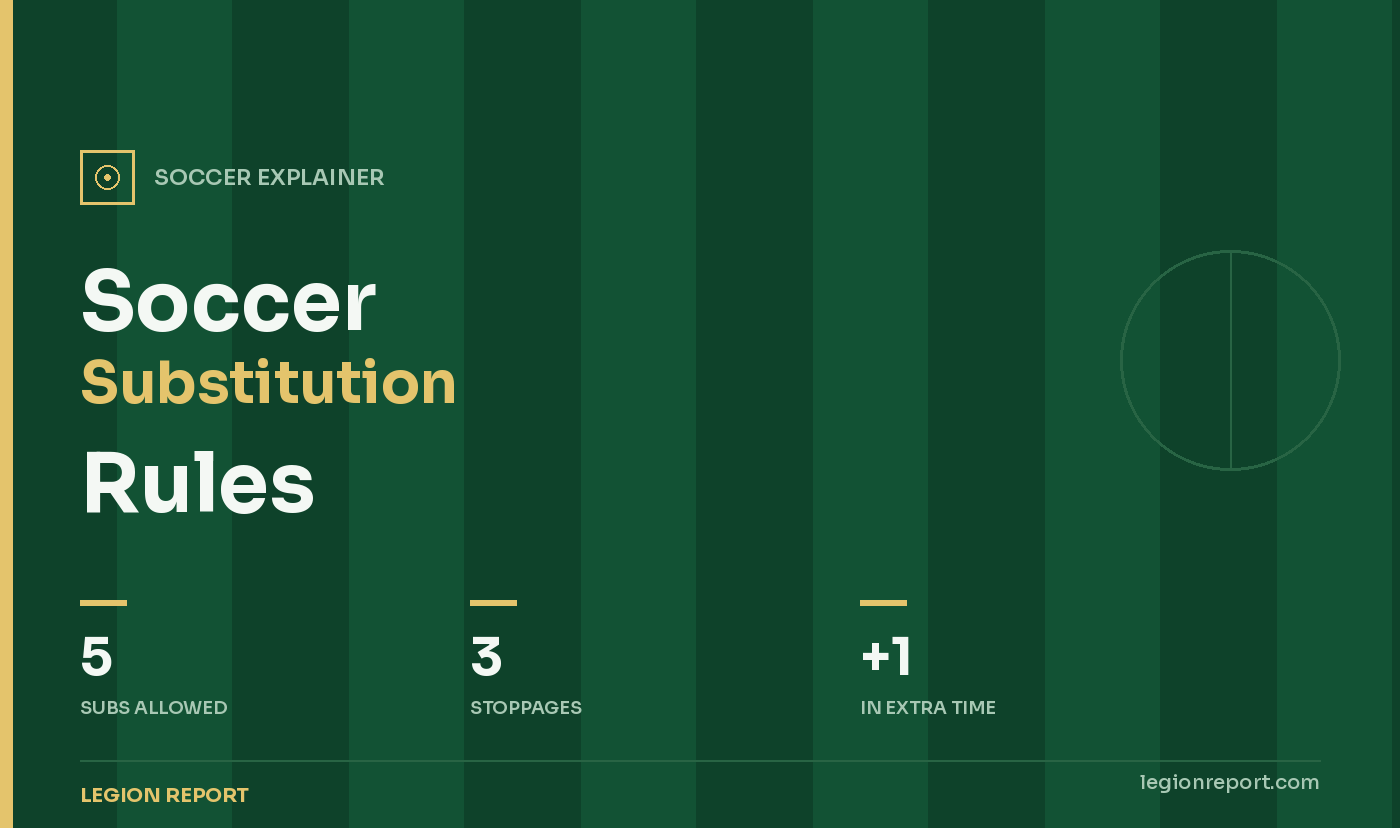
The chart below breaks down the soccer substitution rules, the number allowed, the stoppage limit, extra time, and concussion subs. Take a look, then we’ll go through the details.
The core substitution rules
In most top-level competitions today, each team is permitted up to five substitutions during a match. The key restriction is that those five changes must be made within a maximum of three stoppages in play (substitutions made at half-time do not count toward this limit). This three-stoppage rule was introduced alongside the increase to five subs specifically to prevent teams from repeatedly breaking up the game to waste time or disrupt the opposition’s rhythm.
Substitutions can only be made when the ball is out of play and with the referee’s permission. The player coming off leaves the field, usually at the nearest point, and the substitute enters at the halfway line once the departing player is off and the referee signals. All substitutes must be named on the team sheet before kickoff, and, crucially, once a player has been substituted off, they cannot return to the game.
How the rules have changed
Substitutions are a relatively modern feature of soccer. In the sport’s early decades there were none at all, if a player was injured, their team simply played on with ten men. Substitutes were gradually introduced from the 1960s, initially allowing just one change, often only for injury, before expanding to two. From 1995, the familiar three-substitution rule became standard across the game and remained in place for around 25 years.
The most recent and significant change came out of the 2020 pandemic. To help players cope with congested schedules and reduce injury risk, competitions were temporarily allowed to permit five substitutions. The change proved popular and was seen as beneficial for player welfare, so in 2022 the Laws of the Game were permanently amended to allow five subs, the rule used at the highest levels of the game today.
Extra time and concussion substitutes
The rules provide for additional substitutions in specific circumstances. If a match goes to extra time, such as in a knockout cup tie, each team is granted one further substitution (and an additional stoppage in which to use it), on top of any unused changes from the regulation 90 minutes. This recognizes the extra physical demand of the additional 30 minutes of play.
Separately, many competitions have introduced concussion substitutes as a player-safety measure. If a player suffers a suspected concussion or head injury, they can be permanently replaced by a concussion substitute that does not count toward the team’s normal allocation of subs. To keep things fair, the opposing team is also granted an additional substitution when this happens. This protocol is designed to remove any incentive to keep a potentially concussed player on the field.
Substitutions at other levels
It is worth noting that substitution rules can vary depending on the competition and level of play. While five subs across three stoppages is standard at the top of the professional game, some leagues and competitions have different allowances, and crucially, in much youth, amateur, and grassroots football, “rolling” or “return” substitutions are common. This means players who have been substituted off are allowed to come back on later, the opposite of the professional rule.
The size of the substitutes’ bench also varies, with major competitions allowing teams to name anywhere from nine to fifteen substitutes, even though only five can be used. These variations exist to suit the needs of different levels, prioritizing participation and player rotation at grassroots level while maintaining competitive integrity at the elite end of the game.
Final Word
Soccer’s substitution rules now center on a simple framework: up to five substitutions per team in most top competitions, made within three stoppages, with an extra change available in extra time and separate concussion subs for player safety. The jump from three subs to five, made permanent in 2022, is the most significant recent change and has given managers far more tactical flexibility.
The one constant through all the changes is that a substituted player cannot return at the professional level, making the timing of each change a genuine tactical decision. For more on the flow of a match, see our explainer on how long a soccer match lasts.