

It is one of soccer’s most familiar sights: the final whistle blows, and players from opposing teams seek each other out to swap shirts, walking off the field bare-chested or wearing the colors of the team they just battled against. The jersey exchange is a beloved tradition, but where did it come from, and what does it actually mean? The answer is a story of respect, history, and a few modern complications.
At its heart, exchanging jerseys is a gesture of sportsmanship and mutual respect between players, a way of honoring the contest and the opponent after the final whistle. The tradition dates back decades, with one famous early example from 1931, and over time it has grown into a cherished ritual, especially after big matches, where a swapped shirt becomes a treasured memento of a shared sporting moment.
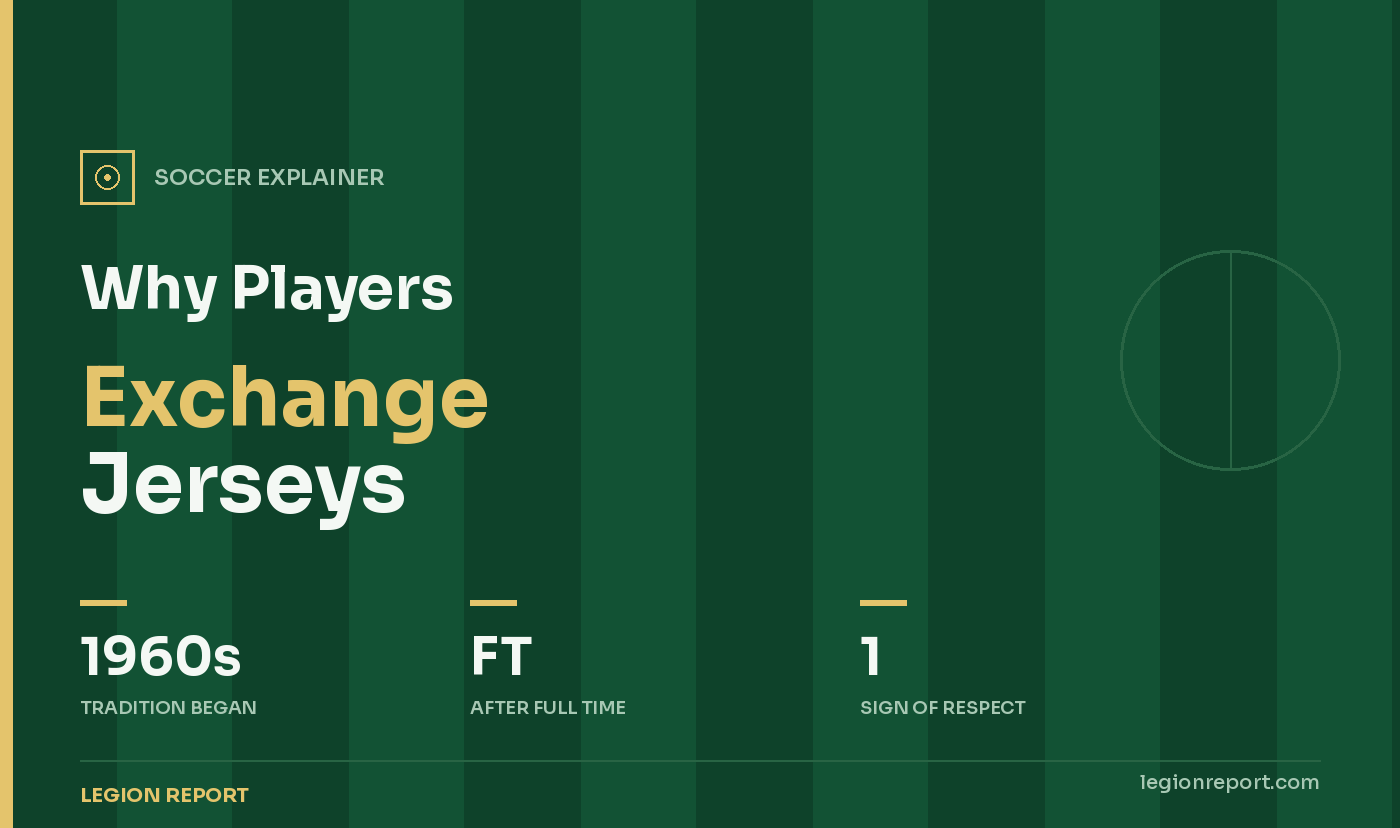
The chart below breaks down the jersey exchange tradition, its origins, its meaning, and the modern rules around it. Take a look, then we’ll get into the story.
The meaning: respect and sportsmanship
At its core, the exchange of jerseys is a gesture of mutual respect and sportsmanship between opposing players. After 90 minutes of fierce competition, swapping shirts is a way of acknowledging the contest, honoring the opponent’s effort, and showing that the rivalry was a sporting one rather than a personal grudge. It is football’s version of the handshake taken a step further, a tangible symbol of camaraderie among players who share the same profession.
The gesture also carries an element of admiration. For a young player, swapping shirts with a childhood idol or a legend of the game is a special honor and a moment they will treasure. The jersey becomes a memento, a physical reminder of having shared the field with a great player or competed in a memorable match. This is why players will often seek out a specific opponent they particularly respect to request a swap.
Where the tradition came from
The practice of swapping shirts has been around for the better part of a century. One of the most frequently cited early examples dates to 1931, when France beat England for the first time, and the French players, thrilled with the achievement, asked their opponents to exchange shirts as a souvenir of the historic occasion. From these early, spontaneous moments, the gesture gradually became more common.
Over the following decades, the tradition spread, particularly at international level, where players from different countries had fewer opportunities to meet and a shirt swap carried extra significance. By the time of the major World Cups from the 1960s onward, exchanging jerseys had become an established and widely recognized ritual. Today it is a routine sight after most significant matches, from World Cup finals to domestic league games.
The modern rules and etiquette
While swapping shirts is a custom rather than a formal law of the game, some rules and strong etiquette govern when it is acceptable. The accepted moment is after the final whistle, once the match is over. Removing your shirt during play, or even celebrating a goal by taking it off, results in a yellow card under the Laws of the Game, so any on-field swapping is out of the question while the ball is live.
Swapping at half-time is also frowned upon and has caused controversy. A notable instance came in a 2013 Manchester derby, when two players exchanged shirts as they walked off at half-time, drawing criticism that it sent the wrong message with a competitive half still to play. The episode reinforced the unwritten rule that the exchange is a full-time gesture, marking the end of the contest, not a mid-match courtesy.
The practicalities and legacy
Because players want to both give their shirt away and keep a swapped one, they often carry spare jerseys, and kit staff prepare extras for high-profile matches where many swaps are expected. The shirts themselves can take on significant value: a jersey worn and swapped by a legend of the game can become a prized collector’s item, and many swapped shirts end up framed, donated to charity auctions, or displayed in museums and trophy rooms.
Ultimately, the jersey exchange endures because it captures something essential about the spirit of the sport. It is a small act that says competition and respect can coexist, that opponents can battle fiercely for 90 minutes and then honor one another at the end. In an era of intense rivalries and high stakes, the simple swapping of shirts remains one of football’s most graceful and human traditions.
Final Word
Soccer players exchange jerseys as a gesture of respect and sportsmanship, a tradition stretching back to at least 1931 that has become a cherished ritual after big matches. The swapped shirt is both a sign of mutual admiration and a treasured memento, especially when it comes from a respected opponent or a legend of the game.
While it is a custom rather than a rule, etiquette keeps it to full time, never during play or, ideally, at half-time. It remains one of the sport’s most enduring symbols of camaraderie. For more on the traditions and rules of the game, see our explainer on soccer card rules.