
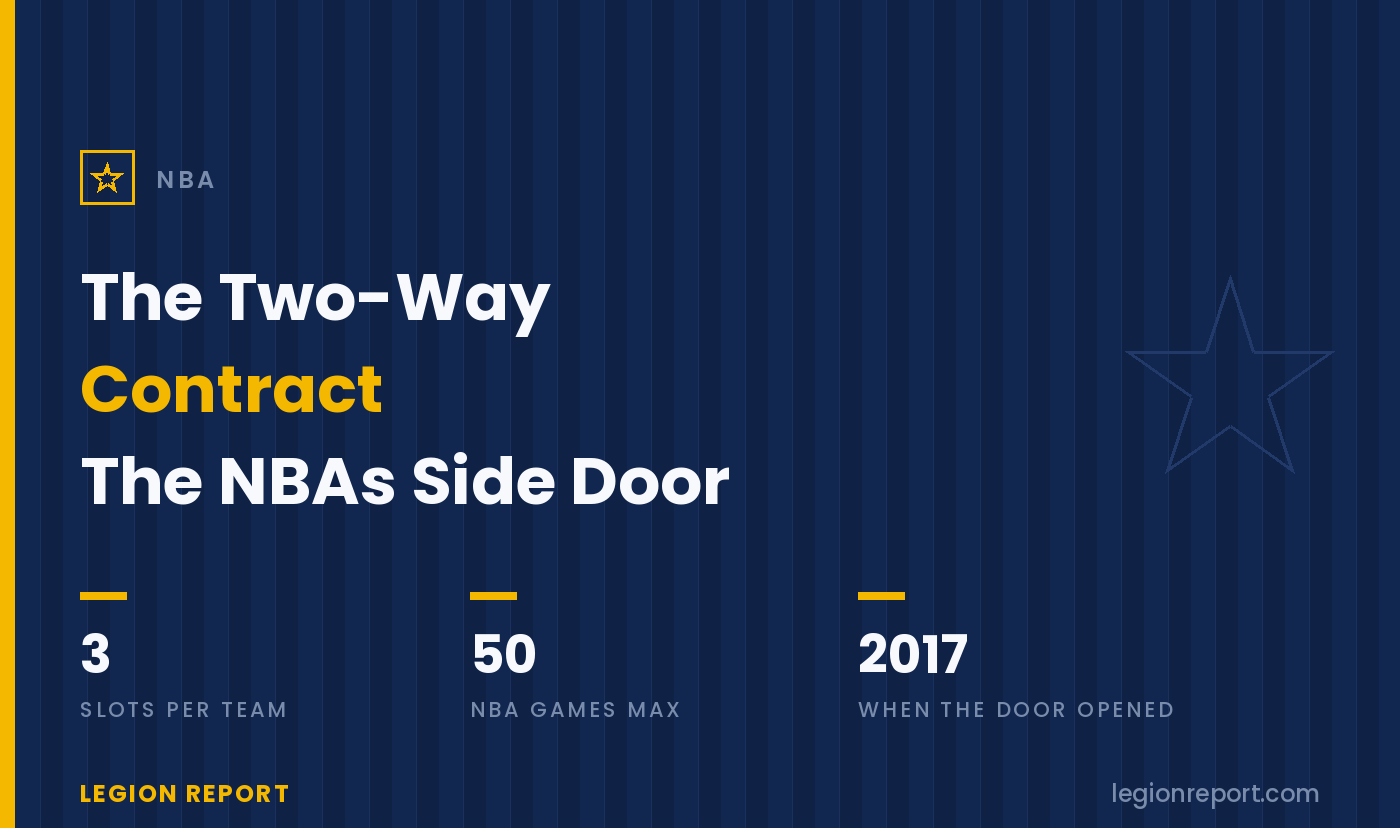

The two-way contract is modern basketball’s most important invention for players you haven’t heard of yet. Created in 2017, it lets each NBA team carry three extra players who split their season between the NBA and the G-League — paid roughly half the rookie minimum (about $600,000), capped at 50 NBA games, ineligible for the playoffs unless converted, and living one hot month from a standard contract. Alex Caruso, Duncan Robinson, Lu Dort, and Austin Reaves all came through this pipeline: it’s the NBA’s official side door, and it’s how the league quietly fixed its development problem.
Here’s everything about how two-ways work: the money, the limits, the conversion path, and why teams treat these three slots like lottery tickets.
The chart below covers the rules, the money, and the pipeline’s greatest hits. Take a look, then we’ll break it all down.
Why the NBA Built a Side Door
Before 2017, the NBA had a development leak: rosters capped at 15 meant teams couldn’t stash projects, so fringe prospects faced a binary — make a real roster or vanish overseas, where a Frenchman named Lu Dort or a Michigan shooter like Duncan Robinson might never come back. The two-way contract patched the leak by inventing a third state of employment: property of an NBA team, paid NBA-adjacent money (roughly half the rookie minimum, real life-changing income for an undrafted 23-year-old), developed inside the franchise’s own G-League system, and callable to the big club for up to 50 games a season. The constraints are the design, not the flaw — the game cap and playoff ineligibility force a decision point, so a two-way who proves he belongs (Caruso defending, Robinson shooting, Reaves doing everything) gets converted to a standard deal before the deadline math bites, while the roster spot recycles to the next audition. The 2023 CBA’s expansion from two slots to three per team was the league admitting the experiment worked: ninety development jobs now exist that didn’t a decade ago, Summer League each July is effectively their hiring fair, and the undrafted-to-rotation-player pipeline that produced Caruso, Dort, Robinson, and Reaves runs at a rate no draft pundit would have believed. It’s the best value instrument in the sport — three lottery tickets per team, and somebody cashes one every season.
Final Word
The two-way contract, explained: three slots per NBA team for players who split time between the NBA and G-League, paid roughly half the rookie minimum (~$600K), capped at 50 NBA games and barred from the playoffs unless converted to a standard deal — the 2017 invention (expanded to three slots in 2023) that built the modern development pipeline and produced Caruso, Robinson, Dort, and Reaves from basketball’s margins. Every July’s Summer League is its hiring fair; every spring’s conversion deadline is its drama.
The audition where these deals get won is in NBA Summer League, explained, the pay tiers around it are in Summer League salaries, and baseball’s version of the grind is in minor league baseball salaries.