
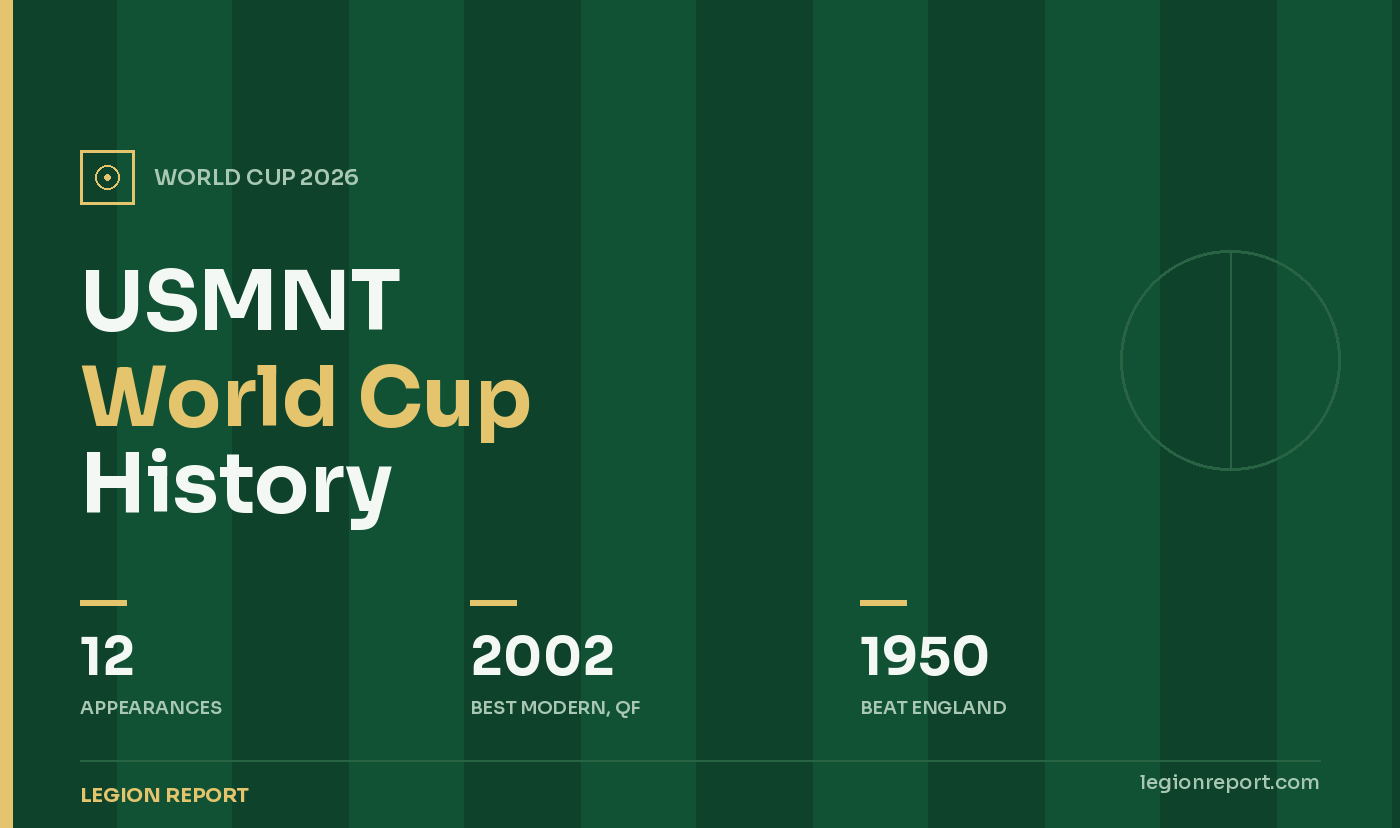

The United States men’s national team has one of the most fascinating and uneven World Cup histories in the sport. It features a stunning early peak, a decades-long disappearance, and a modern resurgence that has turned the US into a regular presence on the world stage. As co-hosts of the 2026 World Cup, the USMNT is writing its latest chapter in front of a home crowd, with the whole nation watching.
The headlines of that history are remarkable: a semifinal run at the very first World Cup in 1930, one of the biggest upsets the tournament has ever seen (the 1950 win over England), and a quarterfinal appearance in 2002 that remains the benchmark of the modern era. The US has never won the trophy, but its story is packed with iconic moments, heartbreaks, and heroes.
The chart below breaks down the USMNT’s complete World Cup history: every appearance and finish, the all-time records, and the biggest moments. Take a look, then we’ll go through it in detail.
The stunning start: 1930 and 1934
The USMNT’s World Cup story began with its highest peak. At the inaugural 1930 World Cup in Uruguay, the US won its group with 3-0 victories over Belgium and Paraguay before losing 6-1 to Argentina in the semifinals. Because no third-place match was played, FIFA officially records the result as a third-place finish, still the best in the team’s history. That tournament also produced a landmark: American striker Bert Patenaude scored three goals against Paraguay, recognized by FIFA in 2006 as the first hat-trick in World Cup history.
The 1934 World Cup in Italy was a brief and painful contrast. Played as a straight knockout, the tournament saw the US drawn against the hosts in the opening round and thrashed 7-1 by a strong Italian side that would go on to win the trophy. It was a harsh reality check after the heroics of 1930, and it marked the end of the USMNT’s first competitive era on the world stage.
The “Miracle on Grass” and the long absence
The 1950 World Cup in Brazil delivered one of the most famous results in the sport’s entire history. On June 29, 1950, a US team made up largely of part-time and amateur players beat England, one of the tournament favorites, 1-0 in Belo Horizonte, with Joe Gaetjens scoring the only goal. The upset was so unthinkable that some British newspapers reportedly assumed the scoreline was a typo and printed it as a 10-1 England win. Known as the “Miracle on Grass,” it remains one of the greatest World Cup shocks ever, even though the US still exited in the group stage.
What followed that glory was a stunning void. The USMNT failed to qualify for the World Cup for 40 years, missing all nine tournaments from 1954 through 1986. The reason was simple: professional soccer infrastructure in the United States was almost non-existent while the sport exploded globally elsewhere. For four decades, one of the game’s early overachievers was completely absent from its biggest event.
The modern era: qualification and 1994
The USMNT’s return began with qualification for the 1990 World Cup in Italy, ending the 40-year drought and signaling a new era for American soccer. Though the young team lost all three group games, simply being back mattered enormously. The momentum built toward 1994, when the United States hosted the World Cup for the first time, a tournament that set attendance records, captured the nation’s imagination, and directly led to the founding of Major League Soccer. On the field, the host US team reached the Round of 16 before losing to eventual champions Brazil.
After a disappointing 1998 campaign in which the US finished bottom of all 32 teams, the program was searching for a defining modern result. It would arrive four years later in the most emphatic fashion, in a run that remains the gold standard for American soccer at a World Cup.
2002: the modern high point
The 2002 World Cup in South Korea and Japan is widely regarded as the USMNT’s greatest modern achievement. Drawn into a tough group, the US stunned a talented Portugal side 3-2 in their opener, then advanced to the knockout rounds. There they faced arch-rivals Mexico in the Round of 16 and won 2-0, thanks to goals from Brian McBride and Landon Donovan, still the only knockout-stage win in USMNT World Cup history and a cathartic result against their biggest rival.
In the quarterfinals, the US pushed powerhouse Germany to the limit before losing 1-0, a match forever remembered for a blatant handball by Germany’s Torsten Frings on the goal line that went uncalled and denied the US a potential equalizer. It was as close as the US has come to a semifinal in the modern era, and it established 2002 as the benchmark every subsequent generation has tried to match.
Heartbreaks, a shock, and the road to 2026
The years since 2002 have brought more Round-of-16 appearances and painful near-misses. In 2010, Landon Donovan’s dramatic stoppage-time goal against Algeria won the group in one of the most iconic moments in American soccer, before a heartbreaking extra-time loss to Ghana. In 2014, goalkeeper Tim Howard produced a record 15 saves in a Round-of-16 loss to Belgium, an all-time individual World Cup display in defeat. Then came the low point: failing to qualify for the 2018 World Cup entirely, a genuine national shock.
The US bounced back to reach the Round of 16 at the 2022 World Cup in Qatar before losing 3-1 to the Netherlands. That set the stage for 2026, when the United States co-hosts the World Cup alongside Canada and Mexico, qualifying automatically as host for its 12th appearance and first home tournament since 1994. With a talented generation led by Christian Pulisic and the advantage of home soil, the USMNT enters 2026 with genuine hope of finally surpassing the 2002 quarterfinal and reaching uncharted territory.
Final Word
The USMNT’s World Cup history is a story of dramatic highs and long valleys: a third-place finish at the very first tournament in 1930, the legendary “Miracle on Grass” over England in 1950, a 40-year absence, and a modern peak at the 2002 quarterfinals. The US has never won the trophy, but its record features some of the competition’s most unforgettable upsets and moments, from Patenaude’s first-ever hat-trick to Tim Howard’s heroics.
Now, as co-hosts in 2026 with a talented squad and a home crowd behind them, the USMNT has its best chance in a generation to write a new best chapter. For more on how home advantage has shaped the tournament, see our guide to host nations that won the World Cup.